actuellecd

Blog

116 results
  • 8
  • 9
  • 10
  • 11
  • 12
  • 13
  • 14
  • 15
  • 16
  • Jane and The Magic Bananas in Altremusiche

    “Recensione”, Michele Coralli, Altremusiche, May 18, 2012
    Friday, May 18, 2012 Press

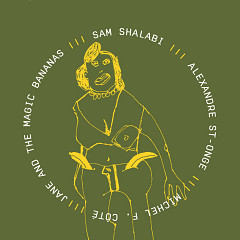
    Musica sghemba per un trio dinocolato basso/chitarra/batteria, che per un’abbondante mezz’ora divaga senza possibili direzioni all’interno di un mondo sonoro abbastanza chiuso e claustrofobico. I tre negano dinamiche, fraseggi, strutture e disegni ritmico-melodici. C’è un continuo ripiegarsi su se stessi attorno a pseudo-pattern apparentemente casuali, che prendono il volo come un uccello chiuso in una stanza, le cui traiettorie rimbalzano da un punto all’altro senza conclusione. La chitarra di Sam Shalabi, sorda e monocromatica, è forse la maggior responsabile di questo “impaccio” linguistico. Da parte sua anche il basso di Alexandre St-Onge, cupo e azzerato nella determinazione di altezze facilmente identificabili, dà il suo contributo all’ottusità del panorama. Forse è proprio Michel F Côté a dare profondità di campo attraverso un drumming sempre molto ricercato, a-virtuosistico e per questo decisamente puntuale e azzeccato.

    Jane and the Magic Bananas è una buona metafora sonora della realtà di oggi, chiusa in se stessa da competenze così straordinarie, da risultare inutili. Certamente competenze che non vengono messe in campo, ma nemmeno evocate. Il groviglio di suoni che conduce direttamente a uno sgabuzzino sembra un nuovo messaggio Fluxus, lanciato per dire a chi può entrare in contatto con questa musica che in certi momenti si può abbandonare tutto, per cercare davvero il senso del perché facciamo arte o del perché non possiamo farne a meno.

    Bozzini Quartet in Gramophone

    “What’s cooking in The Composer’s Kitchen?”, Kate Molleson, Gramophone, May 10, 2012
    Thursday, May 10, 2012 Press

    Take the Bozzini Quartet, add six young composers, season with two mentors and stir it all together in Montréal for a tantalising menu of contemporary music-making.

    The premise is simple enough: six young composers spend two weeks in April bouncing ideas off each other, a couple of mentors and a string quartet, first in Montréal, then in Yorkshire. The end goal is a showcase at the Huddersfield Contemporary Music Festival in November. Other groups run other similarly intensive composition workshops, so what makes the Composer’s Kitchen particularly worth writing about?

    Probably it’s the ethos of the thing. Billed as ‘a combination of laboratory, playground and masterclass’, the project is hosted annually by one of Montréal’s more industrious and open-minded new music ensembles, the Bozzini Quartet. They’re clearly skilled adjudicators, too, because the six composers (two Brits, four Canadians) selected from 60-odd applicants turned out to be an unusually down-to-earth, musically diverse and genial bunch.

    A few days into the Montréal week, composer and CK mentor Christopher Fox confided his epiphany to this effect: ‘I used to teach at Darmstadt’s summer school where students would soon enough kill each other if it meant they’d win the final prize,’ he said. ‘Here there’s no hint of competition. Everyone’s piece gets showcased in the final concert, and because they’re all coming from different musical backgrounds they seem happy to pitch in with constructive feedback on each other’s work. Actually, they all seem to genuinely like each other. Bloody brilliant.’ For his part, Fox’s ‘mentoring’ looked a hoot; more reciprocal enthusiasm than teacher-to-student pronouncement.

    Some of the composers turned up with pieces that were nearly finished and mostly needed logistical help tweaking details of notation to make the parts playable. Thierry Tidrow brought a score of dense and convoluted microtones that took the Bozzinis — some of the best sight-readers in the business — dozens of attempts to navigate. They patiently explained the pros and cons of various common symbols, while Fox’s fellow mentor Malcolm Goldstein, veteran improviser of the New York avant-garde, just shook his head. ‘Ultimately the composer’s responsibility is to communicate his intentions with absolute clarity,’ he sighed, and pulled out a pile of Morton Feldman scores to demonstrate.

    Other participants arrived with nothing more than words and the genesis of an idea, and it was these who stirred up the real depths of debate as the week went on. What’s the point of writing down music? Where does a composer’s obligation end? What potential can be drawn from raw open strings and the harmonics of subtle tuning? John Lely produced a single sheet of spare four-part chords, which the group tugged apart for hours. Lovely stuff.

    Composers, mentors and Bozzinis members now have six months to gestate before reuniting for Part II. Huddersfield’s director Graham McKenzie cites the Composer’s Kitchen as a prime example of how the festival should invest in incubating new work. I’m looking forward to the final results in November.

    Take the Bozzini Quartet, add six young composers, season with two mentors and stir it all together in Montréal for a tantalising menu of contemporary music-making.

    Vivaces in Monsieur Délire

    “Listening Diary”, François Couture, Monsieur Délire, May 3, 2012
    Thursday, May 3, 2012 Press

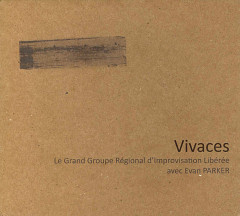
    For the 2011 edition of Rencontres de musiques spontanées, the Grand groupe d’improvisation régionale libérée had invited none other than the great improvising saxophonist Evan Parker. Vivaces documents the concert that came out of their collaboration. Three improvisations: a free one, one conducted by Parker, and a final one conducted by Raphaël Arsenault. I can’t help but think of the London Improvisers Orchestra when I hear this sound mass (11 Rimouski-based musicians, plus Parker and trombonist Scott Thomson) unfold, react, and interact. The ambient sound capture is not perfect, but it’s okay enough. And after all, Evan Parker has released very few titles on Québécois labels, so I’m glad we have this one.

    And after all, Evan Parker has released very few titles on Québécois labels, so I’m glad we have this one.

    La Formule Xyz in Montreal Mirror

    “Music Reviews”, Lawrence Joseph, Montreal Mirror, May 3, 2012
    Thursday, May 3, 2012 Press

    What happens when two classically trained musicians forego their customary instruments and get noisy? Martel’s viola da gamba is exchanged for static of unspecified origins, and Lauzier’s bass clarinet and sax are prepared and amplified to the point of feedback. Similarly, Tetreault forgoes LPs and focuses on the in-bred sound of his turntables’ motors and needle pick-ups. Far from formulaic, there are composers’ minds at work here, with gratingly engaging foreground phenomena emerging from background drones, concerto style. 8.5/10

    Far from formulaic, there are composers’ minds at work here, with gratingly engaging foreground phenomena emerging from background drones, concerto style. 8.5/10

    Jean René in La Tribune

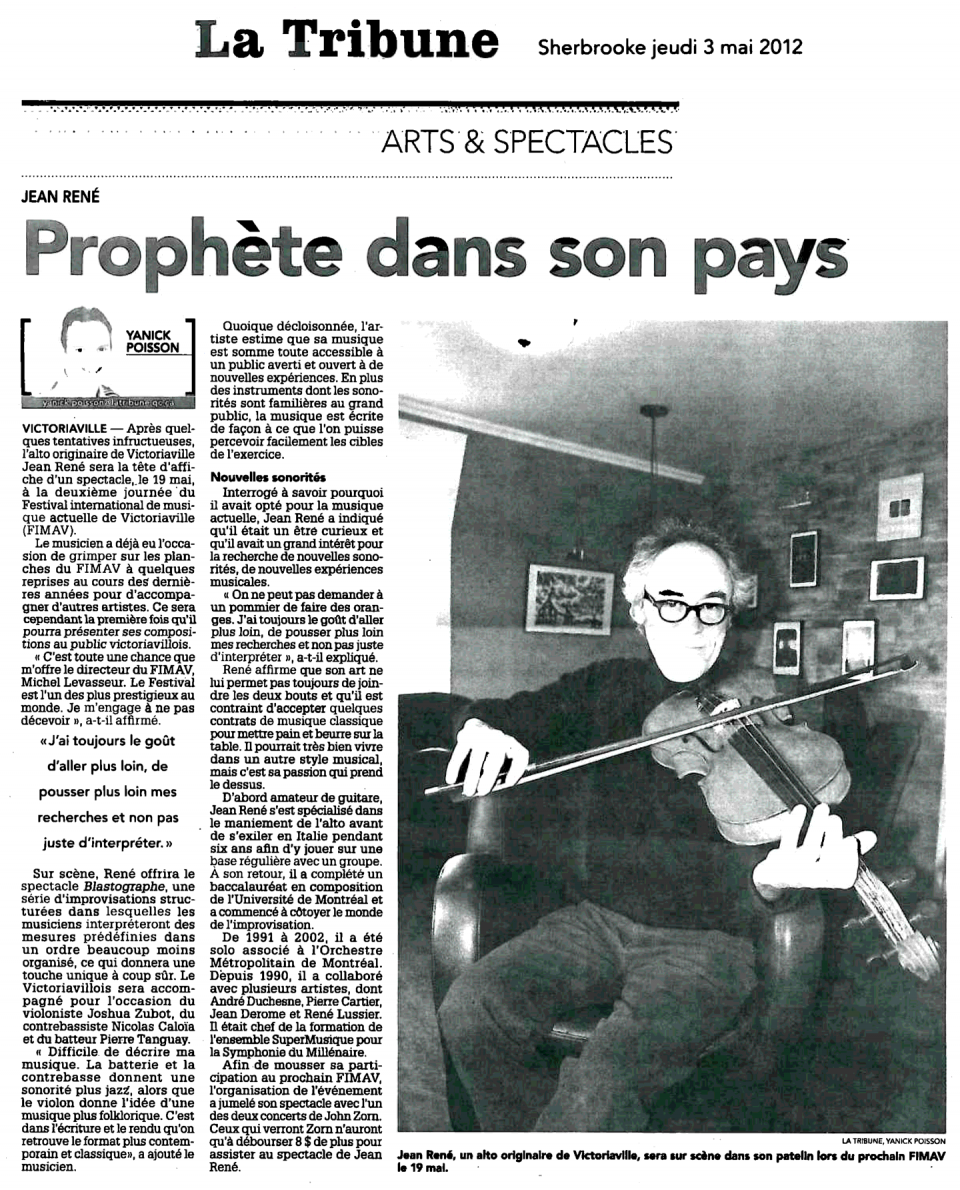
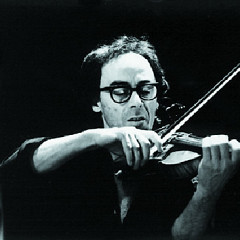
    Jean René. Prophète dans son pays”, Yanick Poisson, La Tribune, May 3, 2012
    Thursday, May 3, 2012 Press
    J’ai toujours le goût d’aller plus loin, de pousser plus loin mes recherches et non pas juste d’interpréter.

    Sur un fil in Monsieur Délire

    “Listening Diary”, François Couture, Monsieur Délire, May 2, 2012
    Wednesday, May 2, 2012 Press

    The Italian microlabel Setola di Maiale just released an excellent (yes, excellent) record by Rimouski-based bassist Éric Normand. In October 2009, Normand assembled a stellar quintet to record three of his own compositions and an original rereading of John Tchicai’s Fields, Cows and Flowers. He is surrounded by Jean Derome, Michel F Côté, James Darling (cello) and Antoine Létourneau-Berger (vibes and cymbals). On Sur un fil, Normand deploys Spartan and enlightened compositional skills, and his score leaves plenty of room for all instrumentalists to showcase their extended techniques. Great level of interaction between musicians, and there’s something magic going on between them and the score. A demanding but highly satisfying listen. Bravo.

    Great level of interaction between musicians, and there’s something magic going on between them and the score. A demanding but highly satisfying listen. Bravo.
  • 8
  • 9
  • 10
  • 11
  • 12
  • 13
  • 14
  • 15
  • 16