actuellecd

Blog

429 results
  • 56
  • 57
  • 58
  • 59
  • 60
  • 61
  • 62
  • 63
  • 64
  • Toronto (Duets) 2007 in Exclaim!

    “Review”, Glen Hall, Exclaim!, March 1, 2009
    Sunday, March 1, 2009 Press

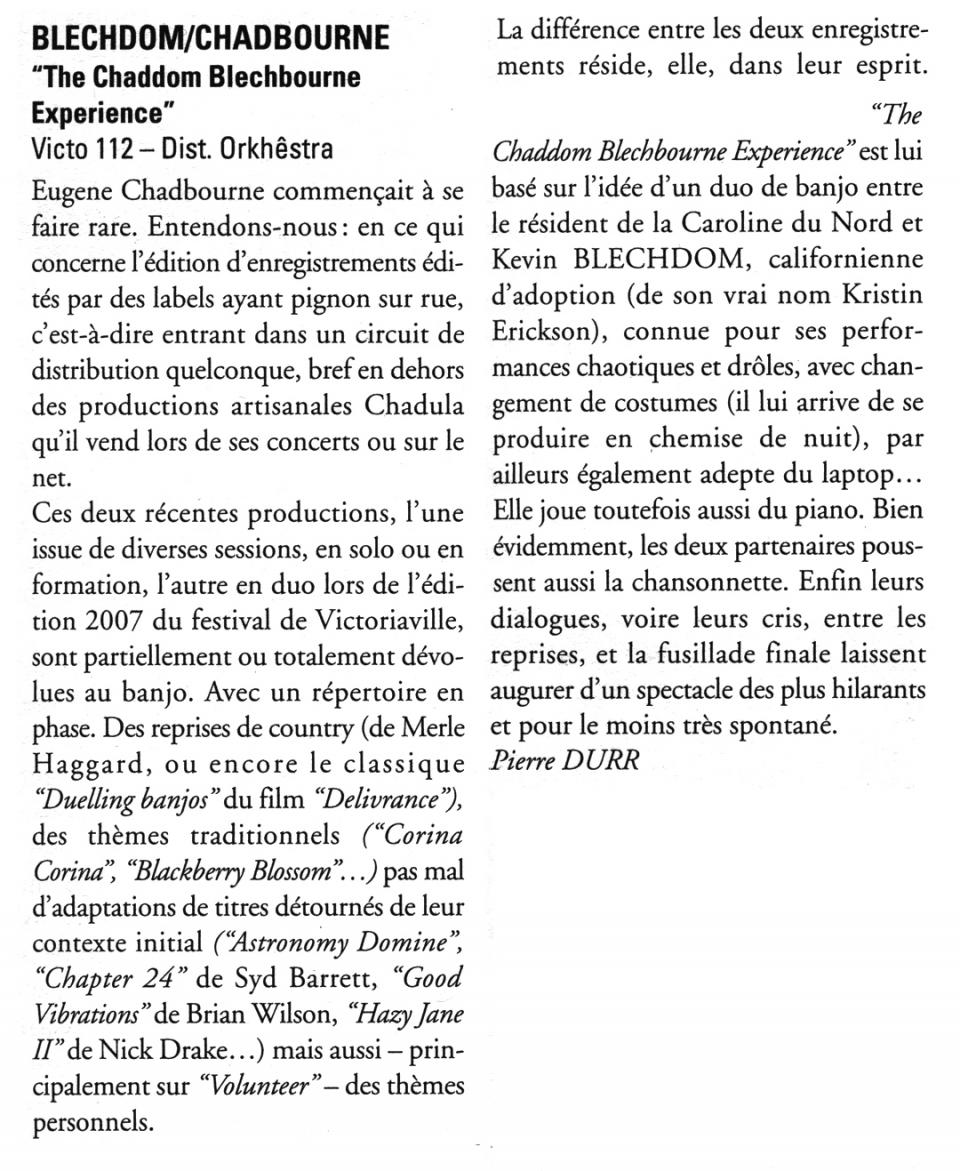
    It’s common for young musicians to do projects of music by their heroes just to pick up the vibe and, maybe, some reflected validation. But saxophonist Kyle Brenders takes this gambit to a whole other level by recording compositions by his mentor, modernist visionary Anthony Braxton, with the man himself. Breathtakingly audacious, yes, but when listening to this 93-minute, two-CD release it becomes apparent that the twosome are technically well-matched. This balanced pairing perform two of Braxton’s uniquely imaginative pieces with energy, precision and creativity. Long composed parts are executed with vigour, yielding to improvised sections that flow logically from the preceding notated materials. And it’s the improv sections where Brenders shows he is thoroughly equipped to lock horns with the master on his turf and at his level. By turns, the pair act as foils/accompanists for one another, finishing phrases and inspiring and/or goading each other to further heights. Recommended.

    Breathtakingly audacious, yes

    Free Burma in Exclaim!

    “Review”, Nilan Perera, Exclaim!, March 1, 2009
    Sunday, March 1, 2009 Press

    This release by Rainer Wiens plots the latest facet of musical progression by one of Canada’s most creative artists. The subtext of groove provides a rich base for compositions that are populated by a multi-level chorus of songs. These songs range from the literal representations of birds to interwoven melodies that dance with each other and have a remarkable habit of staying in the listener’s memory. Wiens’ extensive study of West African rhythms has informed much of this CD but it’s nowhere near as straightforward as the simple application of rhythms. In No Obvious Solution, for example, the groove cooks happily along, and one rests comfortably in its wake, but then the rhythms morph into permutations that leave Africa for parts unknown. This extrapolation is the result of a carefully thought-out method that takes each instrumental part and rephrases it to the point of vertigo — quite an ear-opening and remarkable experience. Wiens’ sophisticated use of rhythm plus an adherence to clear and beautiful harmonic material has borne fruit in a music that someone can not only react to as a listener but, like all good popular music, can also comfortably inhabit as a participant. However, the music isn’t the only thing that informs this CD. The title isn’t simply a political slogan; it represents a lived experience.

    What’s the story behind the title?

    Wiens: I was working on this music at the same time the political demonstrations were happening in Burma in 2007 and it brought up memories of a trip I made there in 1991. During that journey, I was smuggled across the border from Thailand to visit with the rebel Karen tribesmen. It was an incredible experience. Among many amazing things that happened there was a gamelan performance in the middle of the jungle by musicians who had to pile all their instruments on the backs of elephants and flee Burma because they made music that criticized the government. In spite of incredible hardship, the people in this camp were friendly and generous and I felt humbled by their ability to smile in the face of tragedy. As a result, I developed a strong attachment to this warm and courageous community. Sadly, all the friends I met there were later killed in raids by the Burmese military.

    And how did this affect you in 2007

    Wiens: This memory gave me the emotional push to complete the music, get the ensemble organized and make the CD. I then decided to dedicate all the proceeds to the people of Burma via the Buddhist monks, who have set up an aid network that bypasses the military dictatorship.

    Among many amazing things that happened there was a gamelan performance in the middle of the jungle by musicians who had to pile all their instruments on the backs of elephants and flee Burma because they made music that criticized the government.

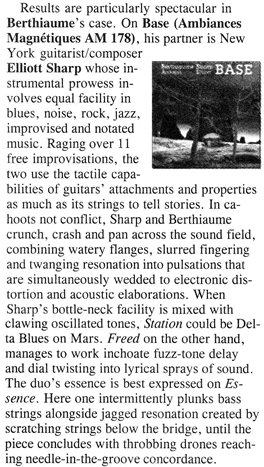
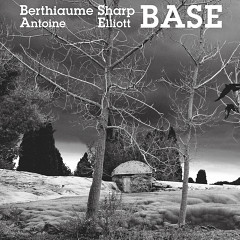
    BASE in The WholeNote

    “Review”, Ken Waxman, The WholeNote, no. 14:6, March 1, 2009
    Sunday, March 1, 2009 Press
    Results are particularly spectacular

    Ellwood Epps, Philippe Lauzier, Pierre-Yves Martel in Hour

    “Improv Al Dente”, Mike Chamberlain, Hour, February 26, 2009
    Thursday, February 26, 2009 Press

    Mardi Spaghetti celebrates a year of twirling improv at Le Cagibi.

    The front room of Le Cagibi, the comfortable, funky neighbourhood café at St-Laurent and St-Viateur, is normally populated by students and post-university types huddled over their laptops. But for the last year, the back room has been the scene of Mardi Spaghetti, a Tuesday night improvised music series curated by Josh Zubot, Philippe Lauzier, Pierre-Yves Martel and Gordon Allen. The series brings together musicians, often in whimsical combinations, and each one of the four organizers is responsible for one Tuesday per month. The musicians come from disparate musical worlds — jazz, musique actuelle, rock — but improvisation is the common thread, according to Allen. In the year since the series began, more than 100 musicians have taken part. This coming Tuesday, March 3, Mardi Spaghetti is marking its one-year anniversary with a party and a number of special events, including a reprise of Martel’s “toiletronics,” a performance from inside the washroom that sits beside Le Cagibi’s stage, and an improvisation in the alley by Allen. Allen, the trumpeter with the porkpie hat and crooked grin, has practically been a one-man scene-maker since arriving in Montréal from Guelph a couple of years ago, as he’s also one of the people behind L’Envers, the performance space at 185 Van Horne that’s been running since September. He’s proud of what Mardi Spaghetti has accomplished. “Because Mardi Spaghetti is happening every week, it’s in the back of people’s minds, so it’s now part of the fabric of the neighbourhood and that café,” Allen says. “It’s intimate, with a small stage, and the room has a particular feel to it. It’s like the back room, not the dungeon. Because of the big windows, there’s a view from the street, and people stop by and listen because of that. There was already a good level of activity in Montréal for improvised music, but this series has made the music more visible, quite literally.”

    There was already a good level of activity in Montréal for improvised music, but this series has made the music more visible, quite literally.
  • 56
  • 57
  • 58
  • 59
  • 60
  • 61
  • 62
  • 63
  • 64