actuellecd

Blog

304 results
  • 24
  • 25
  • 26
  • 27
  • 28
  • 29
  • 30
  • 31
  • 32
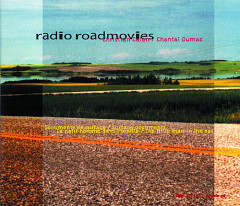
  • Radio Roadmovies in Vital

    “Review”, Frans de Waard, Vital, no. 427, June 14, 2004
    Monday, June 14, 2004 Press

    This is one of those things that fall out of the sky and you have no idea who or what it is about. One Chantal Dumas and one Christian Calon made a trip through Canada, and this double CD is the sort of Hörspiel about it. Recording natural elements on their trip, as well as say rain falling on the tent but also them speaking about places they visit (not always as a clear narration) or the meeting of people, like ‘the chiefs in the Gitskan village of Kispiox’. It’s hard to say wether a lot of post-processing took place. There are moments in there in which I think all the sounds are as they are, but in some cases there might be also some sort of post-processing. Not that’s really important at all, because it’s a fascinating journey to hear. You could wonder if it’s something you’ll find spinning a lot, but in all it’s a captivating recording. On the second CD Documents de surface (Surface Documents) nine tracks are presented of sounds as they actually were but then presented in collage form. Grouped together are various wind sounds or water systems. Here no talking but instead pure soundscapes, which are quite delicate and nice. The narrative aspect is all gone here, but on the other hand I can imagine people playing this disc more often. Quite a surprise this double pack, in a very nice digipack.

    … a captivating recording… in a very nice digipack.

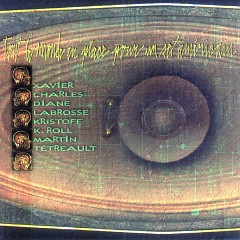
    Tout le monde en place pour un set américain, Kristoff K.Roll in Signal to Noise

    “Reviews”, Nathan Turk, Signal to Noise, no. 34, June 1, 2004
    Tuesday, June 1, 2004 Press

    Attendees of the May 17, 2003 presentation that yielded Tout le monde en place pour un set américain — part of the annual Festival International de Musique Actuelle in the remote Quebec town of Victoriaville — were encouraged to wander around the performers’ stage, which lay in the room’s center with ten loudspeakers surrounding the seats. But even detached from this interactive spatial element, the sound collages of Carole Rieussec and Jean-Christophe Camps (appearing as the duo Kristoff K.Roll), Xavier Charles, Diane Labrosse and Martin Tétreault still captivate. Tous, the first of the disc’s two extended pieces, ruminates over a motive of sinister speaker crackle with metallic scree, the clomping of wood and random blurts from Tétreault’s “dismembered turntables”, which he utilizes both with and without LPs. Samples of children splashing in water eerily juxtapose at one point with rattlesnake percussion, septic bass tones and screams of feedback, while later a sickly harmony sets in among sounds of buzzing conduits and a prepared violin. En place has a similar feel but recasts the first piece’s building blocks — Camps’ and Rieussec’s found-object chatter, Labrosse’s “electric eye” machine (similar to a theremin) and Charles’ ghostly clarinet phrases — in new timbrel contexts. The sonic tapestries of PSI or Martin Archer are a fair reference point for what results, though Tout le monde en place pour un set américain teems with unusual vitality. The ending of En place, for example, winds down like a weather front circa 2340 A.D., with the calm static of a dying amp and subliminal humming returning the disc’s sound storm to rest, just as it began.

    … unusual vitality.

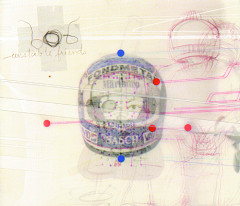
    Unstable Friends in The Squid’s Ear

    “Review”, Phil Zampino, The Squid’s Ear, June 1, 2004
    Tuesday, June 1, 2004 Press

    The first release on Montréal’s & Records, managed by Fabrizio Gilardino and Michel F Côté, presents the rhythmic song works of Éric Bernier, assisted by Côté himself and Guy Trifiro, with additional musicians from the well known Ambiances Magnétiques collaborators Jean Derome, Bernard Falaise, Normand Guilbeault and Alexandre St-Onge. The songs stay in a easy groove, reminding in many ways of the early works of Holger Hiller. The sonics are fascinating, the songs dark interwining works with odd electronics and insertions. Most pieces are by Bernier, with a Burt Bacharach cover to end the CD (Don’t Make Me Over).

    The sonics are fascinating, the songs dark interwining works with odd electronics and insertions.

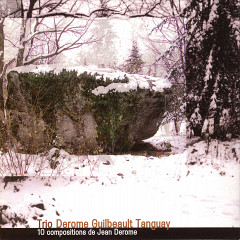
    10 compositions in Mouton Noir

    “Le Noir compact”, Éric Normand, Mouton Noir, June 1, 2004
    Tuesday, June 1, 2004 Press

    Jean Derome et Pierre Tanguay sont des collaborateurs de longue date. Musiciens polyvalents, ils ont touché à tous les styles, mais leurs principaux faits discographiques, les plus personnels du moins, documentent l’aspect le plus radical de leur démarche.

    Pourtant, leur amour du jazz ne se dément pas. Avec Normand Guilbeault à la basse, les deux musiciens étiquetés «actualistes» forment un trio culte du jazz à Montréal, avec raison. Guilbeault est plus facilement associé à la scène jazz, bien qu’il aime faire des détours par d’autres musiques, traditionnelles ou actuelles, ou accompagner le chanteur Richard Desjardins.

    10 compositions de Jean Derome, réunit des pièces que le trio a progressivement intégrces à son répertoire constitué aussi de morceaux d’Ellington, de Mingus, comme de Lee Konitz. Ludique et enjouée, cette musique se laisse d’abord entendre comme un jazz plus conventionnel, mais dangereusement imprégné de l’esprit tordu de ses créateurs. Sobre, mais généreux, le trio nous entraîne dans les contrées du swing, là où le plaisir est contagieux. Les trois instrumentistes font encore une fois preuve de leur grande subtilité, se jouant sans cesse des dynamiques et des timbres dans la prétendue linéarité du jazz qui coule légèrement. Derome, en avant, est irréprochable; jouant sax baryton et flûte, c’est à l’alto qu’il se montre le plus convaincant. Son jeu, à la fois sensible et calculé, mesure l’excès et dose ses effets comme jamais, évoquant tantôt Sonny Rollins par son emphase rythmique, tantôt Ornette ou Dolphy, mais conservant avant tout ses caractéristiques propres. Sachant contrôler parfaitement les inflexions de son instrument sans jamais chercher à en mettre plein la vue, Derome est fascinant, drôle et touchant tout au long de l’enregistrement. Derrière ce souffle de fraîcheur, la batterie de Tanguay, comme toujours, répand la joie et la liberté avec une désinvolture et une musicalité unique pendant que Guilbeault tient la barre et parfume le tout d’une rondeur qui voudrait nous faire croire que tout arrive si facilement. Disque de maturité pour trois musiciens exceptionnels, 10 compositions est un grand disque de jazz. Tout sauf conventionnel, en fait.

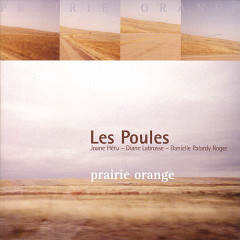
    Prairie orange, Joane Hétu, Diane Labrosse, Les Poules, Danielle Palardy Roger in Signal to Noise

    “Review”, Cristin Miller, Signal to Noise, no. 34, June 1, 2004
    Tuesday, June 1, 2004 Press

    The 19th annual Seattle Improvised Music Festival took place this winter over two week-ends in Febuary. This year brought a turning point for the festival, as the long-term orginizers turned over the reins to musicians newly very active in the scene, all of whom are directly or indirectly affialited with Open Music Workshop. Open Music Workshop (or OMW) is a relatively young entity, less than two years old, but has constitued something like a second wave in the improvised music scene in Seattle. This shift in leadership was reflected in the shape of the festival this year, which cast a wider net and included a broader range of approaches to music making.

    The next weekend I also managed to catch Les Poules (Montréal) at Consolodated Works, a large warehouse-like art gallery and performance space. Les Poules have beon playing together for over a decade, and every passing minute of their long history and musical intimacy. Joane Hétu (vocals, alto sax) staked out a minimalist territory of voiceless fricatives and static noises, which she mined over the course of the performance. Diane Labrosse (electronics) explored a similarly focused territory, while Danielle Palardy Roger’s percussion poured out speechlike with orchestraly various gestures accumulating over time into a complex field. A drama of highly attuned listening slowly emerged full of simultaneous starts, frequent finishing of each others’ sentences, and sudden collective laughter. Occasionally, certain silences were allowed to move with grace to the center of the circle.
    A drama of highly attuned listening slowly emerged full of simultaneous starts, frequent finishing of each others’ sentences, and sudden collective laughter.
  • 24
  • 25
  • 26
  • 27
  • 28
  • 29
  • 30
  • 31
  • 32