actuellecd

Blog

255 results
  • 19
  • 20
  • 21
  • 22
  • 23
  • 24
  • 25
  • 26
  • 27
  • Martin Tétreault, Ambiances Magnétiques in AllMusic

    “Portrait: Martin Tétreault”, François Couture, AllMusic, June 15, 2002
    Saturday, June 15, 2002 Press

    In the late ’80s and early ’90s, Martin Tétreault was the quietest member of Ambiances Magnétiques, Montréal’s influential new music collective. He was providing strange turntable collages to the projects of his colleagues and released a couple of mind-boggling solo albums. When minimal techno and experimental electronica hit the museums at the turn of the millennium, he became the label’s biggest international name, multiplying collaborations with the likes of Otomo Yoshihide, Kevin Drumm, Xavier Charles, and Janek Schaefer. This career boom was accompanied by a stylistic shift from vinyl quotation to an approach of the turntable as a “pure” sonic device. In the process, what he lost in sense of humor, he gained in harsh intensity.

    Tétreault has a background in fine arts. Much like the Czech radical artist Milan Knizak, he began to work with vinyl because paper led him to a dead-end. In 1984, for the first time he took an LP, cut it in half, flipped one piece over, pasted it back together, and played the result on a turntable. Tétreault continued to experiment at home, developing cutting and skipping techniques and collecting hundreds of cheap records he found at fleamarkets. Three or four years later, his next-door neighbor overheard his shenanigans. It was Ambiances Magnétiques guitarist André Duchesne, who quickly introduced Tétreault to his group of musician friends. Michel F Côté enrolled him in his ensemble Bruire. The turntablist’s first appearance on record can be found on the 1989 LP Le Bbarman a tort de sourire. He remained with the group throughout the 1990s and beyond. He also played with René Lussier, Jean Derome, and Diane Labrosse.

    His first large-scale album, Des pas et des mois, came out in 1990. Then, besides the occasional Bruire album, Tétreault kept a rather low profile. Things changed in 1997-1998 when he began to let go of quotation and cut-ups to develop a more textural style that eventually saw him throw away the record to play the turntable itself, sticking the tone-arm in the motor, placing the needle directly on the platter, etc. These new developments were at the heart of his duo with René Lussier, introduced by the highly abstract and noisy Dur noyau dur in 1998. A participation to the Japanese project Four Focuses opened doors; so did a subsequent duo session with Yoshihide (21 Situations, 1999) and a solo CD for the Belgian label Audiophile (La nuit où j’ai dit non, 1998). By then, the turntable had become a trendy instrument of avant-garde expression and Tétreault embarked on a busy touring and recording schedule. In 2002, he curated the “Turntable Hell” tour (in England) financed by the Contemporary Music Network.

    … what he lost in sense of humor, he gained in harsh intensity.

    liberum arbitrium in Voir

    “Critique”, Réjean Beaucage, Voir, June 13, 2002
    Thursday, June 13, 2002 Press

    Le trio Napalm Jazz a d’abord sévi sur les ondes radiophoniques de la Vieille Capitale avant d’entreprendre une existence virtuelle sur le site notype.com et de donner naissance par mutation soustractive (de trio à duo) à morceaux_de_machines. Aimé Dontigny et Érick d’Orion nous offrent donc sur ce troisième “vrai disque” de No Type une série d’improvisations réalisées lors d’une résidence aux studios d’Avatar, à Québec, avec des instruments que l’on n’a pas pris la peine d’identifier sur la pochette (on imagine une panoplie de gadgets électroniques). Ça gicle littéralement de tous bords tous côtés. La méthode favorite de composition du duo est l’accumulation, et chaque pièce nous fait découvrir une nouvelle définition du mot “saturation”. Avant de monter le volume, assurez-vous que vos haut-parleurs sont toujours sous garantie!

    … chaque pièce nous fait découvrir une nouvelle définition du mot ‘saturation’.

    liberum arbitrium, morceaux_de_machines in Vital

    “Review”, Brian Lavelle, Vital, June 13, 2002
    Thursday, June 13, 2002 Press

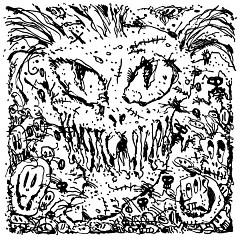
    Swathed in the closest I have yet seen to a Savage Pencil-esque liquefying demon sleeve — a truly fitting representation in pen and ink of this Canadian duo’s music — morceaux_de_machines’ debut CD is an insanely free journey into the possibilities of live laptop performance. Aimé Dontigny and Érick d’Orion’s improvisations are nothing less than startling in a context where the debate often centres mundanely around the merits or otherwise of watching individuals perform the digital equivalent of tape-based works. There is dripping sweat in this music; there is a refreshing ferocity and brutal dynamism in abundance. It seems even at times that the ghost of Coltrane’s 1966/67 interstellar live work pervades the proceedings. The resulting brew is a primordial mix of cut-ups, lifts, uncategorisable loops, acrid and acidic soundscaping and more, all the components reaching half-life at similar points in the fray. Like the sound of the multitude of layers being stripped internally from the walls of the atom, this is pure jazz fission. The penultimate track on liberum arbitrium is entitled rothko and the choice is apt, even as a generalised pointer to the sonic landscape of this disc: oversized slabs of dense, textural colour juxtaposed in an end-to-end fashion, exaggerated, confrontational, surprising — all essential qualities of a difficult but completely mesmerising sonic soup.

    There is dripping sweat in this music; there is a refreshing ferocity and brutal dynamism in abundance. It seems even at times that the ghost of Coltrane pervades the proceedings.

    June 21 – July 5, 2002: Live DAME musicians

    Thursday, June 13, 2002 In concert

    Many DAME musician will be performing this summer. First, the Fanfare Pourpour will take part in Saint-Fortunat’s incredible music festival, June 21 and 22. Then, at the Festival international de jazz de Montréal, L’Orkestre des pas perdus will play outside from July 3 to 7. Also playing during the festival at the museum of contemporary arts, Les Projectionnistes July 3 and world renowned guitar player René Lussier July 6. This edition of L’OFF Festival de Jazz de Montréal also proposes plenty of DAME-related shows. Jean Derome will play at Lion d’Or June 27, July 3 and 5. Pierre St-Jak June 27. Rouge ciel June 29. Normand Guilbeault with an hommage to Mingus July 1. Martin Tétreault and Pierre Cartier July 3. Lee Pui Ming in duo with Joane Hétu aith also the {nbio:derome_je}-{nbio:guilbeault_no}-{nbio:tanguay_pi} trio July 5. Go see them all!

    Canot-camping, expédition 4 in Splendid E-Zine

    “Review”, Luke Martin, Splendid E-Zine, June 12, 2002
    Wednesday, June 12, 2002 Press

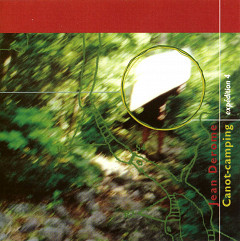
    Canot-camping is a rather strange kettle of fish. Its appearance on disc marks the preservation — though I’d imagine not in the ultimate version thereof — of a composition that’s complex, frustrating, and often surprisingly rewarding. Why so? Because it’s akin to John Zorn’s Cobra (and other segments of that composer’s other, earlier work) inasmuch as it relies on a series of gestures to inform players what to play, and when. Some of these are listed in the liner notes — it’s reassuring to note that metal’s favoured devil’s horns gesture is used to symbolize “solo” — though there are over sixty of them available to choose from. So, rather than a set score or “right” way of handling Derome’s ideas, there’s only performance to use as a yardstick: this CD is a record of the fourth canoeing excursion that’d been made, though the piece has since gone through two more iterations.

    Derome and the ten musicians under his direction try their damndest to bring the river into your headphones, to make you a part of their canoeing holiday. Largely, they succeed; the tones of the ensemble — winds, two contrabasses, strings, some brass and some self-constructed instruments — are broad enough that you can hear the “nature sounds” that are evoked, without being overly conscious of being able to namecheck the instrument from which they originate. There’s no feeling of avant-jazz chops-for-chops-sake showmanship: everything here sounds naturalistic. From the traffic sounds of the disc’s opener — all honking horns and traffic-jam frustration — to the glistening star-sounds of Lac 3/Constellations and the grunting-muso bestiary of Animaux, you’re there, in the boat, hearing (sometimes literally) the sound of paddle slicing into water. Admittedly, there are times when nothing makes sense — save for the rocking feeling of the music, which manifests itself as an occasional auditory seasickness — but the quality on display here, and the deft touch exhibited by the musicians, is enough to make you push on through the slacker pieces.

    Like much loosely-guided improv, there are moments on this disc that’ll try your patience; hard-blown horn farts and moments that are more indicative of pissing about than of a journey by canoe occur occasionally, and frustrate immensely — though thankfully, this is rare, and a mark of the high quality captured here. There are negative aspects to this trip upriver, but the evocative soundscape that’s created by this paddle-carrying troupe is superb.

    … the evocative soundscape that’s created by this paddle-carrying troupe is superb.

    René Lussier, Ambiances Magnétiques in AllMusic

    “Portrait: René Lussier”, François Couture, AllMusic, June 6, 2002
    Thursday, June 6, 2002 Press

    Throughout the 1980s and most of the ’90s, René Lussier was the prime mover on Montréal’s new music scene. His guitar work has been compared to Fred Frith, with whom he has often toured and recorded. Spread between solo work, duos and large ensemble pieces, between studio compositions, structured improvisation, free improv and film music, his impressive body of work represents a full course in “musique actuelle,” a term he helped to peg down. His masterpiece remains the speech-music collage Le trésor de la langue which earned him the Paul Gilson Award in 1989. He also received the Freddy Stone Award in 1996 for his contribution to Canadian new music.

    Lussier began to play guitar in high school bands. He started to develop his own brand of jazz-meets-folk-meets-freak in the collective Conventum. This group included guitarist André Duchesne with whom he stroke a lasting friendship. He recorded two albums with Conventum and a handful of film scores, the first of what would become an endless list (over 50 by 2001). After the group’s disbanding, Lussier enrolled in the Grand Orchestre de Montréal, an experimental fanfare of sorts where he met Nébu saxophonist Jean Derome. Together they recorded music for the National Film Board of Canada and got involved in many projects, some of which included Duchesne and clarinetist Robert Marcel Lepage.

    The four of them founded the collective and record label Ambiances Magnétiques in 1983. That year Lussier released his first solo album, Fin du travail (Version 1), the title of which (“Finished work [1st version]”) already displayed his uncanny sense of humor. His big break came in 1986 when Michel Levasseur, artistic director of the Festival International de Musique Actuelle de Victoriaville (FIMAV), proposed a duo concert with Fred Frith. Henry Cow and the whole Rock-in-Opposition movement had been a big influence on Lussier — this was his chance. The resulting album Nous Autres introduced him to an international audience. In 1988 Frith invited him and Derome to join Keep the Dog.

    In 1989, with the help of Frith and a cast of Ambiances Magnétiques players, Lussier recorded Le trésor de la langue. Pushed by its political resonances, the album became the label’s biggest seller and the first classic item in the history of musique actuelle. Further albums, solo and with Les Granules, established him as a highly creative and witty composer and improviser. But as years passed Lussier felt the collective weight more and more on his shoulders. The mid-to-late ’90s saw him experimenting with more abstract forms of improvisation with mixed results and severing links with old friends, including Derome when he left his band Les Dangereux Zhoms. In 2001 he resolutely stepped away from the collective and released CDs on Ohm Editions and La Tribu. The album Tombola Rasa and a country-folk project with American maverick Eugene Chadbourne indicated a return to earlier pleasures at the start of the new decade.

    … his impressive body of work represents a full course in “musique actuelle”…
  • 19
  • 20
  • 21
  • 22
  • 23
  • 24
  • 25
  • 26
  • 27