actuellecd
  • This website is also available in English.

Blog

109 results
  • 1
  • 2
  • 3
  • 4
  • 5
  • 6
  • 7
  • 8
  • 9
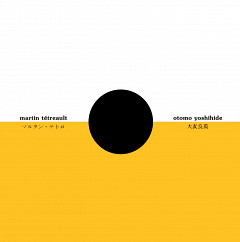
  • 21 situations in Nightwaves

    “Review”, Nightwaves, no. 4, November 1, 1999
    Monday, November 1, 1999 Press

    This recording represents a long anticipated collaboration between two turntable manipulators, one from Québec, the other from Japan. It is a completely improvised work involving noise, needles, scratching and vinyl. Some of the tracks (Spoutnik) do show flashes of atmosphere and mood, yet many seem to be pointless, noisy messes (Debris and Friction).

    This work is noise in the truest sense of the word. Convention has been completely disregarded for a totally experimental ethic that you will either enjoy or loathe. 21 situations is comprised of non-musical sonic deconstructions that embraces sound experimentation as the ‘be-all end-all’. Perhaps this album would be more engaging if it wasn’t so left-field and the sound pallette wasn’t so abrasive.

    Tétreault and Yoshihide have indeed suceeded in achieving audio environments, yet the substance factor is almost non-existant. Ultimately this work is forgettable, pointless and not worthy of repeated listenings. Members of the artistic “elite” may refer to this as daring and innovative, but the rest of us will just be left scratching our heads, wondering why studio time was wasted on such an undecipherable mess.
    This work is noise in the truest sense of the word.

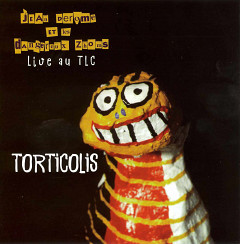
    Torticolis in Cadence

    “Review”, Frank Rubolino, Cadence, no. 25:11, November 1, 1999
    Monday, November 1, 1999 Press

    Two groups enjoyed the honors as the main events for the evening. Jean Derome’s et Les Dangereux Zhoms opened with a boisterous set that exerted plenty of muscle, mainly through the vigorous drumming of Pierre Tanguay and raw trombone blasts from Tom Walsh. Derome’s compositions set up a vaudevillian, almost circus atmosphere with heavity composed material played in a very unstructured and freewheeling way. The compositions, which often were woven into extended suites, were intricate, often blurring the line between written and improvised. The band often ignited into wondrous, freely spun passages behind the pulsating beat from Pierre Cartier on bass and Guillaume Dostaler on piano and keyboards. Derome’s alto solo on Really Sorry was one highlight of the forceful set.

    Derome’s alto solo on Really Sorry was one highlight of the forceful set.

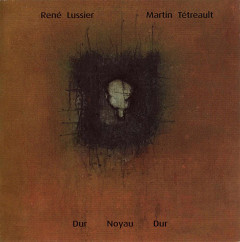
    Dur Noyau Dur in Nightwaves

    “Review”, Gary Flanagan, Nightwaves, no. 4, November 1, 1999
    Monday, November 1, 1999 Press

    This work represents a virtual melange of found sounds (recorded in real time without benefit of samplers). Abrupt guitar strummings come and go, couped with the sound of somebody stumbling through a room in the dark. The sound manipulations of avant-garde guru Martin Tétreault (turntables, pick-ups, radios) are combined with the ultra minimal, spastic guitar workings of René Lussier. This work will either fascinate or frustrate you, depending on your level of open-mindedness. If you prescribe to the “sound as art” school, you will enjoy it wholeheartedly.

    Tétreault has been gaining much exposure lately for his very nonconventional approach to turntables. He is more concerned with the noises that turntables can produce by manipulating and altering the internal mechanisms, rather than what the machine can produce by gliding a needle through some grooves. This tinkering seems to produce both interesting and forgettable results. Dur noyau dur sounds less like an album of non-music than it does an art school project by two sound chemists. There isn’t one hint of conformity on this entire disc.

    This work will either fascinate or frustrate you depending of your level of open-mindedness, […] If you prescribe to the “sound as art” school, you will enjoy it wholeheartedly.

    volume 4: Mystère, Ambiances Magnétiques in Nightwaves

    “Review”, Gary Flanagan, Nightwaves, no. 4, November 1, 1999
    Monday, November 1, 1999 Press

    This is a bizarre, strange and atmospheric compilation of audio mysteries. It is often unnerving and spooky, but certainly not inaccessible. The artists featured on this disc use everything from drums, violins, synthesizers, samplers, turntables, flutes and saxaphones to create an expansive blend of provacative soundscapes.

    Some of the tracks could be considered spoken word (La nuit est longue et sans plis by Patrice Desbiens). Other tracks, in fact most of them, are combinations of cryptic, mysterious found sounds and traditional acoustic instruments. Some tracks even border on operatic (Que saisir sinon by Pierre Cartier). Motormouth by the Fred Frith Guitar Quartet is a refreshing instrumental with a strong jazz flavour. Rarely is this hybrid of electronic and acoustic so rewarding, but this compilation pulls it off superbly. These “songs” are sad, suggestive, weird and vividly unique all at once.

    Unlike most sojourns into experimentalism, this CD does not completely alienate the listener with a barrage of caustic noises. It actually posesses flashes of structure, therefore making it a fine primer to this league of sound structure. Credit must also be given to Luc Beauchemin and Jean-Francois Denis for the beautiful (and original) design of the CD case. Highly recommended for followers of the avant-garde.

    … bizarre, strange and atmospheric compilation of audio mysteries.

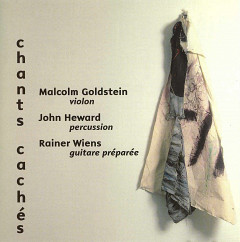
    Chants cachés in Splendid E-Zine

    “Review”, Irving Bellemead, Splendid E-Zine, November 1, 1999
    Monday, November 1, 1999 Press

    Free improvisation is a mystery to many people. Reactions range from “that’s not music” to “they’re frauds” to “my five year old could do that” to “wow. ” What many people don’t realize is that despite its free and open nature, it is possible to become very good at free improvisation, particularly when you play with a close group of people over a long period of time. Malcolm Goldstein (violin), John Heward (percussion) and Rainer Wiens (prepared guitar) make up one such group, and wow are they good! Chants cachés is a richly detailed, subtle yet energized disc, and it really shows off the highly developed musicality of three improvisational veterans. Chants cachés might be tough listening for a while if you haven’t listened to much music like this before, but it’s well worth the effort.

    … wow are they good! Chants Cachés is a richly detailed, subtle yet energized disc, and it really shows off the highly developed musicality of three improvisational veterans.

    Chants cachés in Cadence

    “Review”, David Lewis, Cadence, no. 25:11, November 1, 1999
    Monday, November 1, 1999 Press

    Composer and violin player Malcolm Goldstein is being recorded with increasing freguency and exhibits some of his most aggressive playing to date. In contrast percussionist John Heward performs with comparative restraint and sounds virtually absent from Trio 3. His only conventional performance is during the dynamic drive of Trio 5. Heward’s minimalism supplies crucial creative tension and space to a project that magnifies the input of Goldstein and Wiens. From the bell-like sononties that introduce Trio 6 to a timbre like steel drums in Trio 3, the prepared guitar of Rainer Wiens plays a pivotal role. His interplay with Goldstein and the inventive textures he adds to Trio 3, Trio 4, Trio 5 and Duo 1 are what make such absorbing and rewarding listening.

    Wiens’s interplay with Goldstein and the inventive textures he adds… are what make such absorbing and rewarding listening.
  • 1
  • 2
  • 3
  • 4
  • 5
  • 6
  • 7
  • 8
  • 9