actuellecd

Blog

100 results
  • 9
  • 10
  • 11
  • 12
  • 13
  • 14
  • 15
  • 16
  • 17
  • Ayaya Moses in The Wire

    “Soundcheck Review”, Mike Barnes, The Wire, no. 167, January 1, 1998
    Thursday, January 1, 1998 Press

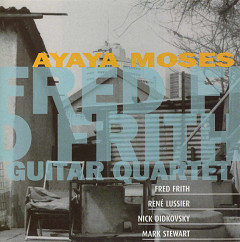
    Formed seven years ago the Fred Frith quartet finally releases its first CD. The music within is a dazzling display of… well,virtually everything that electric guitars can produce in the right hands. The pieces run the gamut from clean strumming and delicate melody through to blocks of atonal noise and all points in between. The electric guitar was originally, and will always essentially be a rock instrument -at least to these ears- and there’s something of the spirit of rock’n’ roll in this chamber ensemble playing certainly in its energy and hands on and amped up visceral power.

    Although ostensibly his group, Frith’s quartet isn’t merely a platform for his ego. The other members René Lussier (who also played in Les 4 Guitaristes de l’Apocalypso Bar), Nick Didkovsky and Mark Stewart each chip in a piece.

    The tracks range trom strict composition to spontaneous exclamations. The delicate oriental style unison passages in Vivier’s Pulau Dewata are intermittently broken up by stabs of feral power. The group composition The Stinky Boy Suite throws up huge blocks of noise which sandwich insect scratches and single bent notes. Here, Frith’s trademark strummed brittle chord h sixteenths is laid over what sounds like the three other guitars being dismantled. The hour or so of music is staggering.
    La Bête / The Beast Within in Rubberneck

    “Review”, Declan O’Driscoll, Rubberneck, no. 27, January 1, 1998
    Thursday, January 1, 1998 Press

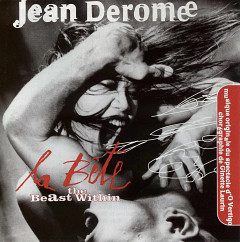
    Derome’s music for the dance La Bête is again wide ranging in its sources, intograting woven moments of minimalism, declamatory pained voices, a gentle waltz and, on Jean-Joseph, a phone ringing, voices arguing, knocking, a plangent melody, a siren and a jackhammer.

    La théorie des nerfs creux in The Wire

    “Soundcheck Review”, Phil England, The Wire, no. 167, January 1, 1998
    Thursday, January 1, 1998 Press

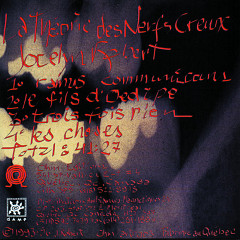
    Avatar’s director is Jocelyn Robert. His The Hollow Nerve Theory uses sound as a metaphor for the electrical activity of the brain, as activated by all manner of external stimuli. The set of four pieces starts off in high-activity beta mode with juxtapositions of mechanical, electrical and digital noise at a velocity approaching the cuts on John Oswald’s Plexure. there is a gradual thinning of materials (towards alpha) which only reveals further complexities: a chaos of independent activities running simultaneously and at different speeds. “Thinking is a noisy process” is the legend on the artwork. The paradox being that this CD is best experienced without the mediation of linguistic or analytical thought. Direct visceral stimulation. he sound of synapses firing. Excellent.

    Direct visceral stimulation. he sound of synapses firing. Excellent.

    Compost in CFLX 95.5 FM

    “Délire actuel: Critique”, François Couture, CFLX 95.5 FM, January 1, 1998
    Thursday, January 1, 1998 Press

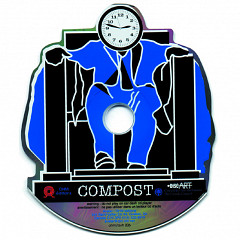
    La nouveauté de la semaine est un disque étrange que seuls les milieux d’avantgarde peuvent offrir. Première constatation: le disque n’est pas rond! En effet, il est découpé de façon à épouser la forme d’un homme assis dans une chaise. Ensuite, il n’y a pas de livret. Enfin, le disque porte seulement deux mentions. D’abord ce titre: Compost. Puis cette note: Pas de noms, pas de titres, pas de copyright. Pour nous éclairer, l’étiquette Ohm éditions (de Québec) présente la chose comme une combinaison d’odeurs provenant de différents fonds de tiroirs qui “par processus biochimionumérique” se trouvera sur un disque intitulé tout simplement “Compost. “ Alors qu’est-ce? Il s’agit d’un disque de trente minutes divisé en trente plages de trente secondes chacunes. Mais cette manipulation est artificielle: il s’agit en fait d’une seule et même pièce. Nous sommes dans l’art audio. Pendant trente minutes, on nous présente un collage de différents fragments, des échantillonnages, des fragments de musique, des manipulations électroacoustiques, etc. Le tout donne une bouillie (ou un compost) consistant, d’un fort intérêt. Du kitsch à la sculpture sonore, des extraits télé aux bruits de mastication en passant par Dave Brubeck sur orgue de Barbarie, Compost crée un monde sonore éclectique et complexe. Et maintenant, qui doit-on remercier?

  • 9
  • 10
  • 11
  • 12
  • 13
  • 14
  • 15
  • 16
  • 17