actuellecd

Blog

100 results
  • 8
  • 9
  • 10
  • 11
  • 12
  • 13
  • 14
  • 15
  • 16
  • Chèvre in Musicworks

    “Review”, Spike Taylor, Musicworks, no. 71, June 1, 1998
    Monday, June 1, 1998 Press

    This duet CD documents the quieter sides of two amazingly creative musicians. I write this review having seen them perform just last night at Toronto’s Music Gallery where they reiterated that nothing they were playing was from this new CD, which René Lussier still peddied hard during song breaks. They downplayed it, said it cost too much, and ignored it for their set-list. This routine showed their sense of humour (which pervades their improvising) and an engaging acceptance of non-commerciality and high creativity.

    The quieter sides of Lussier and Tanguay are as jarring as the blasts of elastic noise they can generate on stage. Chèvre features Lussier playing acoustic as well as electric guitar, which leaves him with less to work with in generating and altering sounds. It forces Pierre Tanguay to take a different tack on drums, too, and they both assume the space with brilliance. It’s a small, mischievous record by two friends driven on by each others’ imaginations and compositional structures Where or how these songs exist on paper, we don’t know. We can just be glad that this CD is available. No matter how hard they migEt try to convince you to pass it by, Lussier/Tanguay La vie qui bat, Chèvre whichever is the title— is a brilliant example of laughing minds a-hold of guitars and drums.

    … a brilliant example of laughing minds a-hold of guitars and drums.

    Bavards in Cadence

    “Review”, Michael Rosenstein, Cadence, no. 24:6, June 1, 1998
    Monday, June 1, 1998 Press

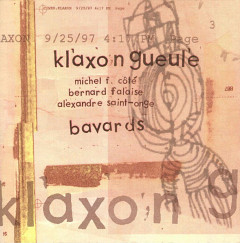
    On their debut release, the electric trio Klaxon Gueule blasts out with an unbridled energy that manages to absorb many influences while still sounding fresh and vital. One minute, they bristle with the harmolodic intensity of James Blood Ulmer’s mid-’80s trio, the next they drop down to the quietest whispers of buzzing and hissing electronics, the next they bellow out molten torrents of churning, slashing potency. Drummer Michel F Côté, who has been an integral member in many interesting projects coming out of the Montréal improvisation scene, drives this music with lithe, vigorous rhythms. With a flexible sense of time and astute attention to dynamics, he can nimbly segue the improvisations from caterwauling fusillades to open, chattering freedom. Guitarist Falaise approaches the music with a rock derived intensity, building up deftly controlled, dense textures with shredded power chords, choked feedback, and crackling electronics. He tears off fiery harsh-edged chords to shape cascading phrases, or drops burred textures and crackling sparks of electronics into the free interplay. Bassist Saint-Onge adds a percolating bottom to the mix, adding a linear flow to Falaise’s broader textures.

    Over the course of the first CD, the trio blasts through a series of 3 to 5 minute pieces that burst along like barely contained conflagrations. The second CD adds alto player Christopher Cauley for a series of longer pieces. The addition of alto gives the music a clear connection to the harmolodic energy of Ornette Coleman and Prime Time, but the four seem to acknowledge that basis and build from it. Each drives the music in equal parts, with sax, bass, and guitar weaving in and out of Côté’s churning rhythms. Particularly on slower pieces like Quatro II, Cauley’s free-blues keenings give the music a more linear shape than the trio pieces, but even then, the music builds in dynamic waves rather than along thematic structures. Particularly on the second CD, these musicians have managed to combine rock energy, electronic textures, and a finely attuned sense of group interaction into complex improvisations with gripping physicality.

    … these musicians have managed to combine rock energy, electronic textures, and a finely attuned sense of group interaction into complex improvisations with gripping physicality.

    La Bête / The Beast Within in Musicworks

    “Diverse Derome Delights”, Spike Taylor, Musicworks, no. 71, June 1, 1998
    Monday, June 1, 1998 Press

    La Bête / The Beast Within is original music commissioned from Jean Derome by the Montréal dance company O Vertigo. It’s a more careful work than Perec hommage. More impressive, too, I think, in the way that it stands back from the focus of the project (the choreography, as opposed to the memory of Perec or seventeen games) as a mature and highly original major work. It is no less chaotic than the other, yet Derome handles the content (I have not seen the O Vertigo production) with an openness and intensity that is a dance itself. Nine musicians are enlisted for La Bête, among them René Lussier, Diane Labrosse, Pierre Tanguay, and extra-specially Joane Hétu, doing vocal acrobatics. She tears into the centre of the action here amid textures of reeds, flutes, and piano, and holds the centre as lead instrumentalist—no lyrics, just new ideas pouring out of them all from Derome on down. I recommend this disc highly, and though you’ll wish you had been able to take in the entire experience of La Bête / The Beast Within, the CD stands with Jean Derome’s best works of any size.

    I recommend this disc highly.

    Je me souviens — Hommage à Georges Perec; Tu r’luttes, Jean Derome in Musicworks

    “Diverse Derome Delights”, Spike Taylor, Musicworks, no. 71, June 1, 1998
    Monday, June 1, 1998 Press

    Over the past fifteen years or so, Montréal composer and improvisor Jean Derome has built a body of work that expresses a singular musical vision that pushes out in many directions — for small, mid-sized, and large ensembles; for theatre, film, dance, and any other manner of collaboration. Derome is game for all of them. Two recent releases on the excellent cooperative label Ambiances magnétiques, features headfuls of musical ideas for three very different groups under similarly diverse circumstances. That is to say, there is unity to the entirety of Derome’s projects, but they are madly each their own and beautifully so. Je me souviens is not so much a large-ensemble work as one for big band. Thirteen players have a ball playing through a cycle of Derome’s knock-offs of swing, doo-wop, and big-band jazz, all laced with a characteristic sense of humour—note the front line of Martin Tétreault’s scatting turntable and a section for three jews-harps. This work is dedicated to the memory of French experimental writer Georges Perec, whose comically enigmatic inventions on the page are well remembered by the composer and arranger with a sympathetically inventive will to swing. Listen to Je me souviens, read Perec, and invent your own from there. There is an additional bonus band appended to the big band on this disc, namely a sextet of Québec improvisors playing up their differences against a Belgian side in what is called “17 jeux variés pour 12 improvisateurs”. There are furious moments of creation captured in moments of intense—and again, very humourous—sound effecting. The tunes are live collaborations, but evoke the image of a tape splicing bender from a bottomless source. They do this music boldly and all game for the game. La Bête—The Beast Within is original music commissioned from Jean Derome by the Montréal dance company O Vertigo. It’s a more careful work than Perec hommage. More impressive, too, I think, in the way that it stands back from the focus of the project (the choreography, as opposed to the memory of Perec or seventeen games) as a mature and highly original major work. It is no less chaotic than the other, yet Derome handles the content (I have not seen the O Vertigo production) with an openness and intensity that is a dance itself. Nine musicians are enlisted for La Bête, among them René Lussier, Diane Labrosse, Pierre Tanguay, and extra-specially Joane Hétu, doing vocal acrobatics. She tears into the centre of the action here amid textures of reeds, flutes, and piano, and holds the centre as lead instrumentalist—no lyrics, just new ideas pouring out of them all from Derome on down. I recommend this disc highly, and though you’ll wish you had been able to take in the entire experience of La Bête—The Beast Within, the CD stands with Jean Derome’s best works of any size.

    Solos de guitare électrique in AllMusic

    “Review”, François Couture, AllMusic, May 22, 1998
    Friday, May 22, 1998 Press

    Since 1978 guitarist René Lussier has taken an active part in the rise and institutionalization of the Montréal “musique actuelle” scene. It is only in May 2000 that he released his first solo guitar album. Solos de guitare électrique (“Electric Guitar Solos”) was recorded in 1998 in the studio with eight microphones placed in front of the amplifier, behind it, around the room and even in the adjacent studio. The audio perspective changes from one piece to the next and sometimes within one improvisation, expanding the sound palette. In the late 1990s, Lussier’s playing had become a lot more self-absorbed and abstract, less and less related to rock or jazz improvisation and getting closer to improvised audio art. His use of steel wool and other devices to brush, crunch and scratch the strings and the pick-ups often result in electroacoustic-like textures. The clownish side of Lussier’s music is absent on this record. In consequence, it tends to be more linear, ideas remain narrow, but well executed. Lussier is better when he has to respond to another player, like on Qu’ouïs-je? with Martin Tétreault. Here, he produces interesting textures, but the whole thing lacks some emotion, a third dimension. Not as engaging as other electric guitar-only albums like Hans Tammen’s Endangered Guitars, it still remains worthwhile, especially for those who want to study the guitarist’s playing up close.

    His use of steel wool and other devices to brush, crunch and scratch the strings and the pick-ups often result in electroacoustic-like textures.

    Chèvre, Chevreuil in Le Devoir

    “L’homme de chantiers; René Lussier est la cheville ouvrière de l’improvisation”, Serge Truffaut, Le Devoir, May 16, 1998
    Saturday, May 16, 1998 Press

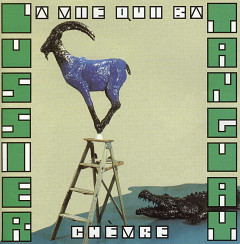
    La Vie qui bat, celle du chevreuil et celle de la chèvre, c’est la musique de la vie animale. C’est «pété». C’est fou, joyeusement. Ce sont autant de fables qu’il y a de morceaux. C’est Lussier qui roucoule, par guitare interposée, comme une grenouille. C’est Tanguay qui rythme, par batterie interposée, la vie du petit cheval.

    La Vie qui bat, volume 1 et volume 2, c’est «de l’improvisation libre. C’est une entente: on s’assoit et on improvise dans le respect de l’autre. C’est une histoire de confiance musicale. Ce n’est pas du jazz. Ce sont des rythmes, des notes. C’est libre de références. C’est comme trippé. Ce n’est pas manufacturé. C’est le plaisir qu’on recherche à faire de belles choses ensemble».

    Guitariste éclectique, compositeur très sensible, arrangeur plein d’humour, animateur, militant, acteur… René Lussier est davantage qu’un musicien. Il est artiste.

  • 8
  • 9
  • 10
  • 11
  • 12
  • 13
  • 14
  • 15
  • 16