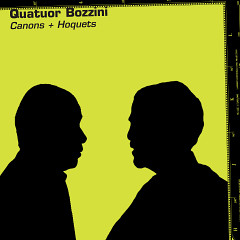
The Bozzini played two contemporary pieces that exploit extended techniques and raw sonorities, many of them percussive and harsh. They also played a piece by Brahms that sounded, at first, to have the same raw quality as the earlier pieces, but seemed out of place and unpleasant here. Gradually, it dawned, that the Bozzini touch, so raw, made the Brahms sound fresh and new and gave much pleasure.
Claude Vivier’s Pulau Dewata is a Balinese inspired ‘single line’ score that does not specify any musical instruments. Since its birth in the late ‘70’s this piece has been arranged for saxophone quartet, solo percussionist and chamber orchestra. Tonight’s performance was arranged for the Quattuor in 2002 by composer Michael Oesterle and has been recorded by them.
On hearing the first few minutes of Vivier/Oesterle’s repetitive, percussive, staccato short phrases, one could easily imagine the sound of it in winds or brass or percussion—an altogether pleasant and interesting effect. There is very little in the way of melody until the very end. The musicality of Pulau Dewata relies on alternation and combination of thinly orchestrated queer pitches and timbres, changes in rhythms and dynamics.
The music is stark, repeatedly focuses the attention and relaxes it into a pregnant calm. The Quattuor Bozzini convey the authority of their understanding of the music and their enthusiasm for it.
Thomas Steigler’s Namenlose Garten [String Quartet No. 3], (2003)” is a 20 minute piece, commissioned by the Bozzini and recently recorded by them. The writing is based on eighth, quarter, and semi-tones, which allows some very smooth, glossy textures that are attractive. Even the passages of silent and almost silent bowing give the illusion of a mirrored surface. Many of the sonorities are onomatopoeic, often resembling whale sounds, and lugubrious, electronic, guttural, digestive tract sounds, sounds from the margin of the musical palette. Based on a portfolio of garden drawings, Steigler’s sonic environments are intriguing.
The themes that open Brahms’s third and last string quartet are happy, scherzo-like and polka in rhythmic interplay, and one could not quite connect with the Bozzini’s account which seem to carry over much of the high contrast, stark, not to say ‘harsh’ tones of the previous experimental pieces. However, the second movement, which is lush, slow and improvisatory, seemed to come out as a refreshing blend of Brahms and Bozzini. Passages bore their signature glassiness; disjointed timing and harsh timbres in other passages seemed to bring out new and attractive textures in Brahms’s music.
Clemens Merkel, a deft player, intrigued by getting fluty sounds out of his first violin during the third movement, in which the voice of Stéphanie Bozzini’s viola, moody and passionate, also distinguished itself. The theme and eight variations of the finale showed the Bozzini at their best. Though the main thrust of this group seems to be in New Music (they have recorded Steve Reich, Jurg Frey, Jo Kondo, Howard Skempton) I would welcome another chance to hear the sound they make playing great music of the past.


![Quatuor Bozzini / Aussi sur la photo: Stéphanie Bozzini, Alissa Cheung, Clemens Merkel, Isabelle Bozzini [Photo: Michael Slobodian, Montréal (Québec), 20 janvier 2020]](https://res.electrocd.com/image.php/image/q/quatuorbozzini_.9954.jpg?width=n2&cropratio=1:1)
![Geneviève Letarte [Photo: Raymonde April]](https://res.electrocd.com/image.php/image/l/letarte_ge.1.jpg?width=n2&cropratio=1:1)