actuellecd

More from the blog

19 results
  • 1
  • 2
  • 3
  • 4
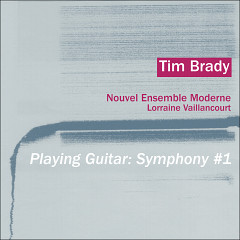
  • Playing Guitar: Symphony #1 in Hour

    “Review”, Mike Chamberlain, Hour, February 3, 2005
    Thursday, February 3, 2005 Press

    Montréal’s Tim Brady is a true mad scientist of guitar sound, placed here on Earth, it seems, to smash the barriers between high and low culture. His wild guitar sounds are daggers in the heart of classical music pretense, and God love him for it. The title of Brady’s latest tells much of the story, as it’s certainly the guitar playing that deserves top billing. Here, the music has a relentless drive to it and, to be honest, it is a bit wearying at times, but at the same time, one has to admire the way that Brady works with Lorraine Vaillancourt’s NEM to bring out their playful side.

    … one has to admire the way that Brady works with Lorraine Vaillancourt’s NEM to bring out their playful side.

    Playing Guitar: Symphony #1 in Splendid E-Zine

    “Review”, Mike Meginnis, Splendid E-Zine, January 28, 2005
    Friday, January 28, 2005 Press

    While Playing Guitar: Symphony #1 was not conceived as such, and thus lacks much of the cohesiveness you would expect, it is indeed, arguably, a symphony. There are some rough spots, but the overall picture is one of virtuosic performance, risky and thrillingly academic composition, and promising insights into fresh compositional possibilities. Brady’s guitar is intended as the centerpiece and the ensemble’s modifications toward this end are the gimmick, but I found the guitar to be probably the least interesting individual element. As a booster of the other instruments, it does an excellent job. When it’s expected to stand alone, it often fails to grab attention as required. This may be a question of my familiarity with the electric guitar versus the relative unfamiliarity of what I think was Brady’s intended audience — of my power to be underwhelmed by a theoretically overwhelming instrument, versus their palpable fear of it. Really, though, it doesn’t matter; the matter scarcely hinders this excellent music, as long as you don’t think about that particular aspect too hard. (Hint: leave the liner notes in the case where they belong.)

    Playing Guitar…’s first movement opens with a wash of guitar noise, displaying the power of the ensemble’s secret weapon and one of Brady’s innovations: a sampler, with elements as simple as single electric guitar tones and as complex as legions of electric guitars making thunderous noise, mapped to its keyboard. This is a powerful muscle, but it’s used sparely, as an accent and underpinning and resonance more than driving force. The tone is set. Like the most intense results of the minimalist movement meeting with traditional compositional ideas, the structures are highly repetitive from second to second, but differ wildly from minute to minute. It feels like the crystalline form of jazz: all the seemingly coincidental brilliance and immediacy of a Coltrane performance without half of the tom-foolery.

    The second movement speaks more to the minimalist movement at its more radical stages: a horn drones sadly in the foreground while all manner of ambient strangeness flutters and rumbles behind it. The seeming aimlessness of these moments is counterbalanced perfectly by the intensity with which they are performed — by the tension every second of horn exudes. The ensemble keeps you so tense, you’ll hardly notice that the sound is building, building, building, until suddenly the whole construct is shimmering. Brady’s guitar is shepherding the elements together and the strings are hard to keep up with. For one perfect second, the whole mess comes together — and then, even more suddenly than the moment arrived, it is gone. Only the sampler’s ambient drones and whines remain.

    The third movement is an ill-advised sampler solo. It has little form and hardly any reason, accomplishing nothing the other movements won’t do better, but it’s fun to listen to. Thankfully, the fourth movement displays the sort of intensity we expect in the climax of a great, cerebral action film, but with none of the ham-fisted emotional manipulation. It begins as a particularly combustive traditional composition and transforms into the most thrilling moments you’ll hear in the entire symphony, unraveling melodically even as it doubles, triples, quadruples in size. It is spectacular.

    This leads to another more traditionally minimalist movement, which takes the elements left over from the previous one and stretches them far past the point of comfort. Again, that remarkable tension. Some of the instruments in the ensemble have been subtly modified with electronic amplification so as to work better with Brady’s guitar, and you’ll hear the most obvious benefit here.

    After a wank-fest guitar solo, we come to the closing movement. Nothing about this one stands out in particular, as it is, appropriately, the synthesis of all the best ideas from the previous movements. By now, comparisons to Godspeed You! Black Emperor are inevitable, but even with his minimalist leadings, Brady doesn’t fuck around nearly as much on his way to the official explosion of sound and musical fury. In a perfect world, the record would stop here.

    Unfortunately, an additional composition is included as a supplement to the symphony, though it doesn’t come close to matching its luster. “Frame 1 — Resonance” is painfully sophomoric, making heavy-handed use of a hesitant piano layered with electric guitar. The gimmick is that the electric guitar is supposed to behave as a sort of amp for the piano, matching it note for note. This is treated as a profound realization requiring a lot of space and, indeed, nearly thirteen minutes to absorb. When the guitar stops matching the piano and instead attempts desperate new tricks to accent it, the entire exercise becomes pointless and unfathomable, with the already incoherent piano material falling apart almost completely. Even if this was an improvised piece, it wasn’t a success.

    Otherwise, though, Playing Guitar… is your opportunity to hear seventeen professionals playing the hell out of a few brilliant pieces and a couple of wanky ones. To not buy it, if you have the money on hand now or any time in the near future, is to deprive yourself of a valuable and singular experience.

    … virtuosic performance, risky and thrillingly academic composition, and promising insights into fresh compositional possibilities.

    Top Albums of 2004

    Tuesday, January 11, 2005 New releases

    Ambiances Magnétiques is making many year-end top lists. First, Mike Hansen of WhynotJazz on CKLN picks Prairie orange by Les Poules. François Couture of Délire actuel on CFLX picks Playing Guitar: Symphony #1 by Tim Brady. Mike Chamberlain chose 10 compositions by the Trio Derome Guilbeault Tanguay for his selection in Coda magazine, same as Bart Plantenga for radio Patapoe in Amsterdam. Finally, Montréal’s cultural weekly Ici (Montréal) also picked Playing Guitar: Symphony #1 in addition to Joëlle Léandre and Gianni Lenoci’s Sur une balançoire.

    Portrait Montréal, Playing Guitar: Symphony #1 in Vital

    “Review”, Dolf Mulder, Vital, no. 456, January 5, 2005
    Wednesday, January 5, 2005 Press

    The music released through the Ambiances Magnétiques label covers a wide spectrum: extreme noise music by Tétreaul, all kinds of improvised music and jazz, beautiful songs by someone like Letarte, but also modern ‘classical’ music. Both two new cds belong to the last category.

    Canadian composer and guitarplayer Brady offers two of his new compositions on his new cd. Playing Guitar: Symphony #1 is a work in 5 movements, two movements being subdivided in two parts. If you aks me what is ‘classical’ about his work then it surely is the symphonic nature of this piece. We hear Tim Brady on electric guitar accompanied by the 15-piece Nouvel Ensemble Moderne. Besides there is an important role for live electronics and sampler played by Brady. Part 1 is a very driven — Louis Andriessen like — piece. The second movement is dense and at a much lower pace. The third movement is more or less completely electronic. Like in movement 1 we hear in the second part of the third movement the complete ensemble playing a very dynamic hammering intersection, that continues in movement 4. The first part of the 5th movement is a beautiful solo piece for Brady on guitar. In the second part the music becomes very complex and culminates in a climax fading out with quiet electronic sounds in the last few seconds. It’s very rich and engaging work. At the core of this recording is the live recording a the piece in june 2003. In the process of mixing and editing guitar and sampler parts were added. The second compositions Frame 1 — Resonance is performed by his ensemble Bradyworks, consisting here only of two players: Pamela Reiner on piano and Tim Brady himself on guitar and treatments. For this composition Brady was inspired by a thought of a friend who imagined a piece for piano and guitar where “the guitar would act like a big, electronic resonator for the piano part, becoming a huge electroacustic sustain pedal”. Again a more than interesting work by Brady.

    On Portrait Montréal everything is in four: four compositions from four different composers, played by four musicians, the Quatuor Bozzini. We hear the following works: Pulau Dewata (by Claude Vivier), Quatuor à cordes II (Jean Lesage), Daydream Mechanics V (Michael Oesterle) and A New Song of many faces for in These Times (Malcolm Goldstein). String quartet Quatuor Bozzini plays music from classical and romantic times, but have a great love for modern music. For their debut cd they concentrate on modern music from their hometown Montréal. What strikes me first listening to this cd is the enthousiastic and daring playing by this quartet. Pulau Dewata is played here in an arrangment by Michael Oesterle. It was Vivier’s tribute to balinese music. The post-minimal composition Daydream Mechanics V by Oesterle also is inspired on folk music. Though not asiatic music this time. Now we hear echoes of eastern Europe. Jean Lesage on the other hand stays close to the western classical tradition. He plays with this idiom with great skill and dedication. Malcolm Goldstein is not only a composer but also a well-known improvisor on violin. So it should not wonder that his composition gives room for improvisation. As a result this is the most vivid piece on this cd. First of all this cd introduces us to a great and ‘fresh’ string quartet and secondly it offers a well-balanced portrait of modern composed music from Canada.

    What strikes me first listening to this CD is the enthousiastic and daring playing by this quartet… First of all this CD introduces us to a great and ‘fresh’ string quartet and secondly it offers a well-balanced portrait of modern composed music from Canada.

    Playing Guitar: Symphony #1 in Ici Montréal

    “Compact!”, François Nadon, Ici Montréal, December 2, 2004
    Thursday, December 2, 2004 Press

    Tim Brady a toujours été un cas particulier. Il est ce musicien improbable qui réussit à se tenir en équilibre entre la tradition classique européenne et le jazz. Sa prernière symphonie rend bien compte de cette dualité. Son travail va au-délà d’un ramassis de citatioris, c’est un manifeste pour une coexistence des styles. Brady nous offre sa vision personnelle de ce que devrait être la musique d’aujourd’hui.

    Brady nous offre sa vision personnelle de ce que devrait être la musique d’aujourd’hui.

    Atlas Epileptic, Playing Guitar: Symphony #1, Jardin d’exil in Blow Up

    “Recensione”, Enrico Bettinello, Blow Up, no. 79, December 1, 2004
    Wednesday, December 1, 2004 Press

    Attivissima, la scena canadese testimoniata dalla Ambiances Magnetiques, ci presenta il compositore e chitarrista Tim Brady in un ambizioso lavoro per chitarra elettrica, campionatore e orchestra. Più che un concerto, ci spiega nel libretto, l’attitudine è quella sinfonica, con le varie parti a integrarsi e l’elettronica a fare da volano – sia nel filtraggio degli strumenti acustici, sia nell’uso del campionatore come espansione dell’aspetto chitarristico. Si toccano diverse atmosfere – alcune felicemente allucinatorie, altre leggermente didascaliche–e il lavoro è di ottimo livello. Bello anche il più breve Frame 1.(7+)

    Di impronta chiaramente jazzistica è invece Jardin D’Exil dell’Ensemble En Pièces guidato dal sassofonista Philippe Lauzier e dal pianista Alexandre Grogg e splendidamente a suo agio sul filo dell’equilibrio tra struttura e libertà, avvicinandosi a molti spunti del jazz europeo più avanzato.(7)

    Doppio – cd audio + cd video–è Atlas Epileptic dell’artista multiforme Pierre-André Arcand, poeta visuale, dj, performer. Il titolo è già fantastico. L’uso di vari espedienti, tra cui il software Macchina Ricordi, la manipolazione di campionamenti di precedenti lavori, il trattamento della voce, rende il disco [e il suo fratello “visuale”] un interessantissimo susseguirsi di esperienze. (8)

    8
  • 1
  • 2
  • 3
  • 4