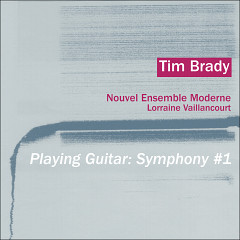
Playing Guitar: Symphony #1 in Splendid E-Zine
While Playing Guitar
Playing Guitar…’s first movement opens with a wash of guitar noise, displaying the power of the ensemble’s secret weapon and one of Brady’s innovations
The second movement speaks more to the minimalist movement at its more radical stages
The third movement is an ill-advised sampler solo. It has little form and hardly any reason, accomplishing nothing the other movements won’t do better, but it’s fun to listen to. Thankfully, the fourth movement displays the sort of intensity we expect in the climax of a great, cerebral action film, but with none of the ham-fisted emotional manipulation. It begins as a particularly combustive traditional composition and transforms into the most thrilling moments you’ll hear in the entire symphony, unraveling melodically even as it doubles, triples, quadruples in size. It is spectacular.
This leads to another more traditionally minimalist movement, which takes the elements left over from the previous one and stretches them far past the point of comfort. Again, that remarkable tension. Some of the instruments in the ensemble have been subtly modified with electronic amplification so as to work better with Brady’s guitar, and you’ll hear the most obvious benefit here.
After a wank-fest guitar solo, we come to the closing movement. Nothing about this one stands out in particular, as it is, appropriately, the synthesis of all the best ideas from the previous movements. By now, comparisons to Godspeed You
Unfortunately, an additional composition is included as a supplement to the symphony, though it doesn’t come close to matching its luster. “Frame 1 — Resonance” is painfully sophomoric, making heavy-handed use of a hesitant piano layered with electric guitar. The gimmick is that the electric guitar is supposed to behave as a sort of amp for the piano, matching it note for note. This is treated as a profound realization requiring a lot of space and, indeed, nearly thirteen minutes to absorb. When the guitar stops matching the piano and instead attempts desperate new tricks to accent it, the entire exercise becomes pointless and unfathomable, with the already incoherent piano material falling apart almost completely. Even if this was an improvised piece, it wasn’t a success.
Otherwise, though, Playing Guitar… is your opportunity to hear seventeen professionals playing the hell out of a few brilliant pieces and a couple of wanky ones. To not buy it, if you have the money on hand now or any time in the near future, is to deprive yourself of a valuable and singular experience.