Sauter au contenu principal
actuellecd

Ambiances Magnétiques

94 résultats
  • 8
  • 9
  • 10
  • 11
  • 12
  • 13
  • 14
  • 15
  • 16
  • Ambiances Magnétiques dans Écouter voir

    «Éloge de la musique libre», Luc Bouquet, Écouter voir, no 106, 1 octobre 2000
    dimanche 1 octobre 2000 Presse

    Faire de la musique libre au Québec n’est pas une entreprise de tout repos; peu de public, manque de scènes attentives à cette nouvelle expression musicale, quasi indifférence des instances culturelles et des médias. Malgré ce, deux labels ont su s’imposer à force d’investissement et d’implication. Ambiances Magnétiques et Victo ont chacun à leur manière réussi à faire exister une scène québécoise à l’étonnante diversité. Petite visite guidée.

    Ambiances Magnétiques

    Ambiances Magnétiques est né au début des années quatre vingt grâce au saxophoniste Jean Derome et au guitariste René Lussier. Suite à une série de concerts pour instruments et bandes magnétiques sous l’intitulé Ambiances Magnétiques, les deux musiciens décident de prendre en charge la production et la diffusion de leurs enregistrements, les quelques rares structures existantes ne désirant pas s’encombrer de tels musiciens iconoclastes. Avec pour modèle les européens de Recommended Records allait naître Ambiances Magnétiques, coopérative de musiciens et rassemblement de producteurs indépendants. C’est ensuite au tour de Joane Hétu, Diane Labrosse et Danielle Palardy Roger, alias le groupe Wonder Brass, de rejoindre le collectifen 1985. Avec Robert Marcel Lepage, Michel F Côté, André Duschesne et Martin Tétreault, autres musiciens du collectif, le label doit faire face aux pires difficultés pour que soit reconnue à sa juste valeur une musique éclectique et insaisissable. Le gouvernement québécois n’accordant aucune subvention au label, les musiciens se rabattent sur le Conseil des Arts du Canada, lequel finance individuellcment les artistes. Mais il faut aussi faire face au peu d’intérêt que portent le Canada et les Etats-Unis à cette libre musiquc (20% seulement des ventes). C’est en 1990 que le label s’empare du format compact-disc; Luc Beauchemin, Fabrizio Gilardino et Anna Morelli créant un lien graphique évident entre les différentes pochettes tandis que le studio 270 de Robert Langlois devient le point de ralliement des artistes du label. Un an plus tard, Joane Hétu, désormais capitaine du navire Ambiances Magnétiques crée DAME (Distribution Ambiances Magnétiques Etcetera), et distribue outre le label maison, les firmes Ohm/Avatar, Amim, Monsieur Fauteux ainsi que les enregistrements des membres du collectif parus sur d’autres labels (Victo, Cuneiform, ReR). De nouveaux réseaux se créent avec l’Asie, le Mexique et les pays scandinaves, les artistes québécois se produisent en France dans quelques festivals incontournables (Banlieues Bleues, Musique Action…), de nombreux artistes internationaux (Ikue Mori, Joëlle Léandre, Fred Frith) enregistrent sur le label, attisant de ce fait la curiosité des amateurs du genre. Avec plus d’une centaine de références le catalogue DAME exprime magnifiquement la richesse d’un collectif et totalement impliqué dans une musique écrite ou improvisée, électroacoustique ou bruitiste, simple ou savante, mais toujours inouïe. En voici quelques moments forts.

    DAME exprime magnifiquement la richesse d’un collectif et totalement impliqué dans une musique écrite ou improvisée, électroacoustique ou bruitiste, simple ou savante, mais toujours inouïe.

    Ambiances Magnétiques dans AllMusic

    «Portrait: Ambiances Magnétiques», François Couture, AllMusic, 1 octobre 2000
    dimanche 1 octobre 2000 Presse

    Although the name Ambiances magnétiques is mostly known for (and perceived as) the Montréal experimental music record label, there is also an artists’ collective which preceded it. This nucleus of musicians has built what is now known as the Montréal experimental music scene.

    It all started in 1982 when guitarist René Lussier and saxophonist/flutist Jean Derome presented a few duo concerts in Montréal under the name Ambiances magnétiques (which translates to “Magnetic Atmospheres”). They teamed up with guitarist André Duchesne and clarinetist Robert Marcel Lepage and launched the label Ambiances magnétiques in 1983, an entity managed by the members of the collective that would release records of the members, with occasional guests that would always have some sort of connection to the nucleus — up until the late 1990s, when the label started to broaden its horizons. In 1986 the group was extended to include Joane Hétu, Diane Labrosse and Danielle Palardy Roger, three hard-working musicians performing together in various avant-pop girl groups (Wondeur Brass, Justine). Hétu would soon be left in charge of the label itself. Radio DJ and drummer Michel F Côté was enlisted in 1988 and finally turntablist/record manipulator Martin Tétreault (discovered accidentally as he was overheard by his unsuspecting neighbor André Duchesne in the late 1980s) officially joined in the mid-1990s.

    The collective only performed a couple of times as a group, an event documented on the 1992 CD Une Théorie des Ensembles. They work more as a pool of musicians and a cooperative and they succeeded in creating their own underground network to support an experimental scene. This includes the record label, but also Distributions Ambiances magnétiques Etc. (DAME), a distribution outlet, and production companies such as Productions SuperMémé which orchestrates concert series and events in Montréal. By late 2000, the label had 90 titles under its belt and all Ambiances magnétiques members had become keystones in the development of demanding music in Canada.

    This nucleus of musicians has built what is now known as the Montréal experimental music scene.

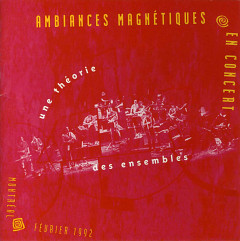
    Une théorie des ensembles, Ambiances Magnétiques dans AllMusic

    «Review», François Couture, AllMusic, 1 octobre 2000
    dimanche 1 octobre 2000 Presse

    This CD was an event. Une théorie des ensembles was the first live album from Ambiances magnétiques (the label) in almost 10 years of existence. It was also the only album ever to be credited to Ambiances magnétiques (the artists’ collective). Recorded on February 7 & 8, 1992 at the Maison de la Culture Frontenac in Montréal, this CD presents performances from all eight members of the collective at the time (founders René Lussier, Jean Derome, André Duchesne and Robert Marcel Lepage}; 1986 inductees Diane Labrosse, Danielle Palardy Roger and Joane Hétu}; 1988 last addition Michel F Côté — Martin Tétreault would join later in the mid-1990s).

    The album opens and closes on two ensemble pieces. Ambulances en plastique is a Derome-penned rock fanfare, while Montréal, 7 h a. m. bears a typical rock guitar-driven Duchesne stamp. This fantastic guitarist/composer has worked so rarely in the 1990s every bit of material is a delight to hear. Between these two pieces, five Ambiances magnétiques groups show their chops. Duchesne’s Locomotive plays fair renditions of three tracks off its CD. Côté’s Bruire delivers two very nice improvs going in the same direction as the second album Les fleurs de Léo. There are also two tracks from the all-girl group Justine, mostly improvised although the first one is recognizable as Vidanges Domestiques (thanks to the quirky melody), off their last CD Langages Fantastiques. The album’s highlight is Les Granules’ 13-minute suite Le bizarre échevelé, a never-recorded piece and the last thing Lussier and Derome’s duo put on disc. The two tracks from La Flore laurentienne are the only crumbs remaining from this Lepage project — and it’s a pity: very good blend of extended clarinet techniques and a more rock/techno approach. Overall, Une théorie des ensembles is a very enjoyable CD that adds valuable material to these artists’ discographies.

    … a very enjoyable CD that adds valuable material to these artists’ discographies.

    volume 3: Inédits, Ambiances Magnétiques dans AllMusic

    «Review», François Couture, AllMusic, 1 octobre 2000
    dimanche 1 octobre 2000 Presse

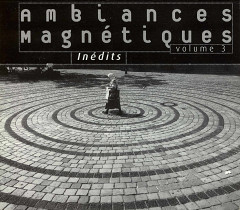
    For the third installment in its compilation series, the label Ambiances Magnétiques decided to give the fan something new: the first two volumes comprised only previously available material and were targeted toward the neophyte, but Inédits (Unreleased) was a fan-pleaser. This CD contains tracks from all nine members of the Ambiances Magnétiques collective: René Lussier, André Duchesne, Jean Derome, Robert Marcel Lepage, Joane Hétu, Diane Labrosse, Danielle Palardy Roger, Michel F Côté and Martin Tétreault. Most pieces were recorded at Studio 270 with engineer Robert Langlois (Ambiances Magnétiques members’ usual hang-out — therefore, sound quality is often excellent) and represent transitional experiments. Some others were recorded by Radio-Canada (Canada’s national radio) and document live projects that never made it on record. It is interesting to note that some performances already hinted at the direction these musicians would take in the late 1990s (especially Côté’s trio Klaxon Gueule, Lussier and Hétu). Inédits contains valuable contributions from Lussier and a noisier-than-usual suite from Derome (very nice) but the album is most noticeable for the contributions of more discreet musicians. Since his 1992 CD Locomotive, André Duchesne has been very quiet and even though his Les Barrages (“The Dams”) is an unremarkable excerpt from a symphonic work, Les toasts brûlées (“Burned Toasts”) is the only existing document from his short-lived band Diesel. Danielle Palardy Roger is another discreet artist; her two performances exemplify her work outside Ambiances Magnétiques’ “girl groups” (Wondeur Brass, Les Poules, Justine}). Finally, the excerpt from Martin Tétreault’s Chronique du disque (an unreleased radio piece) is one of his best performances. Fans of Ambiances Magnétiques will find a lot to explore and be surprised about on Inédits.

    Fans of Ambiances Magnétiques will find a lot to explore and be surprised about…

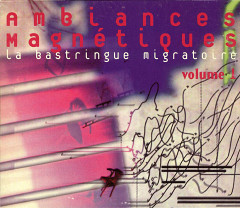
    volume 1: La bastringue migratoire, Ambiances Magnétiques dans AllMusic

    «Review», François Couture, AllMusic, 1 octobre 2000
    dimanche 1 octobre 2000 Presse

    After 12 years of existence and 39 records produced, the seminal Montréal new music label Ambiances Magnétiques felt the need to release its first compilation album, Volume 1: La bastringue migratoire. This retrospective CD came out as the label’s main artists (René Lussier, Jean Derome, Joane Hétu and Martin Tétreault, mostly) were about to change their musical approach. After 1996, the bulk of the label’s production will shift from deconstructed rock idioms where humor often plays a central role (Les Granules, Justine, André Duchesne, Jerry Snell}) to introverted free improvisation. So La bastringue migratoire came at the right time, summarizing the label’s pre-1996 sound. All tracks are taken from albums already published — no unreleased material — and thus this CD offers nothing new to the dedicated fan, but the “musique actuelle” neophyte will find it a helpful sampler. Every major act on the label is represented: René Lussier (thrice if one counts the track by his duo Les Granules), Jean Derome, Martin Tétreault, Justine, Évidence, Bruire and André Duchesne, plus a few lesser-known artists such as Geneviève Letarte and Jerry Snell. The booklet includes presentations of every artist on Ambiances Magnétiques.

    La Bastringue Migratoire came at the right time, summarizing the label’s pre-1996 sound. […] the “musique actuelle” neophyte will find it a helpful sampler.

    volume 3: Inédits, Ambiances Magnétiques dans White Noise

    «Review», Scott Russell, White Noise, 1 juin 2000
    jeudi 1 juin 2000 Presse

    Samplers tend to be the orphans of most labels’ output, often incoherently compiled hand me downs from previously released discs they are frequently overpriced and tend to be acquired by accident or misfortune. Few people would openly admit to considering them worthy purchases. Inedits (from Canadian electro-acoustic label Ambiances Magnétiques) is such a rattlingly entertaining set which is so well conceived and organised, it comes over like a single piece of work rather than a sampler. The performers work predominantly in small groups; duos trios and soloists, but their use of cut’n’paste montage techniques combined with turntables, tapes and live electronics adds a whole world of dimensions to the proceedings. Amongst the stand out tracks is Martin Tétrault and Marc Tremblay’s fabulous Chronique du disque which opens with a blast of vinyl scratches that sounds like a thunderstorm then segues into a cheesy jazz vibes ensemble which is overtaken by a plunderphonics sequence that resembles the work of cartoon composer Carl Stalling. Elsewhere Jean Derome contributes 8 duo and trio’s (with Tétreault again and Joane Hétu) from a film project entitled Retour au Blanc. It sounds improvised with the players going at it with a variety of weapons including queasily manipulated orchestral music, fidgeting hand held objects. air emptying out of a balloon, groaning sax, manipulated percussion and a bit which sounds like the laser gun fight out of Forbidden Planet. René Lussier contributes impeccable solo guitar piece that (in my mind at least) recalls players like Fred Frith and Gary Lucas in it’s brightness of tone and attention to space and texture. There are so many other terrific moments (André Duchesne & Diesel playing fiddly, Henry Cow like fusion; Robert Lepage pitting his Clarinet against the electric scrapes and flutterings of The Impromptistes) that warrant attention that I’m ay a loss which to describe next. That alone is a singular achievement and one that makes this complation well worth your attention.

    … well worth your attention.
  • 8
  • 9
  • 10
  • 11
  • 12
  • 13
  • 14
  • 15
  • 16