Sauter au contenu principal
actuellecd

Blogue

3585 résultats
  • 22
  • 23
  • 24
  • 25
  • 26
  • 27
  • 28
  • 29
  • 30
  • Fatrasies dans The WholeNote

    «Review», Ken Waxman, The WholeNote, no 30:1, 1 septembre 2024
    dimanche 1 septembre 2024 Presse
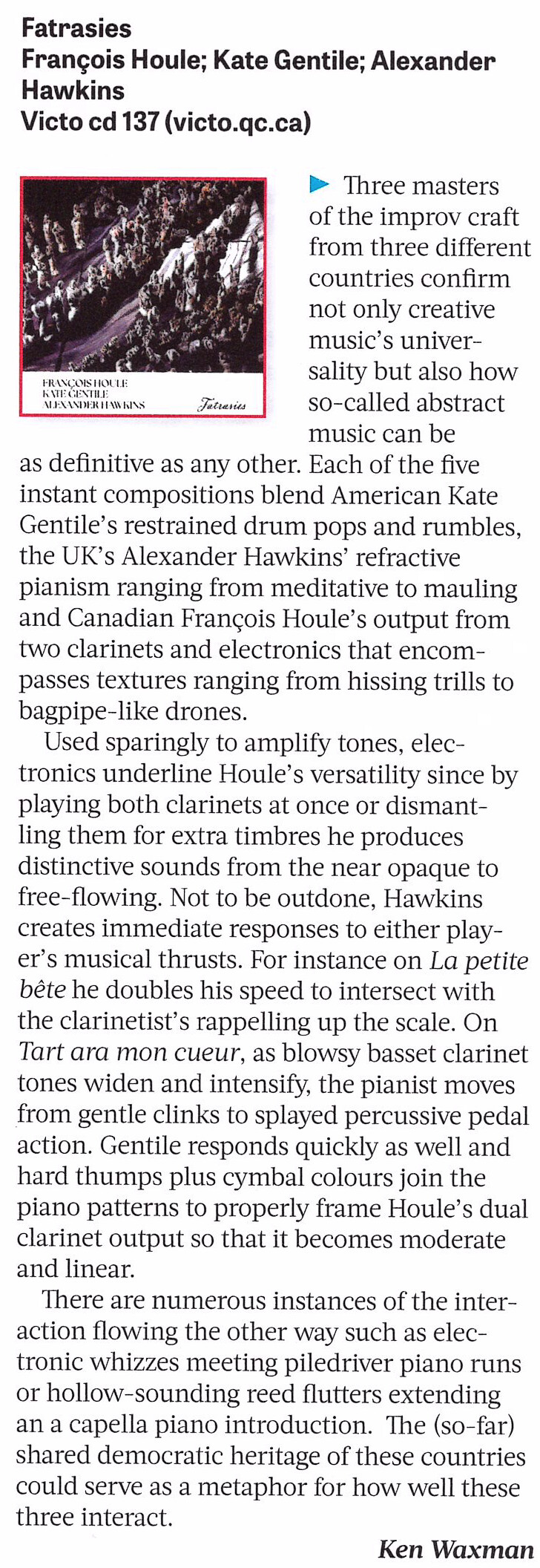
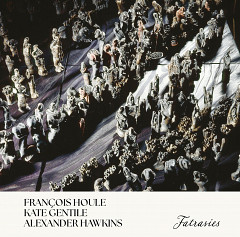
    Three masters of the improv craft from three different countries confirm not only creative music’s universality but also how so-called abstract music can be as definitive as any other.

    Rebecca Bruton + Jason Doell: a root or mirror, blossom, madder, cracks; together dans PAN M 360

    «Critique», Frédéric Cardin, PAN M 360, 1 septembre 2024
    dimanche 1 septembre 2024 Presse

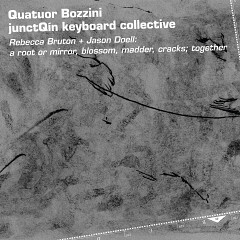
    Il y a de ces albums qui semblent porter la marque d’un niveau supérieur d’exécution et d’importance créative. C’est le cas de ce tout nouvel opus du magistral Quatuor Bozzini, de Montréal, accompagné ici de l’ensemble piano six-mains (oui, six!) JunctQin (prononcer Junction), de Toronto. Vous me direz peut-être que c’est souvent le cas avec les Bozzini. Bien sûr. Mais concentrons-nous sur cette proposition exceptionnelle, bâtie sur l’exécution de deux œuvres canadiennes: The Faerie Ribbon, de Rebecca Bruton, et to carry dust & breaks through the body de Jason Doell.

    Si les deux pièces sont à tout point de vue expérimentales, elles n’en demeurent pas moins douces et feutrées. La plus accessible des deux est celle de Rebecca Bruton, une compositrice de Calgary. Celle-ci nous invite dans son univers scintillant avec des gestes pointillistes qui illuminent agréablement l’espace. En plus du piano six-mains et des cordes, il est demandé aux interprètes de chantonner doucement ici et là. Le résultat est d’une grande beauté, certes contemporaine, mais accessible grâce à une «centralité tonale» oscillante, inspirante plutôt que directive. La syntaxe discursive de l’œuvre est divisée en épisodes texturaux facilement identifiables: ça débute dans le foisonnement volubile pour se retrouver plus loin dans un monologue mécanique et monotone avant une sorte de synthèse des deux, dans un contrepoint chargé dont la récitation en formules répétitives rappelle Morton Feldman. Mais ce qu’il faut principalement retenir c’est la beauté envoûtante et sophistiquée de The Faerie Ribbon. Les remarquables contrastes de textures, de toucher et de résonances imposées aux interprètes sont entièrement maîtrisées par les sept musiciens, particulièrement les Bozzini, qui doivent redoubler d’efforts pour bien rendre toutes les nuances presque ultrasoniques de la partition.

    Deuxième (et seule autre) pièce au programme: to carry dust & breaks through the body, sans majuscule, de Jason Doell. Je reviens encore à Feldman pour la comparaison, cette fois de façon plus appuyée. Des accords de pianos tempérés sont déposés sur des glissandi descendants répétitifs. La différence avec le compositeur étasunien bien connu est que Doell fait couler très subtilement ses accords de cordes dans des interstices microtonaux. Cela crée une impression d’étrangeté et d’instabilité très finement perceptible grâce à laquelle on finit par se demander si ce sont les cordes qui sont décalées, ou le piano! C’est brillant et, encore une fois, étrangement séduisant.

    La méticulosité de l’interprétation est excellente et les Bozzini, avec leurs amis de JunctQin, accomplissent de petits miracles de douceur et de clarté infinitésimale.

    À ne manquer sous aucun prétexte si vous aimez le meilleur de la musique d’aujourd’hui.

    À ne manquer sous aucun prétexte si vous aimez le meilleur de la musique d’aujourd’hui.

    Rebecca Bruton + Jason Doell: a root or mirror, blossom, madder, cracks; together dans Bandcamp Daily

    «The Best Contemporary Classical Music on Bandcamp, August 2024», Peter Margasak, Bandcamp Daily, 29 août 2024
    jeudi 29 août 2024 Presse

    In his sharply observed liner note essay, Canadian composer Martin Arnold refers to the two pieces on this beguiling album—written by Rebecca Bruton and Jason Doell — as “psychedelic,” which is not a description one expects for contemporary classical music. “It seems to me that undermining/displacing cultural conventions/pre-conditionings is not a straightforward task. You can’t just do something that’s not them: something the opposite or something exotically strange, for example.” Indeed, both works undercut a familiarity with weird, disorienting elements. In Bruton’s Faerie Rhythm, it’s the composer’s own folk-ish, wordless singing and shy whistling that feels deliciously alien, limning elegantly proportioned lines and shapes articulated by Montréal’s endlessly adventurous and adaptable Quatuor Bozzini. All of that sits alongside the work of Toronto keyboard trio junctQín, which sticks exclusively to acoustic piano here. The relative activity of the two outer sections of the piece involved all the musicians, but the two middle parts strip things down to a sparse solo piano passage, which is soon enhanced by solo piano, joining to refashion the outer parts in a solemn, melancholy reverie of unabashed beauty and deceptive simplicity. Doell’s undeniably trippy “to carry dust & breaks through the body” get a lot of its warped qualities from the deceptive fake drone that emerges as the strings steadily pitch down half a step throughout the piece while the piano maintains the same tuning, which makes it seem as if the keyboard is losing it. The interplay between the work’s tender melodic thrust and the increasingly sour harmonic confusion provides its unalloyed power.

    … both works undercut a familiarity with weird, disorienting elements.

    Hypnokaséta dans Bad Alchemy

    «Kritiek», Rigobert Dittmann, Bad Alchemy, no 124, 1 juin 2024
    mardi 13 août 2024 Presse

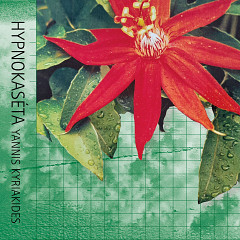
    Hypnokaséta (82U) est une émanation de ce que Yannis Kyriakides a rêvé dans le Corona-Lock-down. Il est interprété par le Quatuor Bozzini, le fantastique quatuor à cordes de Montréal, par Andy Moor (de The Ex, Lean Left, The Heretics avec Anne James Chaton) à la guitare et aux bandes, et par Kyriakides lui-même avec l’électronique. Dans l’alternance du quatuor avec les interludes improvisés de Moor, les cassettes jouent un rôle essentiel. Car c’est la “cassette theory of dreaming” qui est en jeu: là où nous pensions qu’il y avait des rêves, il n’y a qu’un processus de composition non conscient et un processus de chargement de mémoire tout aussi non conscient. Elle est due au spécialiste des sciences cognitives Daniel C. Dennett (1942-2024), dont la vision naturaliste du monde est exempte de fantômes, d’elfes, de lapins de Pâques — ou de Dieu. L’évolution universelle et ce que l’on appelle la liberté et le soi sont exclusivement basés sur les mécanismes de variation, de sélection et de réplication, sur des mèmes, des leitmotivs, des répétitions au “centre de la gravitation narrative”. Kyriakides tisse un fil narratif onirique en six passages fluides: The government’s new cultural scheme / All roads to the airport are blocked / Everyone is nervous, everyone is lost… London is covered in mud… The reluctant hotel manager / She lifts the mountain… Bridges are being dismantled across the city… Et délègue à Moor un processus de composition à son tour inconscient et un processus de mémorisation-chargement tout aussi inconscient. Tissé de manière électroacoustique, l’accord rêveur des cordes — Clemens Merkel & Alissa Cheung aux violons, Stéphanie Bozzini à l’alto, Isabelle Bozzini au violoncelle — laisse de temps à autre apparaître une voix individuelle, chantante et émouvante. Contrairement à l’attente d’un pillage et d’un collage surréalistes, la piste de bande et de guitare etc. n’est ’qu’ un vague film noise ’dans le silence de la nuit’ et un plonk ou un aiguisage filiforme. Quatuor Bozzini rêve la musique ancienne en fluctuations liquides, tombe dans l’arte povera répétitif ou les dissensions complexes dans un bourdonnement bouillonnant ou doux. On dirait parfois un chant d’opéra, puis on entend à nouveau un grondement, barré et électronique, élégiaque et sonore. Moor se lance dans des mutations glissantes sur une grille vide, et Pizzicato cueille A harpsichord in a derelict palace. Des cordes sifflantes et des luths grinçants se mêlent à des pincements fragiles et à des traits délicats. The concert promoter complains that not much happens in the piece / Tranquilizer… Kyriakides suit ses propres rêves, pas les désirs des autres.

    Entrelacée de manière électroacoustique, une voix individuelle chantante et émotive se détache de temps à autre de l’harmonie rêveuse, apparemment aussi tourbillonnante électroniquement, des strings…. Contrairement à ce que l’on pourrait attendre d’un pillage et d’un collage surréalistes, la bande et la piste de guitare, etc. ne sont “que” de vagues bruits de film “dans le silence de la nuit” et un grincement ou un claquement de doigts.

    Hypnokaséta dans Aural Aggravation

    «Review», Christopher Nosnibor, Aural Aggravation, 28 mai 2024
    mardi 13 août 2024 Presse

    When it comes to being a music writer, for me, at least, perhaps even more of a buzz than getting advance listens of the most eagerly-anticipated releases is being exposed to music I otherwise wouldn’t have. And the nature of the avant-garde means that you have to be in the know to know. Being introduced to the Unsounds label and the work of Yannis Kyriakides certainly opened my eyes — and more so my ears — to a whole expanse of music I assumed must exist, but would have had no obvious means of locating or accessing while going about my ordinary life before.

    Although I’ve only dipped in and out of Yannis Kyriakides’ output, more as one with a casual interest than a fan per se, his work has never ceased to impress with its range and constant questing for something different, something new, both sonically and methodologically and “Hypnokaséta (2020-2021) is no exception.

    Kyriakides’ introductory notes explain both the concept and the practice behind the recording of the album: “Hypnokaséta (2020-2021) is a continuous set of 16 pieces for string quartet, improviser (playing cassettes and any instrument) and live electronics. The source material is based on dreams that I had during the first few months of lockdown, April-June 2020. Accounts of these dreams are encoded in the music that is played by the quartet and also encrypted in the sound textures that surround this.

    “The pieces alternate between quartet as the foreground and electronic interludes, where solos or duos underpin the soundscape. The title of the piece (Greek for ‘sleep-cassette’) refers to a theory of dreams proposed by Daniel Dennett, that says that dreams are loaded into consciousness like a cassette tape during the night and played just before waking.”

    It’s longtime collaborator Andy Moor who provides the guitar and tape work on these recordings, and together with Kyriakides’ electronics, which move between shuddering skitters and unsettling scratchiness and quite abstract sounds, when juxtaposed with the strings — which span playful to mournful to droning discord.

    The sixteen pieces have been mastered as six separate tracks, but they flow as one immense composition in a continuous state of transition. Within each of the six numbered tracks, the individual segued pieces bear titles, with their time markers also noted. The titles present, if not strictly a narrative, then a guide to the theme, the idea, the inspiration.

    ‘Hypnokaséta I’ comprises ‘The government’s new cultural scheme’, ‘All roads to the airport are blocked’, and ‘Everyone is nervous, everyone is lost’, titles which serve to encapsulate the events and the sensations they engendered within the populace at the strangeness and uncertainty of lockdown.

    ‘Hypnokaséta III’ is a stunning work of contrasts, containing as it does the gentle, almost light-spirited string-led ‘The reluctant hotel manager’ and the dramatic, jarring ‘She lifts the mountain’, a dark, alien drone brimming with electronic tension that crackles and tweets. The rapid switches in mood and form recall the sudden and wild extremes I experienced myself during this time: it was impossible to keep up with the constant stream of developments in the news, while at the same time entrapped within the confines of the house, where the world outside felt so very far away, while also having to accommodate the changeable and diverse headspaces of friends, family, and colleagues. No-one knew what the fuck was going on, or how to cope.

    There was an air of unreality about it all, and at times it became difficult to distinguish between the bewildering nightmarish reality of the wakeful hours and bewildering nightmarish sleep, and in drawing on dreams in the creation of Hypnokaséta (2020-2021), Kyriakides captures the essence of that abstract space forged in the mind where everything blurs. This blurring and abstraction is also reflected in the titles: ‘The concert promoter complains that not much happens in the piece’ sounds like something that could happen in one of those self-reflective semi-anxiety dreams, and ‘Bridges are being dismantled across the city’ has an apocalyptic sense of separation, while ‘Body swap opera’, ‘Swimming pool synthesis’, and ‘Mutations on an empty grid’ are altogether more surreal in their connotations.

    Throughout the album, the lister is jolted from a moment of tranquil reverie by some abrasive thud or rasp, an unexpected spike in volume, and a turn towards an altogether more disquieting atmosphere.

    The composition is nuanced, the placing of the switches and transitions perfectly timed to achieve optimal impact, never allowing the listener to truly settle, to relax, to sit back and enjoy, and the moments of tension are indeed tense; but credit must also go to the performers: the strings are played with a keen awareness of the importance of both dynamics and detail, and Moor, in his capacity of ‘improviser’ brings texture and tone delivered with an infallible intuition. The album’s structures may be subtle, almost invisible, but they’re affecting, and as a whole, Hypnokaséta (2020-2021) is an experience which permeates the psyche in unexpected ways.

    There was an air of unreality about it all, and at times it became difficult to distinguish between the bewildering nightmarish reality of the wakeful hours and bewildering nightmarish sleep…

    Hypnokaséta dans Inactuelles

    «Critique», Dionys, Inactuelles, 28 mai 2024
    mardi 13 août 2024 Presse

    Mon compagnonnage avec Yannis Kyriakides se poursuit disque après disque. Septième article consacré aux disques qu’il signe seul, ou cosignés avec Andy Moor. Je renvoie à l’article Amiandos pour quelques éléments biographiques sur Yannis, à l’article Rebetika pour Andy. Les renseignements fournis par le compositeur lui-même sont précieux pour comprendre la genèse de ce nouvel album: «Hypnokaséta (2020-2021) est un ensemble continu de 16 pièces pour quatuor à cordes, improvisateur (jeu de cassettes et de n’importe quel instrument) et électronique en direct. Le matériel source est basé sur les rêves que j’ai faits au cours des premiers mois de confinement, entre avril et juin 2020. Les récits de ces rêves sont encodés dans la musique jouée par le quatuor et également cryptés dans les textures sonores qui l’entourent. Les morceaux alternent entre quatuor en premier plan et intermèdes électroniques, où solos ou duos soutiennent le paysage sonore. Le titre de la pièce (en grec pour «cassette de sommeil») fait référence à une théorie des rêves proposée par Daniel Dennett, selon laquelle les rêves sont chargés dans la conscience comme une cassette pendant la nuit et joués juste avant le réveil.» Ce n’est pas la première fois que les rêves sont au centre de la musique du compositeur. Il y eut évidemment Dreams, en 2012, mais la plupart des œuvres de Yannis sont directement ou indirectement liés aux rêves. Les souvenirs aussi deviennent comme des rêves, surtout ceux d’un passé dont nous sommes coupés, exclus, passé de la partie grecque de Chypre dont il est originaire, évoqué dans Resorts & Ruins, en 2015, passé collectif d’avant la Grande Catastrophe (perte de l’Asie mineure) dans Rebetika. Face, en 2021, interroge le visage lui-même en tant que matière du rêve par sa capacité à nourrir fantasmes et craintes. Hypnokaséta poursuit l’exploration des territoires oniriques en revenant à leur veine intime…

    Le disque sublime d’un des plus grands compositeurs de notre temps, magistralement interprété. Un chef d’œuvre éblouissant.
  • 22
  • 23
  • 24
  • 25
  • 26
  • 27
  • 28
  • 29
  • 30