Sauter au contenu principal
actuellecd

Blogue

3585 résultats
  • 1
  • 2
  • 3
  • 4
  • 5
  • 6
  • 7
  • 8
  • 9
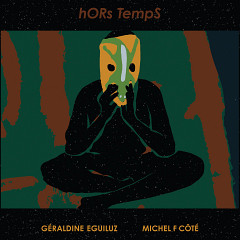
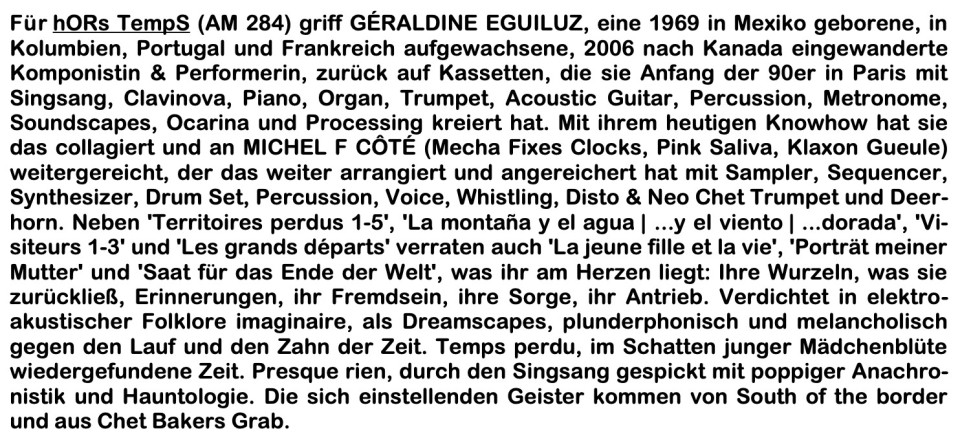
  • hORs TempS dans Bad Alchemy

    «Kritik», Rigobert Dittmann, Bad Alchemy, 1 décembre 2025
    mardi 11 août 2026 Presse
    … révèlent également ce qui lui tient à cœur: ses racines, ce qu’elle a laissé derrière elle, ses souvenirs, son sentiment d’étrangeté, ses inquiétudes, sa motivation. Condensés en un folklore imaginaire électroacoustique, sous forme de paysages oniriques, plunderphonique et mélancolique, à contre-courant du temps qui passe.

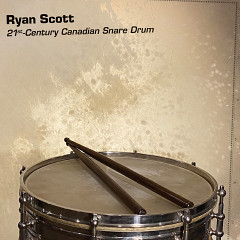
    21st-Century Canadian Snare Drum dans The Arts Desk

    «Review», Graham Rickson, The Arts Desk, 1 août 2026
    mardi 11 août 2026 Presse

    My one gripe with this interesting double album is the lack of sleeve notes; there’s a track listing and a brief overview but nothing else. I did find a useful interview with percussionist Ryan Scott on Canada’s Ludwig Van Toronto website, Scott explaining that he chose to use the snare drum “because it’s really the mother instrument of percussionists” — if you can master the snare drum, it’s likely that you’ll be able to master other percussion instruments. 14 contemporary composers were commissioned to write new works, Scott setting them no limits. There’s an enjoyably eclectic mixture here, various pieces adding extra instruments or electro-acoustic enhancements. Frequently you can’t quite believe what you’re hearing, especially when listening through headphones. Sections in Bekah SimmsSkinscape IV are like being caught in a blizzard, while the opening of Vincent Ho’s Snap Noir could be mistaken for lowing cattle.

    Scott’s own breath and voice become increasingly prominent in Emilie Cecilie LeBel’s heirloom and we hear him singing and whistling in The Far Night.fm by Nichole Lizée. A prominent electronic drone in Christina Volpini’s only ghosts threatens to steal Scott’s thunder, the two voices eventually finding equilibrium, and a resonant bass drum rings out, bell-like like in Sepals by Amy Brandon. Scott’s playing is superb throughout, his concentration and sense of intent palpable. Riveting stuff, then, and stunningly engineered — if you fancy stepping out of your comfort zone this weekend, try this.

    Le jeu de Scott est superbe du début à la fin; sa concentration et sa détermination sont palpables. Un spectacle captivant, donc, et d’une réalisation époustouflante…

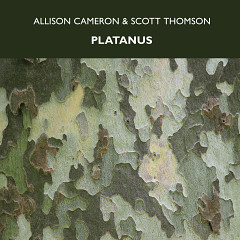
    Platanus dans All About Jazz

    «Review», Glenn Astarita, All About Jazz, 6 juillet 2026
    vendredi 7 août 2026 Presse

    Toronto composer, performer, and improviser Allison Cameron has carved out a distinctive niche in Canadian new music since the mid-1980s, her work marked by an instrumental kaleidoscope and gentle waywardness that tends to elude quick summary. Born in Edmonton and trained at the University of Victoria and York University, she settled in Toronto in 1989, eventually earning a Bang on a Can All-Stars commission that brought her piece November to Lincoln Center in 1994. Montréal trombonist Scott Thomson needs little introduction in these circles: co-founder of AIMToronto, former head of the Guelph Jazz Festival, current Artistic Director of FIMAV, and a player whose allegiance to open improvisation runs bone-deep. The two first crossed paths in 2007 in a trio with the late Toronto polymath Nobuo Kubota. It took the better part of two decades for a proper duo record to materialize. Better late than never.

    The instrument at the center of Platanus is not the trombone. It is a plywood-cased, homemade crackle synthesizer that once belonged to Kubota and eventually made its way to Cameron. When Thomson heard her playing it in 2022, he promptly dubbed it the “Cadillac Cracklebox” — a name that does most of the descriptive work on its own. The album is dedicated to Kubota’s memory, and something of his restless, mischievous spirit seems to have followed the instrument into the studio.

    Three extended pieces work through Platanus with deliberate arboreal logic, moving from grounded rumble to more exposed terrain. Thomson coaxes breaths, squeaks, and near-melodic smears from his horn with the patience of a player who treats silence as a viable option. Cameron’s arsenal — Cracklebox, additional keyboards, and scattered tapes—answers with clicks, white noise, timbral eruptions and Thomson’s multiphonics that arrive on their own schedule. What sets Cameron and Thomson apart from the broader electroacoustic free improvisation pile is the quality of listening between them—genuinely responsive, at times conversational, elsewhere resembling a quiet disagreement between people who respect each other too much to raise their voices.

    Platanus is prickly, patient, and not for the faint of ear—which is precisely what recommends it. Cameron and Thomson have waited nearly twenty years to make this record, and the restraint that shaped that timeline shows up in the music itself. Nothing here is rushed, nothing overstated. It is a small ensemble by any measure, but the sonic world these two construct is anything but.

    Ce qui distingue Cameron et Thomson de la masse des artistes pratiquant l’improvisation libre électroacoustique, c’est la qualité de leur écoute mutuelle: véritablement réactive, tantôt conversationnelle, tantôt s’apparentant à un désaccord discret entre deux personnes qui se respectent trop pour élever la voix. Platanus est un album épineux, patient, qui n’est pas destiné aux oreilles sensibles — et c’est précisément ce qui fait son intérêt.

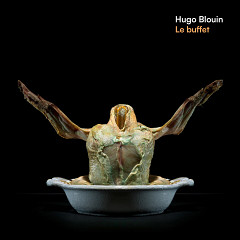
    Le buffet dans Take Effect

    «Review», Tom Haugen, Take Effect, 4 juillet 2026
    vendredi 7 août 2026 Presse

    This 4th album has the multi-instrumentalist Hugo Blouin brings along some friends for the songs that surrounds his friend’s favourite recipes and childhood memories, which makes for a buffet of sounds and ideas.

    The lively mood of Soupe pragmatique starts with Aurélien Tomasi’s bright sax that suits Eugénie Jobin Tremblay’s animated voice which guides the energy, and La patate au sucre follows with John Hollenbeck’s colorful drumming in both busy and calm moments.

    In the middle spot, Un art du temps benefits from Marianne Trudel’s expressive keys amid the unpredictable textures, while La sauce allows for Blouin’s clever bass to complement the pretty vocals.

    Arriving near the end, Du jazz sérieux enlists Émilie Fortin’s well timed trumpet that helps make this the album’s best via the creative jazz climate, and Un camion pizza exits with Marion Rampal’s elegant voice and clarinette basse’s soothing clarinet helping cultivate a mature and cozy finish.

    An eclectic effort that pulls from soul, jazz and avant-garde nods, Blouin’s vision is humorous, intimate, rich and memorable from beginning to end.

    Une œuvre éclectique qui puise dans la soul, le jazz et l’avant-garde. La vision de Blouin est pleine d’humour, intime, riche et mémorable du début à la fin.
    8/10

    hORs TempS dans Take Effect

    «Review», Tom Haugen, Take Effect, 3 juillet 2026
    vendredi 7 août 2026 Presse

    These pieces by Géraldine Eguiluz originally resided on cassettes in Paris in the early ‘90s, and after being presented to Michel F Côté they were restored and reworked into these expressive 16 tracks.

    Territoires perdus #1 opens with raw vocals and plenty of percussive sounds that carries a tribal spirit, and La montaná el agua follows with hazy synth and a slow groove that emits a haze of warmth.

    Further along, La jeune fille et la vie pairs dissonant ideas with unpredictable keys and wordless vocals, while Despedida throbs a bit amid the melodic keys and ethereal vocals alongside much intimacy.

    Close to the end, La montana dorada uses distinct vocal inflections and plenty of background noisesmakers, and Territoires perdus #5 exits with a mesmerizing quality that blends brass into the adventurous finish.

    The duo handle so many instruments here it’s dizzying, where the 4 larger pieces surround farewells, migrations, spirits, loss, finitude, and even joy, and it comes from a very artistic, spiritual and acoustic and electronic angle that’s fascinating.

    Le duo joue ici un nombre impressionnant d’instruments, au point d’en donner le vertige. Les quatre morceaux les plus aboutis abordent les thèmes des adieux, des migrations, des esprits, de la perte, de la finitude et même de la joie, le tout sous un angle à la fois artistique, spirituel, acoustique et électronique qui s’avère fascinant.
    9/10

    Le sourire dans Paris-Move

    «Review», Frankie Pfeiffer, Paris-Move, 3 juillet 2026
    vendredi 7 août 2026 Presse

    Paying tribute to a musical giant is never an easy undertaking. Paying tribute to Steve Lacy is an even greater challenge. Lacy’s unique artistic universe at the crossroads of jazz, literature, poetry, free improvisation, and contemporary composition, remains one of the most compelling in modern music. To approach it requires not only technical mastery but also imagination, courage, and an understanding that the greatest homage is never imitation. With Le sourire, Jean Derome & Somebody Special achieve precisely that.

    Far more than a simple tribute album, Le sourire is an act of artistic dialogue across generations. It is Jean Derome’s second recording devoted to Steve Lacy, following the remarkable Somebody Special (2019), from which the ensemble itself takes its name.

    Rather than revisiting Lacy’s music from a nostalgic perspective, Derome and his musicians embrace its restless curiosity, its literary intelligence, and its permanent search for new forms of expression.

    The result is an album that perfectly embodies everything that has made Jean Derome one of Canada’s most fascinating musical figures for over four decades.

    As co-founder of the legendary Ambiances Magnétiques label, Derome has continuously refused stylistic limitations. Composer, saxophonist, flautist, improviser, filmmaker’s collaborator, theatre composer, explorer of both tonal and atonal worlds, his career is remarkable for its diversity and unwavering artistic integrity. With nearly one hundred recordings (!!) and an equally impressive catalogue of music written for film, theatre, and dance, he has established himself as one of Canada’s most original creative voices.

    His numerous distinctions, including six Opus Awards, among them Album of the Year for Musiques de chambres and Résistances, only confirm what attentive listeners have known for years: Jean Derome is one of those rare musicians who continually reinvents himself while remaining instantly recognizable. And that personality is immediately evident throughout Le sourire.

    The album explores one of Steve Lacy’s most fascinating achievements: his extraordinary catalogue of songs based on texts by some of the twentieth century’s greatest poets and writers.

    Rather than choosing familiar jazz standards, Lacy sought inspiration from voices as diverse as Anna Akhmatova, Samuel Beckett, Robert Creeley, Bob Kaufman, and Judith Malina, transforming their words into musical landscapes of remarkable originality.

    Jean Derome & Somebody Special approach this repertoire with profound respect but never with reverence in the limiting sense of the word. Their interpretations remain faithful to Lacy’s spirit while allowing their own collective personality to shine brilliantly.

    Indeed, one of the album’s greatest qualities is its remarkable balance between precision and freedom.

    The music is unmistakably jazz, yet it constantly stretches beyond conventional expectations. Angular melodies, surprising harmonic turns, subtle rhythmic displacements, and moments of exhilarating improvisation coexist naturally. There are echoes of Thelonious Monk, whose influence on Lacy remains unmistakable, but there is equally the unmistakable voice of Jean Derome, playful, adventurous, slightly mischievous, always inventive.

    Throughout the album, swing never disappears, even during the most harmonically adventurous passages. This ability to remain engaging while embracing complexity is one of the defining characteristics of Derome’s music.

    The opening Jack’s Blues, based on a poem by Robert Creeley, immediately establishes the ensemble’s approach. The Smile, from Anna Akhmatova’s poetry, perfectly justifies the album’s title. Delicate yet emotionally rich, it unfolds with quiet elegance, allowing the expressive power of both text and music to emerge naturally. Its companion piece, The Cuckoo, explores contrasting moods with remarkable sensitivity.

    The remarkable Beckett trilogy, Sands 1: Stand, Sands 2: Jump, and Sands 3: Fall, forms one of the album’s intellectual and musical centres. Beckett’s minimalist, enigmatic language finds an ideal musical counterpart in Derome’s refined arrangements. The three movements gradually evolve through subtle transformations, illustrating how jazz improvisation and literary modernism can nourish one another in fascinating ways.

    The two settings of Judith Malina’s poetry, Love and Politics and I Heard the Indian Sage, deepen the album’s philosophical dimension. Malina’s texts seem particularly well suited to Steve Lacy’s musical imagination, and Jean Derome captures their emotional complexity beautifully.

    Judith Malina’s I Heard the Indian Sage, dedicated to Allen Ginsberg, carries far more than a literary tribute. Its meditation on impermanence, spiritual awakening, death (“There is death / because we are nothing”), love (“There is love / because we are crazy / And want to be happy / forever”), and the illusion of certainty echoes the ideals that shaped both Ginsberg and the entire Beat Generation, including Jack Kerouac: a relentless quest for truth beyond social conventions, an openness to Eastern philosophies, and a profound belief in artistic and personal freedom. Steve Lacy was naturally drawn to this poetic universe, and Jean Derome & Somebody Special capture its essence with remarkable sensitivity. Throughout Le sourire, one senses that same Beat spirit, a music that values spontaneity, risk, introspection, and the constant crossing of artistic boundaries. Like the writings of Ginsberg and Kerouac, the album invites us not simply to listen, but to embark on an inner journey where poetry, improvisation, and freedom become inseparable.

    Steve Lacy wasn’t just a brilliant saxophonist, he was someone who immersed himself in literature. Choosing poets like Beckett, Creeley, Kaufman, Akhmatova, and Malina wasn’t accidental; it reflects his conviction that poetry and jazz share a common language of rhythm, silence, surprise, and freedom.

    The album concludes with Heaven, another Robert Creeley setting, offering a beautifully understated ending. Rather than seeking dramatic closure, the music gently dissolves into contemplation, leaving the listener with the impression that this conversation with Steve Lacy continues beyond the final note.

    Throughout all eleven pieces, the musicians display extraordinary collective sensitivity. Nobody attempts to dominate the ensemble. Every voice contributes to a larger musical conversation in which composition, improvisation, poetry, and silence possess equal importance. Listening becomes an act of discovery, each return revealing new relationships between text and melody, between harmony and rhythm, between written material and spontaneous invention.

    One of the album’s greatest accomplishments lies precisely here: Le sourire never feels like an academic reconstruction of Steve Lacy’s music. Instead, it becomes a living continuation of his artistic philosophy. Like Lacy himself, Derome refuses to separate literature from music, intellect from emotion, structure from freedom.

    This is contemporary jazz in its finest sense: music that dares to venture beyond established paths without ever abandoning the essential communicative power of jazz itself.

    The recording also serves as a reminder of the extraordinary artistic importance of Ambiances Magnétiques, a label that has consistently championed adventurous music while maintaining uncompromising artistic standards. Le sourire fits perfectly within that tradition of creative freedom and intellectual curiosity.

    Ultimately, this album is not simply about Steve Lacy. It is about artistic transmission. It is about how great music continues to inspire new generations without becoming frozen in time. Jean Derome & Somebody Special understand that the finest tribute one can pay to an innovator is to continue innovating.

    With Le sourire, they have created a recording that is intelligent, moving, playful, provocative, and profoundly musical. It celebrates Steve Lacy while remaining unmistakably Jean Derome. Few tribute albums achieve such a delicate balance.

    Like the smile evoked by its title, this magnificent recording reveals itself gradually, subtle, enigmatic, generous, and quietly unforgettable.

    A superb tribute to one of jazz’s most singular visionaries, interpreted by one of Canada’s own great musical explorers.
    Plutôt que de revisiter la musique de Lacy sous l’angle de la nostalgie, Derome et ses musiciens s’imprègnent de sa curiosité insatiable, de son intelligence littéraire et de sa quête permanente de nouvelles formes d’expression. Le résultat est un album qui incarne à la perfection tout ce qui a fait de Jean Derome l’une des figures musicales les plus fascinantes du Canada depuis plus de quatre décennies.
  • 1
  • 2
  • 3
  • 4
  • 5
  • 6
  • 7
  • 8
  • 9