Over the past four decades, Jean Derome’s musical interests have spanned everything from standards to skronk. He has composed graphic scores for large ensembles, created multimedia works for string quartets, and devised music for dance, theatre, and cinema works. But what Derome is best known for is his key role in the development of the unique movement in Quebec avant-garde music known as musique actuelle, a phantasmagorical mixture of rock, jazz, folk, and contemporary music. Its fast-cut breakpoints have structural similarities to film scores and electroacoustic works, but musique actuelle is largely improvised in the moment on acoustic instruments.
“When you improvise, first you have to interest yourself, otherwise you will be playing on automatic pilot. If you stop listening like it is the first time, you lose something,” says Derome, sitting at the kitchen table of his home in Montreal’s Plateau neighbourhood one afternoon in late 2014. “Then you have to interest the other players, to create something that will demand some response from them. It is a game in which you are trying to create something unpredictable. If you are totally new at every moment, you will lose the audience and the other players. So you need some continuity and then a break. It is almost a spiritual experience to share a moment of sound in a room. I feel the spiritual presence of the audience when I play, and this is very important. So the three levels are yourself, the other players, and the audience.”
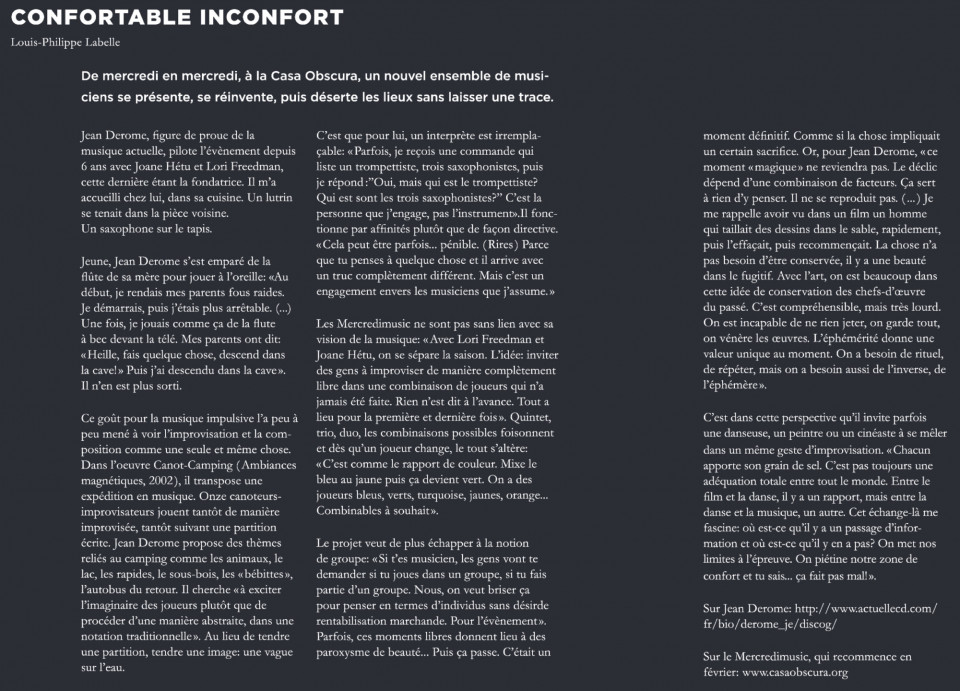
Throughout his diverse range of musical activity, Derome’s musical voice—with its pleasing yet modern melodic quality—is instantly recognizable. His engaging music-imitates-life sensibility often manifests itself subtly in performance, as he plays flute or saxophone with eyes closed, swaying in bare feet. It also permeates entire projects. In his large-scale composition Canot-camping the listener is transported through forests and lakes on a canoe trip by the use of explicit and implicit sonic and visual references. In a work composed for Joker, the a cappella choir founded and directed by Derome’s musical and life partner Joane Hétu, Derome and fellow choristers embark on a nocturnal journey through dreamland, conjuring fantasies and nightmares. In another project with Hétu and the Bozzini String Quartet, Le mensonge et l’identité, the musicians wander about the hall knocking over music stands while relating anecdotes about their lives.
This affirmation of life felt in so much of Derome’s work is shared by longtime collaborators such as drummer Pierre Tanguay, bassist Pierre Cartier, and bassist Normand Guilbault. Guitarist Rainer Wiens recalls his first impression of Derome, whom he met in the early 1980s at a show at the Art Gallery of Ontario, “Jean’s great gift in music is transmitting the joy a child has. Many older musicians become jaded and lose this, but Jean never did. At the AGO, Jean set up several stations, each with a different instrument, and he walked around from station to station playing solo at each one. Jean was not afraid to play beautifully, unlike some other improvisers.”
In June 2013, the Conseil des arts et des lettres du Québec (CALQ) paid homage to Derome with a lifetime achievement award, a multiyear grant (bourse de carrière) that he is using to support various projects, including an extensive tour through Quebec that will start at the Festival International de Musique Actuelle de Victoriaville (FIMAV) in May 2015. So, while his musicmaking remains — as always — in the moment, Derome himself is in more of a reflective mood these days, and happy to talk about the turning points along his singular creative path. I ask what inspired him to move from his conservative flute training to jazz.
“My early meetings with Pierre St-Jak were influential, also Robert Leriche, Robert Marcel Lepage and Yves Bouliane,” he begins. “All these players were a bit older than me and already active in jazz and avant-garde music, and had knowledge of improvised music. My father was a TV producer, so I had access to the CBC music library, and he brought a lot of records home. While at the conservatory I was like Jekyll and Hyde. Playing anything outside the curriculum was strongly discouraged, but I was very active at that time playing about one hundred concerts a year, learning both inside and outside the conservatory. We did lots of noon concerts in CEGEPs and high schools, then rushed back to the conservatory to play Prokofiev, with the improvised noon-hour music still in my head. My first group was Octogaf in 1971, which gradually became Nébu, originally lead by St-Jak. We started as a septet, narrowing down to a trio that released two records. Nébu played at L’Amorce, which was the club of the Quatuor de jazz libre du Québec.”
Derome added saxophone to his musical arsenal early on, in order to solve some specific problems of perception and audibility. “In my early career I was established as a jazz flute player, but I was hoping to be seen as a composer too, as the path of a jazz flautist seemed too narrow. I was listening to sax-players more than flute players, so it was a natural choice to play sax. I started with the help of a few sax-playing friends. Musicians like Yves Charuest provided great advice at the beginning. With the sax, nobody will say ‘Wow! A flute player’ anymore. They will listen to the music the player is playing, rather than what instrument the player is playing.
“Choosing a more common instrument also ended my crusade to show what the flute can do in all contexts. Another reason was that it was the 1980s and bands were playing very loud, drummers were very loud. As a flautist, I was spending whole evenings scratching my nose on the mike, and even yelling into the mike rather than playing flute, since the instrument could not manage to get what I needed. The sax was louder.”
These early experiences laid the groundwork for Derome’s role in the development of musique actuelle. “Being Québécois jazz musicians, we did not have high hopes of fitting anywhere within the jazz tradition per se, so we were less constrained [about trying] new things, and [about finding] a basis for improvisation other than jazz. Robert Marcel Lepage already had game pieces that you could play without any reference to jazz. Another source of inspiration was Québécois folklore. And yet another factor was that we wanted to play with musicians that were not part of traditional jazz or even traditional avant-garde jazz scenes. In this context, a lot of things you might share with other players had no value. It was like quoting Shakespeare to someone who doesn’t know his work. So you needed to find a common denominator among musicians from very different backgrounds—it was the culture of each musician, what they had heard in their lives, that they brought to the pot.”
Derome and other musicians involved with musique actuelle were also experimenting with studio overdubs, particularly in film music. “From there we started to realize that you could create strata of sound that start with one specific sound, and then superimpose different styles of music—foregrounds or backgrounds. In a film you can have background music, but at the same time someone in the film is listening to a radio: these two sounds cohabit. Of course, a lot of these ideas also came from John Cage, who did collage work. We accepted all these sources easily and went bravely into them, and out of that came musique actuelle.”
Passiflora, a 1986 abstract impressionist film directed by Fernand Bélanger and Dagmar Teufel, was the first Dolby stereo film made in Canada. Derome, René Lussier, and André Duchesne contributed score music, and all three explored the possibilities and limitations of what could be done with sound in film. I ask Derome why the wider public seems to embrace new ideas in visual art more than it does analogous ideas in sound art. “The brain does not like to fool around as much with sounds as it will allow with visual art, so the ear is slower to progress than the eye,” he replies. “We are more fearful with our ears, the sense of balance is in the ear, and your ears tell you what is in back of you where you cannot see.
“If you are walking in the woods, you have your ears open as a survival instinct,” he continues. “In one scene in Passiflora there is a screen with two gigantic faces facing each other, twenty feet high, and they are talking. If you pan the dialogue so that they follow the place where the mouths are, there will be twenty-five feet between the two mouths. The brain accepts the visual setting, but the ear does not accept the same change in scale that the eye accepts. So you have to be more conservative with the sound than with the image. In early movies, you did not see large faces talking to you, it was more like theatre, no extreme close-ups. The eye adapted more quickly than the ear to these close-ups. The ear is more sensitive and less supple, more touchy.
“My whole life has been one of action to try to tame the ear and to make the ear of the listener accept all the things that are already integrated into visual art.”
Throughout his career, Derome has been jumping from one genre to another, and from one medium to another. His unique career trajectory illustrates a way forward for many of today’s young musicians. “It was not a conscious decision, but in retrospect I am happy I did so. There is not a big market in Montreal or Canada for any one thing you can do in creative music. For example, if you are just composing film music, you can saturate the market quickly. Or if you play only the music of Thelonius Monk, you can play four places and that will be it for the year. Just by the chance of life, I found a way to continue each project, but never pushed more on one than the other, I just followed whatever was possible at each moment. The way music is structured in society, some go only to classical music, or only ancient music, others like jazz, some that like jazz do not like free jazz. There are so many little niches but I am trying to enter into the worlds of all these little families and do some cross-pollination. It is all integrated.”
The result of this activity is a thriving Montreal scene that has blossomed from seeds sewn more than thirty years ago. “There were few players doing this when I started, but they were very dynamic,” says Derome, who founded EMIM (Ensemble de musique improvisée de Montréal) with like-minded fellow musicians in the late 1970s. “There were many places to play in Montreal. Many of them disappeared over time when prerecorded music started to invade cafés and bars, and we lost a few places of great importance. The audience was getting older too, which concerned me.”
Fortunately, a new wave of musicians has moved to Montreal over the past few years, inspired in part by the welcoming presence of Derome and others associated with Ambiances Magnétiques, the label Derome cofounded in 1984 with Hétu and seven other producers. Derome is grateful for this turn of events. “What I see now is a fantastic change, with younger musicians rediscovering this kind of music. The emergence of people around the Souni per il Popolo, and the loft places like L’Envers and Casa Obscura, Café Resonance and La Passe are a great help,” he says. “This brings closer meetings between Anglo and Franco musicians in Montreal, which is positive. A lot of musicians have come here to play with me and others from the scene, which is a bit of a responsibility, but definitely Montreal has become a magnet for creative music in general.”
Several of Derome’s younger collaborators I spoke with were full of praise for his work ethic and professionalism, and appreciative of his role as a trailblazer. Ellwood Epps, a trumpet player and concert promoter who runs L’Envers, has frequently played with Derome in settings ranging from Monk tunes to impromptu groupings with touring musicians such as bassist Henry Grimes. “When Jean started there was not much history of improvised music in Quebec or even in Canada,” comments Epps. “He was important in getting Canada Council for the Arts recognition for improvised music, which benefitted musicians who came up after him. Despite exploring many different areas, Jean is not just following trends or choosing a flavour of the month; he has had the same interests for forty years. He might be a chameleon, but he has remained the same chameleon all this time.”
Composer and bassist Nicolas Caloia directs Montreal’s avant big-band ensemble the Ratchet Orchestra, which includes Epps and Derome in its ranks. “Derome is important largely because he leads by example. He is committed to the art regardless of circumstances, and he makes you want to keep playing this difficult music. For example, at the end of the show he will wrap wires and put chairs away, and he is always available for rehearsal, even for nonpaying gigs.”
“He helped carry my drums out to the car after a show one evening,” recalls composer and percussionist Thom Gossage, “which is pretty rare. Then he said ‘We like to keep our drummers happy.’ I was pretty impressed.”
Derome’s wry sense of humour in the context of the more mundane facets of a working musician’s life is also appreciated by trombonist Scott Thomson, another recent Montreal arrival, who is the former artistic director of Toronto’s Somewhere There performance space and codirector of AIMToronto Orchestra. “Jean says that he prizes his lack of success, since successful musicians are obliged to play the same music night after night,” Thomson remarks. “I recall a moment during a pop music recording session when Jean and I were playing forgettable music, backing a singer I’d never heard of. Jean leaned over between takes to say ‘Remember how you feel right now. Some pop-music journalist will call you in a decade to ask you about it.’ It was a moment of profound delight in the face of the absurdity of the pop-music star system.”
Derome’s bourse de carrière prize from CALQ coincides with his sixtieth birthday in June 2015, and allows him to fulfill a few dreams that have long been percolating. The Quebec concert tour starting at FIMAV 2015 includes the Festival des Musiques de Création in Jonquière, the OFF Fest in Montreal, the Montreal Jazz Festival, the Quebec Jazz Festival, Suoni per il Popolo, and concerts and workshops in Rimouski, which has a vibrant improvised music scene led by Éric Normand. “Other ensembles will play my music during their seasons,” adds Derome, mentioning new pieces for Transmission and the Quasar Saxophone Quartet that will premier in 2015. Another portion of the grant will support archival work. “Many pieces for tape will be transferred to digital media before the tapes disappear, along with digitizing photos and old newspaper clippings,” says Derome. “Many compositions were done quickly and only played once, so there is much lying about that needs to be archived. The grant will allow me to properly structure and preserve all of this material.”
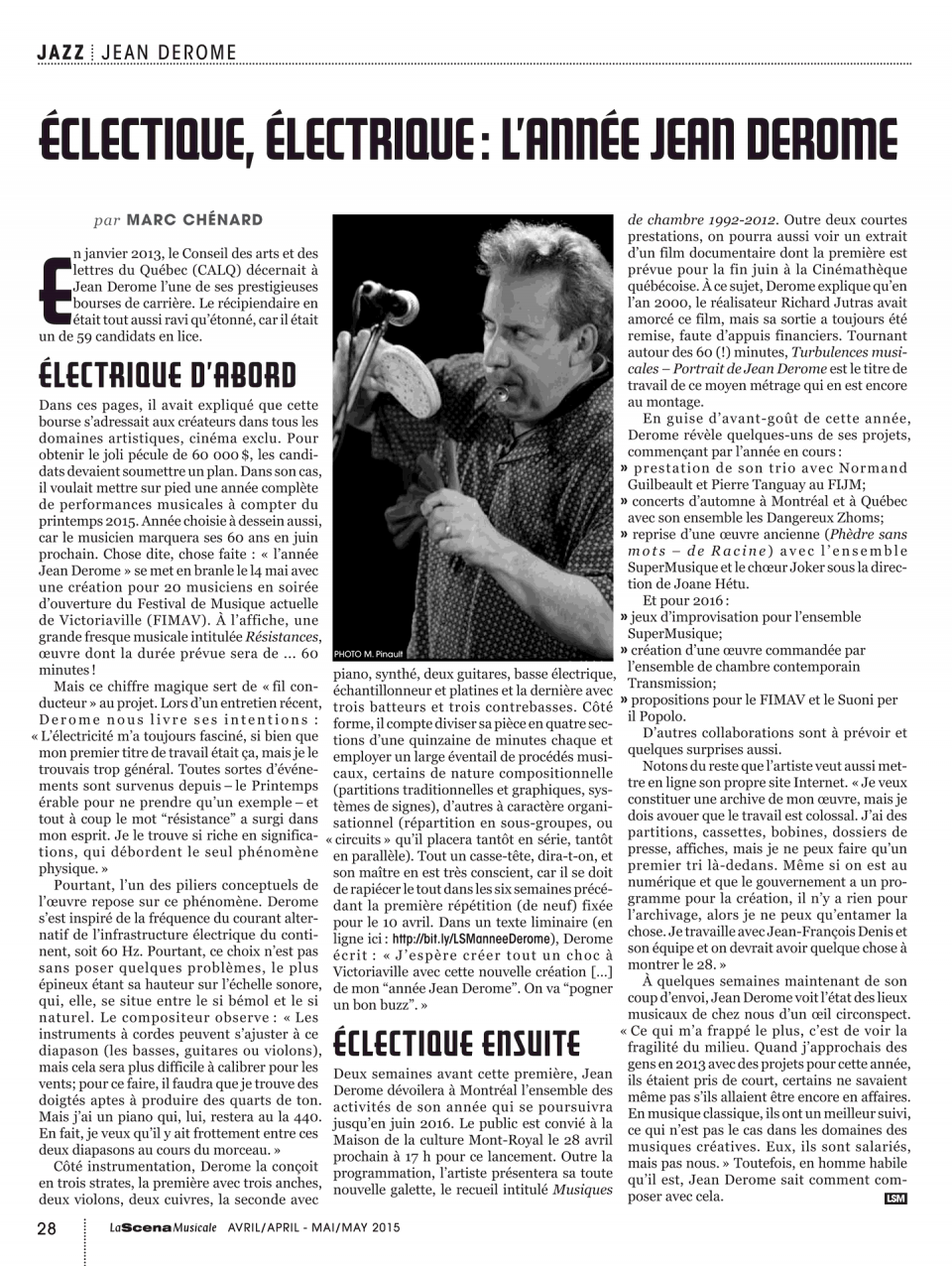
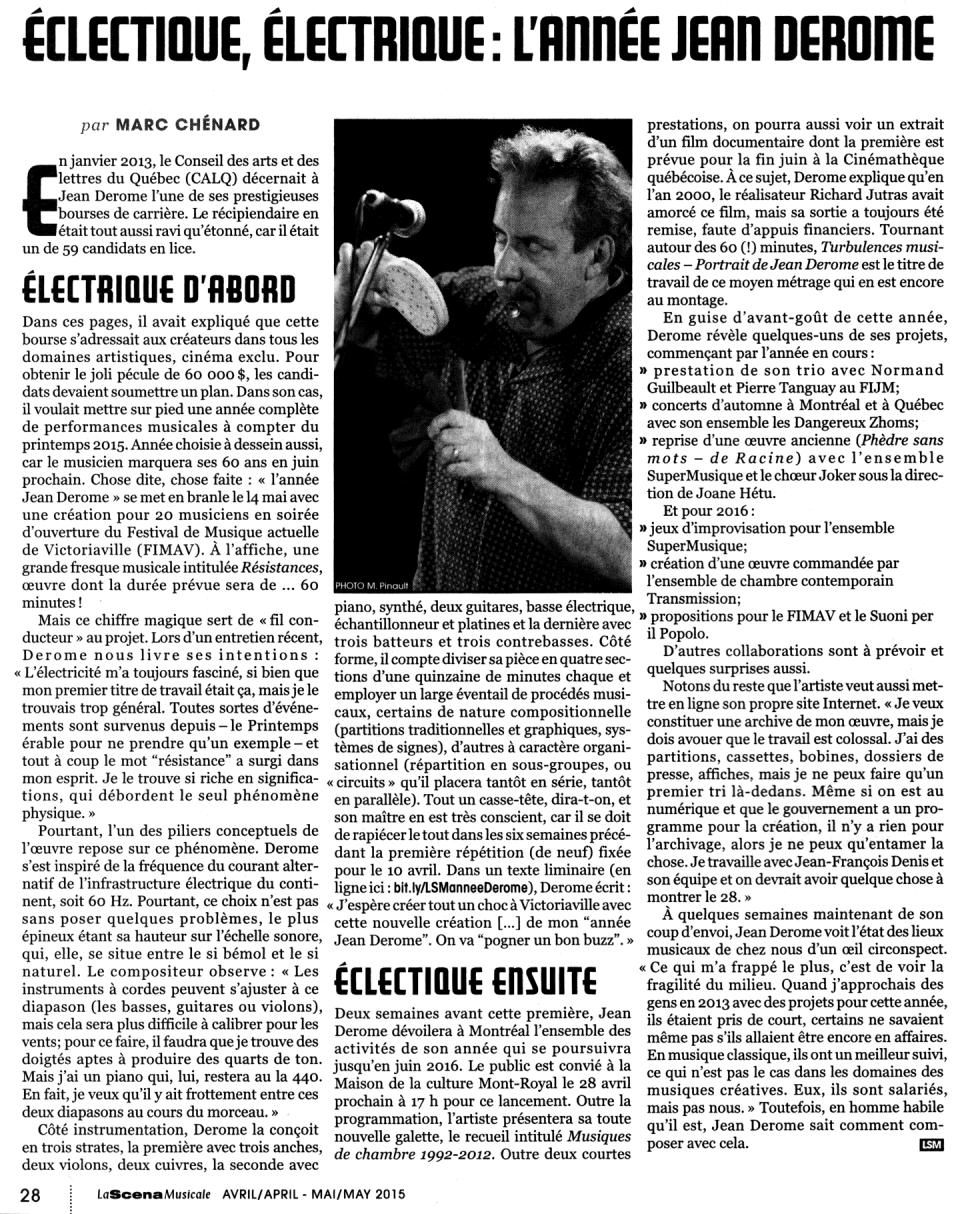
The range of works will match the range of locales in which they will be performed, and the list of collaborators is a who’s who of the Quebec scene he’s been at the centre of all these years. The 2015 edition of FIMAV will open with a new Derome composition for twenty musicians. Based on electricity and titled Résistances, the piece has reawakened his delight in playing electronic instruments, a practice he had put aside in recent years. “My pleasure now is to learn about electricity, so I am studying a lot of physics,” he explains. “Just like I did with Canot-camping, I am trying to find concepts within the subject that trigger ideas for composing. There will be written parts as well as signs for improvisation. Some ideas will be played on synthesizers, but it is not a piece only for electronic instruments. Some wind players have started to sound like synthesizers—for example, John Butcher, Axel Dörner, and Xavier Charles. The textural exchange between different instruments is fascinating.”
There will also be a new recording of Derome compositions largely performed by others, written over many years but finally collected onto a single CD. The works include a clarinet solo by Lori Freedman, a piece for eight flutes, a saxophone quartet, and chamber ensembles, including Cinq études pour Figures, an older work originally written for quintet of musicians from SMCQ and NEM. A third recording from his Thelonious Monk tribute project Évidence, Monk Work, was released in late 2014.
Derome will undoubtedly be busy at the start of his seventh decade, but it is a safe bet that he will welcome the activity. “I believe that the joy in life is the reason to make art, with some sad things too. I once wrote that I am not interested in what is new, I am interested in what is alive. I am looking for the sparkle in life, contact between players and between the music and audience. Everyone feels together in the moment where the music is happening. It is a fight to keep this flame, and I do not think I have lost it yet. I hope to keep it as long as I go.”