Sauter au contenu principal
actuellecd

Éliane Radigue: Occam Delta XV

Quatuor Bozzini / Éliane Radigue

Les perforations infinitésimales qui se propageaient à la surface sphérique du son, telles des escargots mélancoliques, ont fait irruption dans mon esprit et ont appuyé sur le bouton de réinitialisation. L’apparence opaque de l’immobilité ne trahissait guère les merveilles qui se déroulaient en dessous. C’était comme voir un feu d’artifice pour la première fois, réduit à la taille de ma paume et résonnant deux fois plus fort. Un couteau gracieusement offert s’est glissé entre les neurones de mon cortex auditif; les cordes bourdonnantes frémissaient, les harmoniques semblaient devenir plus stridentes. POW, ÉU

Le résultat est comme une eau qui coule, apparemment statique et pourtant toujours changeante, les riches timbres du quatuor à cordes générant des harmoniques aussi sensuelles que celles de n’importe quel synthétiseur. A Closer Listen, Royaume-Uni

J’ai été très honorée de recevoir cette demande du Quatuor Bozzini, dont je connaissais déjà l’immense talent. La première rencontre a été très chaleureuse, amicale et familière, comme une réunion de vieux amis après une longue séparation. —Éliane Radigue

Ainsi débuta la collaboration entre le Quatuor Bozzini et Éliane Radigue. Dans l’atmosphère chaleureuse de son appartement, la compositrice exposa les subtilités de son art. Toute sa carrière, Radigue s’est consacrée à la construction d’une œuvre dans laquelle, à partir de sons tenus, des microbattements entre les fréquences émergent. Occam Delta XV (2018) fut transmis à QB (dédicataire de l’œuvre) par voie de composition orale qui, compte tenu de l’expérience de Radigue avec les instruments électroniques, était le moyen le plus naturel de communiquer.

Pour QB, jouer Occam Delta XV s’apparente à ce qu’on peut ressentir lorsqu’on saute pour la première fois dans un lac; toujours en mouvement, et pourtant toujours un peu la même, la musique de Radigue prend des allures aquatiques. Comme en témoignent ces deux enregistrements d’Occam Delta XV, chaque prestation de l’œuvre offre une expérience musicale différente. «C’est impossible de recréer l’exécution, qui est tellement liée au temps et au lieu» dit Alissa Cheung, «mais nous avons joué la pièce de nombreuses fois, et revenons au même état d’esprit.» C’est donc cet état mental que QB affine au fil du temps; en plus de la bravoure technique requise pour maintenir les notes soutenues, Occam Delta XV exige de QB un mode d’écoute très élevé, «entre la méditation et l’hyper conscience».

La rencontre entre QB et Radigue met en évidence l’état de totale disponibilité qu’exige la musique de Radigue. Et pourtant, comme on peut en faire l’expérience en écoutant cet album, cette conscience aiguë se transfère à tous les auditeurs de sa musique: le son de Radigue bouleverse les attentes concernant la performance, l’écoute et la création musicale.

CD (CQB 2331, 2023)

  • Étiquette: Collection QB
  • CQB 2331
  • 2023
  • UCC 771028373123
  • Durée totale: 74:15
  • Boîtier sympathique
  • 126 mm × 126 mm × 5 mm
  • 35 g

Sur le web

Téléchargement (CQB 2331_NUM, 2023)

  • Étiquette: Collection QB
  • CQB 2331_NUM
  • 2023
  • UCC 771028373185
  • Durée totale: 74:15
Vidéos
  • Bande-annonce: Éliane Radigue: Occam Delta XV; Quatuor Bozzini; vidéo: Gilles Paté; janvier 2023; 4:44
Quelques articles recommandés
La presse en parle

Review

Aly Eleanor, POW, 29 juin 2026
Les perforations infinitésimales qui se propageaient à la surface sphérique du son, telles des escargots mélancoliques, ont fait irruption dans mon esprit et ont appuyé sur le bouton de réinitialisation. L’apparence opaque de l’immobilité ne trahissait guère les merveilles qui se déroulaient en dessous. C’était comme voir un feu d’artifice pour la première fois, réduit à la taille de ma paume et résonnant deux fois plus fort. Un couteau gracieusement offert s’est glissé entre les neurones de mon cortex auditif; les cordes bourdonnantes frémissaient, les harmoniques semblaient devenir plus stridentes.

Review

Joseph Sannicandro, A Closer Listen, 20 décembre 2023

In the first decade of the new millennium, just as she was finally receiving attention for her groundbreaking electronic works, Éliane Radigue surprisingly turned to composing for acoustic instruments. These “Occams” are compositions based on the particular resonances of a given instrument, each score growing out of the relationship between performers and their instrument: Rivers (for solo performer), Deltas (for small ensemble), and Oceans (for large ensemble). Occam Delta XV was written for Montréal string quartet Quatuor Bozzini, who have made a name for themselves as the finest interpreters of 20th century and contemporary new and experimental music. The result is like flowing water, seemingly static and yet always changing, the rich timbres of the string quartet generating overtones as sensuous as those of any synthesizer.

Le résultat est comme une eau qui coule, apparemment statique et pourtant toujours changeante, les riches timbres du quatuor à cordes générant des harmoniques aussi sensuelles que celles de n’importe quel synthétiseur.

Review

Caroline Potter, Tempo, 1 septembre 2023

Since 2011, the compositional project of Eliane Radigue (b. 1932) has been a series of pieces titled Occam; at the time of writing there are over 80 such pieces. The title is derived from Occam’s razor, the principle that all else being equal, explanations and choices which are simple are likely also to be the best. The musical material for Occam Delta XV for string quartet is certainly minimal, though the listening experience is anything but.

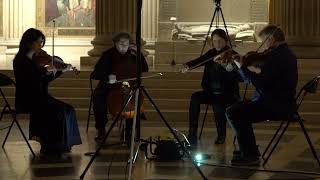
This release from the Montréal-based Quatuor Bozzini, published on their own label, was recorded in the Panthéon in Paris in November 2021. A huge cathedral-like space that looks from the outside like a Greek temple, the neo-classical Panthéon is a national site of homage to great men (and a very few women) of the past. A video released alongside their album, made by Gilles Paté, offers glimpses of the building and of Foucault’s famous pendulum, which is housed inside.1 The CD features two interpretations of the quartet, both just over 35 minutes in duration, with the first being over a minute longer than the second. In the sleeve note, the first violinist, Alissa Cheung, says, ‘You can’t recreate the performance, it’s so much about the time and the place.’ Cheung rightly believes that the quartet demands ‘an extended listening mode, between meditation and hyperconsciousness’.

Like the other pieces in the Occam series, this work is not so much written for a particular medium as for a particular performer or group of performers. Occam Delta XV was developed through a collaborative process with Quatuor Bozzini, who are its dedicatees. Kate Molleson interviewed Radigue for her fascinating book Sound within Sound, and one insight she gleaned was: ‘Every new piece in the Occam series begins with Radigue and a performer sitting down in her apartment and talking about water.’2 In fact, the Occam Ocean works in the series are for ensemble — suggesting a larger body of water — while Occam Delta are for chamber formations, Occam River for a duo, and those simply titled Occam are for a solo instrumentalist. The quartet write in their programme note that Occam Delta XV (2018) ‘is like jumping in a lake when you know the water might be cold. It’s a question of trusting the people you’re playing with.’

The experience of watching the sea, or being immersed in water, is probably the best analogue for a listening experience which is ever changing and yet eternally the same. Occam Delta XV consists of long sustained string lines and a constant four-part texture. This is a completely non-hierarchical work, with all four voices having equal value and making an equally important contribution. Quatuor Bozzini play without vibrato: their sound is at the same time pure and yet not in any way austere. Molleson writes that Radigue’s music is all about ‘perpetual transition’, ‘a recurring process of fade-in, fade-out, cross-fade’, and links this to her musical origins as a composer of musique concrete.3 But the rich circular droning of Occam Delta XV never sounds electronic: the cello usually sounds more like a murmur, and the deep listening the piece prompts means that we are aware of a bow changing direction, of the friction of hair on string, of harmonics and resonances. Occasionally the ear is drawn to one or other of the voices: I found my attention shifting, creating my own path through the music. Is that a violin line ascending, the viola suddenly bringing itself to my attention? Quatuor Bozzini realise an extraordinary feat of concentration and sustained bowing, enabling us as listeners to immerse ourselves completely in the soundworld. The very long fade-out in the last ten minutes or so of the first performance is just one illustration of their astonishing control.

The two performances are of course different from each other: on one occasion I found the second performance rather more fragile and attenuated in the middle of the work than the first one, though I did not feel this was the case on another listen. Either this is an extremely novel type of CD where the performance actually changes each time it is played, or my personal journey through each performance was different each time I listened. Perhaps this is because the music facilitates deep reflection and provides a space for the listener to bring something of themselves to the music? Whatever your own journey through this fascinating recording will be, prepare for an immersive and time-altering experience.

Quatuor Bozzini realise an extraordinary feat of concentration and sustained bowing, enabling us as listeners to immerse ourselves completely in the soundworld. The very long fade-out in the last ten minutes or so of the first performance is just one illustration of their astonishing control.

Kritiek

Ben Taffijn, Nieuwe Noten, 18 juin 2023

Éliane Radigue fait également partie des fondateurs du mouvement musical que l’on nomme souvent minimalisme, bien que tous les compositeurs ne soient pas d’accord avec cette étiquette. Elle a commencé par l’électronique, mais depuis quelques années, elle se consacre presque entièrement à la composition pour instruments acoustiques. Aujourd’hui, nous nous concentrons sur trois pièces récentes, interprétées par les musiciens pour lesquels elles ont été écrites. Le Quatuor Bozzini a publié un enregistrement d’”Occam Delta XV” sur son propre label; l’Ensemble Dedalus a enregistré “Occam Hepta I” et Ryoko Akama joue “Occam XX” au synthétiseur. Ce deuxième album a été publié par Montaigne Noire.

Plus encore que les autres compositeurs que nous comptons dans ce mouvement, Radigue semble s’intéresser à l’essence du son. La musique de La Monte Young s’en rapproche le plus. Il se peut donc que dans ce ’Occam Delta XV’, qui totalise plus d’une heure de musique, nous trouvions remarquablement peu de variations. Radigue se préoccupe davantage de la cohérence du son entre les différents instruments du quatuor à cordes. Parfois, ces sons sont un peu plus éloignés les uns des autres et une stratification apparaît, mais il y a aussi régulièrement un bourdonnement assez régulier. Il s’agit donc d’une musique qui manque de progression, ce qui est d’ailleurs le cas de beaucoup de musique dans ce mouvement, mais Radigue va un peu plus loin que beaucoup d’autres. Cependant, cela ne signifie pas que la musique est statique; il y a beaucoup de choses qui se passent pour ceux qui ont l’oreille. D’ailleurs, le fait que cet album contienne deux enregistrements de l’œuvre, qui, malgré ce manque de variété, sonnent très différemment, en est la preuve.

Traduit du néerlandais.

Texte original

Ook Éliane Radigue behoort tot de grondleggers van de muzikale stroming die we vaak aanduiden met minimalisme, al is lang niet iedere componist het ook met dit etiket eens. Ze begon ooit met elektronica, maar heeft zich al weer enige jaren terug vrijwel volledig toegelegd op het componeren voor akoestische instrumenten. Vandaag aandacht voor drie recente stukken, uitgevoerd door de musici waar het ook voor geschreven is. Quatuor Bozzini bracht een opname uit van ‘Occam Delta XV‘ op hun eigen label; Ensemble Dedalus nam ‘Occam Hepta I’ op en Ryoko Akama speelt ‘Occam XX’ op synthesizer. Dat tweede album verscheen bij Montaigne Noire.

Meer nog dan de andere componisten die we onder deze stroming rekenen lijkt Radigue geïnteresseerd in het wezen van klank. De muziek van La Monte Young komt daar nog het meest bij in de buurt. Zo kan het dus gebeuren dat we in dat ‘Occam Delta XV’, bij elkaar ruim een uur muziek, opvallend weinig variatie aantreffen. Het gaat Radigue eerder om de samenhang van de klank tussen de diverse instrumenten van het strijkkwartet. Soms lopen die klanken wat verder uit elkaar en ontstaat er een gelaagdheid, maar regelmatig is er ook sprake van een vrij gelijkmatige drone. Muziek dus waar geen progressie in zit, dat is sowieso het geval met veel muziek binnen deze stroming, maar Radigue gaat in vergelijking met veel anderen toch nog een paar stappen verder. Dat betekent echter niet dat de muziek statisch is, er gebeurt genoeg voor wie er oor voor heeft. Iets dat overigens ook blijkt uit het feit dat dit album twee opnames van het stuk bevat, die ondanks dat gebrek aan variatie toch wel degelijk verschillend klinken.

Radigue se préoccupe davantage de la cohérence du son entre les différents instruments du quatuor à cordes.

Review

René van Peer, Musicworks, no 145, 1 juin 2023
Occam Delta XV is music as it might appear under an electron microscope — a captivating conglomerate of waves. This is keeping with the way Radigue has approached her art from the beginning: working on the physical properties of sound through imagination.

Review

Simon Cummings, 5:4, 12 mai 2023

You would think, by now, i’d be getting the hang of this piece. Éliane Radigue‘s Occam Delta XV, conceived for the Bozzini Quartet, has crossed my path on a couple of occasions, first at its UK première in Huddersfield in 2018, a performance that i subsequently explored in more depth, and again in January this year at the Dark Music Days in Iceland. i was struck by how different the two accounts of the work had seemed from each other, and that experience has been compounded by a new recording the Bozzini’s have released, featuring two further performances, made on successive days in November 2021.

The first observation to make is that the Huddersfield version, at around 20 minutes’ duration, is nearly half as long as the two recorded performances (37:25 and 36:31 respectively; i didn’t time the Iceland performance but i’m sure it was about the same length). i don’t know the reason for such an extensive change in duration, but considering some of its siblings in Radigue’s output, it may have something to do with optional aspects in terms of how long to remain in one episode before moving on to the next. All the same, an almost doubling in length is surprising.

i used the phrase “unstable stability” to describe the piece before, and as with so much of Radigue’s music, that seems to be an appropriate way to regard its inherent musical behaviour. But of course, the key thing with both of those words is that they constantly undermine each other. What this does not result in is ‘balance’ (i’ve just checked and am relieved to see i’ve never used that word when exploring Radigue’s music); on the contrary, while there’s the semblance of an equilbrium, Occam Delta XV occupies a gentle but permanent tension, like a piece of elastic constantly being gently stretched and released. i don’t hear that as ‘balance’, but as flux, friction, discreet energy, with the abiding sense throughout that, though where we are right now might be somewhere we stay for a while, the music is always looking ahead, ever caught in the midst of a gradual process from infinity to infinity.

From a listening perspective, an outcome of this is that it throws a lot of attention on the here and now, what’s happening in the music moment by moment. For music so glacially slow that might seem counterintuitive, yet it’s that sense of its infinitude that makes the question of a longer-term listening perspective (something i’ve spent years trying to cultivate) seem rather moot. It’s not that such a longer-term perspective is impossible, or meaningless, rather that what Radigue so often seems to be striving for in these works is that persistent state of semi-static movement, where lingering on what’s taking place right now is just as significant as what was happening five, 10 or 20 minutes ago.

In these two performances of Occam Delta XV that liminal stasis is beautifully realised, the Bozzinis keeping things in a tantalising state of sounding resolved, unresolved and in the process of resolving all at the same time. The work’s fluid harmonic state passes between contrasting states of simple and complex, purity and dirtiness; oblique notes suggest themselves as passing notes but don’t so much resolve as become grafted onto the chordal core. Even after this has happened, and that core has been delicately recoloured, it still doesn’t sound like a resolved action; again, everything points on, to the necessity for something more.

Especially nice is the way the Bozzinis control the texture as it ventures into more fragile territory. In the first track (‘2021-11-09’), at around the midpoint there’s a curious impression of rumble, and the harmony seems to be pulling in all directions such that the music sounds like it could just come apart at the seams. It ends up registrally polarised but somehow a perfect fifth fundamental rematerialises, whereupon the upper notes become dancing harmonics of the lower. In the second track (‘2021-11-10’), the fragility sounds more marked, which is appropriate considering how the opening minutes of this performance exhibit a greater sense of flux, as if made of concentric chords rotating at different rates, a mesmerising effect. The fundamental returns in the same way, and the closing minutes of both performances are, depending on your perspective, either an extended coda, gently tilting like soft fabric wafting in a breeze, or simply the current stage in an ongoing process without beginning or end.

In these two performances of Occam Delta XV that liminal stasis is beautifully realised…

Review

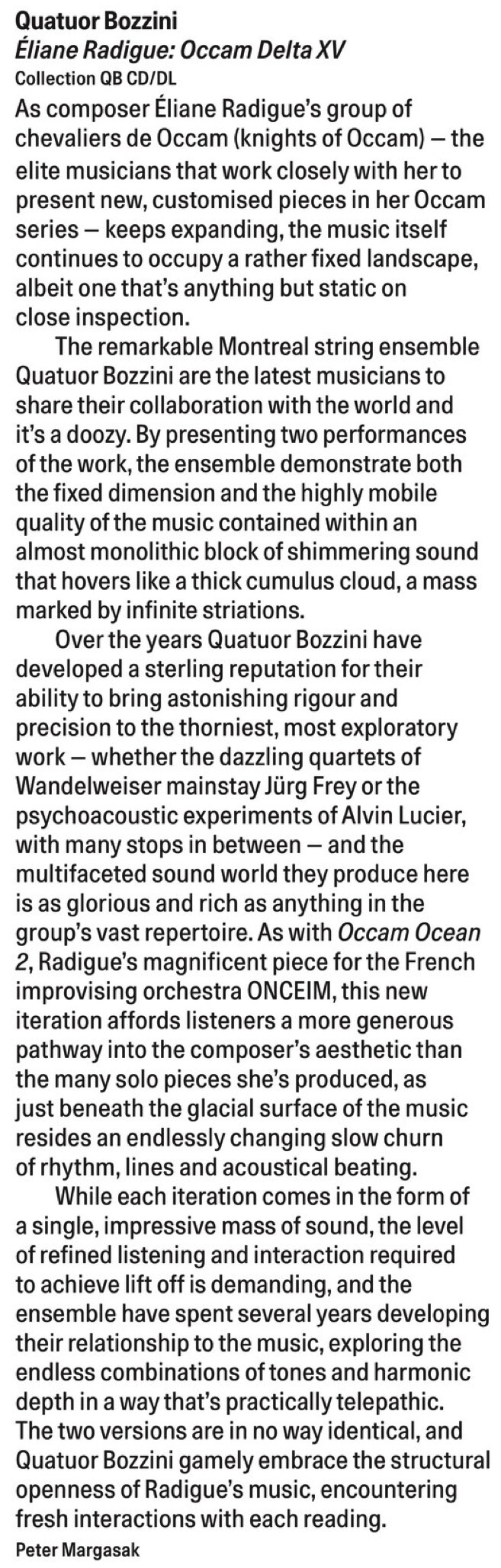
Andrew Timar, The WholeNote, no 28:5, 2 avril 2023
Bozzini’s deeply attentive performance reaches through the recording, touching this listener.

Eight women composers to watch in 2023

Lawrence Dunn, Bachtrack, 8 mars 2023

Éliane Radigue’s working method is one of the most unusual among all composers today. Born in Paris in 1932, she spent her early career making music with tape loops feeding back on themselves, and later with the ARP 2500 synthesiser. But beginning in the late 1990s she began a series of extraordinary works for acoustic instrumentalists.

Much in the same way as she manipulated feedback on tape machines, this time live instrumentalists would be given a small, verbal instruction as impulse (typically a descriptive image), and asked to dwell on it. No notation is made by the composer, though players might make their own notes as memory aids. While attending to the play of high harmonics, musicians’ typically long and sustained pitches interact with utmost subtlety and delicacy (as can be heard in this recording by Quatuor Bozzini).

Radigue’s music is both intense and tranquil, enveloping us but also playing in the foreground. Her Occam series, all constructed in this way through verbal exchange with musicians, has grown to more than 60 works for different instrumental combinations.

Éliane Radigue’s working method is one of the most unusual among all composers today.

Review

Peter Margasak, The Wire, no 469, 1 mars 2023
Over the years Quatuor Bozzini have developed a sterling reputation for their ability to bring astonishing rigour and precision to the thorniest, most exploratory work — whether dazzling quartets of Wandelweiser mainstay Jürg Frey or the psychoacoustic experiments of Alvin Lucier, with many stops in between — and the multifaceted sound world they produce here is as glorious and rich as anything in the group’s vast repertoire.

Review

Keith Prosk, harmonic series, 1 mars 2023

Isabelle Bozzini, Stéphanie Bozzini, Alissa Cheung, and Clemens Merkel perform two 37’ realizations of their delta from Éliane Radigue’s Occam Ocean across consecutive dates on Occam Delta XV.

If it were only the numbered series of releases from shiiin, that each Occam recording introduces something special could be considered a conscious aspect of presentation but as this characteristic continues through independent presentations too it might illuminate the naturalistic diversity inherent to a system whose foundation begins with the foundation of life. Recordings have seemed to so far systematically introduced occam, river, delta, and ocean forms, traced one performer through them, provoked comparison of behaviors in instrumentation with all strings or all winds. Always each showcases the relationship of the performer to their instrument and the limit of each. This delta feels special in that while other ensembles — Zinc & Copper, Decibel, Onceim — are anchored by a chevalier with an occam Quatuor Bozzini stands without as a kind of unit unto itself. This is also the first presentation to provide two recordings together, across consecutive nights and, though it’s ambiguous, I assume the same place.

And it is the first delta to sound deltaic to me. The quartet begins closer to unison than it ends, with the gradual recognition that bowing cadences seem to have drifted towards their instruments’ natural frequencies, twin violins in relative ecstatic excitation over low and slow cello, having got there by a meandering way that felt in the moment to be suspended, slow bowings’ strokes carving bank and bar in epochal time, a rise in volume splaying harmonics like the channel widens at the space it splits, the intuition and the information of never stepping in the same river twice. In between always a world of harmonics like life under a microscope, teeming. A few provide markers across evenings as fossils would. A kind of high-tension tanpura buzz. A dancing satyr fluting. The differences are subtle but tangible, felt more than known and ineffable. Perhaps the satyr’s bolder on the first night and the tanpura on the second. But it lights the imagination to wonder the minute physical parameters that would change the sound, the pressure and the temperature of the room one night or another, beyond the infinite variations in the performers’ hands.

A kind of high-tension tanpura buzz. A dancing satyr fluting.

Review

Peter Tracy, A Closer Listen, 18 février 2023

In certain circles, Éliane Radique needs no introduction. Among the first generation of composers to experiment with electroacoustic music, Radigue began her musical education in the mid-fifties alongside the legendary Pierre Schaeffer, becoming one of the few women involved in the emergence of musique concrète. After early experiments with tape and feedback in the late sixties, she found what would become her characteristic sound via the ARP 2500 synthesizer, which she used exclusively for the next twenty-five years. In the early 2000’s, she finally turned to composing for acoustic instruments, bringing some of the most respected names in experimental music along for the ride.

The Canadian string quartet Quatuor Bozzini have also carved out a niche for themselves as an ensemble dedicated to a specific current of 20th and 21st century experimental music. Stemming largely from American minimalism and the work of John Cage, this tradition might also include names like Morton Feldman, Alvin Lucier, and James Tenney. Despite their obvious aesthetic differences, what these composers and Radigue have in common is more an approach than a single style, a philosophy rather than a system. In this tradition, simple processes yield complex results, time is a material, and the act of listening takes center stage.

Occam Delta XV is the latest work in the ever-expanding Occam Series, begun in 2011 and comprising over eighty unique pieces for a wide variety of instrumentations. Perhaps the defining feature of Radigue’s work throughout both her electronic and acoustic periods is an attention to microbeats, those rhythmic pulses that can emerge when interference patterns occur between similar frequencies. In Occam Delta XV, this is achieved via long, sustained tones that slowly change and recombine overtime. Yet the form of the piece remains something of a mystery: apparently, the performance instructions were conveyed to the ensemble by the composer herself without being written down, resulting in a piece that is never the same twice. For their part, Quatuor Bozzini describe the piece as something more like a state of mind than a score.

The album consists of two nearly equal halves, each comprising a performance of Occam Delta XV. The first rendition is akin to something like John Luther Adam’s Become Ocean or the opening movements of Radigue’s own Kyema (1988) from her epic Trilogie de la Mort. You feel the sun on your skin and the wind in your hair, the dawning of a new and solitary day. The second rendition is harmonically “darker” than the first, yet retains the contemplative air that characterizes Radigue’s work, with a seriousness that brings to mind her interest in Tibetan Buddhism. That the performers are able to coax such an orchestral texture from only four instruments is a testament to their skill and Radigue’s longtime-preoccupation with conjuring up these acoustic phenomena, yet it’s clear that the true work can only be experienced live, where the reverberations of the space create their own acoustic variations.

This is a slow listen: put it on in the background and you’ll completely miss the point. Take the time, listen to each track fully, and try to catch those shimmering tones as they go by. Something like a different mode of listening is possible here, if only you’ll let it emerge.

Le fait que les interprètes soient capables d’obtenir une telle texture orchestrale à partir de seulement quatre instruments témoigne de leur compétence et de l’intérêt que porte depuis longtemps Radigue à l’élaboration de ces phénomènes acoustiques…

Review

Ben Harper, Boring Like A Drill, 6 février 2023

Nearly twelve years ago I was in the audience for Rhodri Davies giving the first performance of Éliane Radigue’s Occam I for prepared harp, little suspecting the proliferation of acoustic pieces that would follow in the series. I’ve blown hot and cold on them ever since that equivocal premiere, having heard various Occam iterations for solo, duo and larger groups which I found either intriguing, technically interesting or just rote. Occam Delta XV, composed for the Quatuor Bozzini in 2018, is the first Radigue piece that’s got me really enthused since hearing her Naldjorlak trilogy at that same gig so many years ago. While Naldjorlak creates awe through its sublime, immaculate surface, Occam Delta XV is far more turbulent. The drones that make up Radigue’s compositions have always been in constant motion, but this string quartet draws on an inherent complexity in the material seldom heard since she abandoned the use of analog synthesiser. A lot of that can be attributed to Quatuor Bozzini, too. Radigue taught them the piece orally and their peculiar quality of playing — making music sound both very new and very old all at once — comes to the fore here. Two performances are presented here, recorded live on consecutive nights in late 2021. It’s a piece that depends on communication and mutual feedback between the four musicians to guide its progress, and so the two versions vary greatly, with each sounding more like a studio creation than a live gig. In the first, variations in the bowing produce a handwoven, folk-like aspect to the music, stretched and suspended into watery, wavering overtones like a Canterbury hippie’s pastoral reverie. Pitch material varies over the course of the piece, thickening into a dense passage of multiphonics while transforming further and further away from its tonal origins. From the second night, things are calmer but darker, thinning out into wisps of harmonics before ultimately resolving in more conventional fashion. I wonder if other quartets could produce astonishing results from this piece, but I suspect they would be very different from the Bozzini.

A lot of that can be attributed to Quatuor Bozzini, too. Radigue taught them the piece orally and their peculiar quality of playing — making music sound both very new and very old all at once — comes to the fore here.

Review

Fiona Maddocks, The Guardian, 28 janvier 2023

For her ongoing series Occam Delta, the French composer Éliane Radigue (b.1932) has collaborated with various performers, marking her shift, this century, from mainly electronic works to music for acoustic instruments. Occam Delta XV (Actuelle) is dedicated to Quatuor Bozzini, who premiered it in Montréal in 2018. Radigue’s music is about constant flux: sounds that appear unchanging yet shift almost imperceptibly. The business of listening is part meditation, part heightened concentration, or “hyperconsciousness”, as the liner note explains it. Out of long, sustained chords, a whirr of microtones and harmonics eventually become audible. The process offers a powerful antidote to our short-attention-span world, if you can take it. Switch your phone off and spot the difference between two different versions, performed live and played with dedication by the Bozzinis.

The process offers a powerful antidote to our short-attention-span world…
Blogue