Sauter au contenu principal
actuellecd

Aussi dans le blogue

19 résultats
  • 1
  • 2
  • 3
  • 4
  • Playing Guitar: Symphony #1 dans SOCAN — Paroles & Musique

    «Critique», Gilles Boisclair, SOCAN — Paroles & Musique, no 31:4, 1 décembre 2004
    mercredi 1 décembre 2004 Presse

    Tim Brady nous éblouit de nouveau avec une œuvre magistrale pour guitare électrique, échantillonneur, grand ensemble de chambre et traitement, forçant l’admiration par la diversité des styles musicaux qu’il pratique (musique de chambre, électroacoustique, improvisée ou vocale). Dans cette composition de 46 minutes, son savoir-faire éclate sur ces longues plages où il combine avec aisance différentes couches sonores (électriques acoustiques, et échantillonnage). Son génie réside dans sa capacité à extraire de cette masse sonore des mélodies joyeuses et dramatiques.

    Son génie réside dans sa capacité à extraire de cette masse sonore des mélodies joyeuses et dramatiques.

    Playing Guitar: Symphony #1 dans L’Express

    «Ce jazz qui nous vient du froid», Dominique Denis, L’Express, 30 novembre 2004
    mardi 30 novembre 2004 Presse

    Parfois, il faut laisser tomber le masque du critique, soit lorsqu’une réaction viscérale — et donc subjective — s’impose d’elle-même (ça m’est arrivé il y a quelques semaines avec le Requiem de Mozart, dans la magistrale version des Violons du Roy), soit parce qu’à défaut d’outils adéquats pour aborder une œuvre qui existe en marge de nos repères habituels, on serait condamné à dire des conneries.

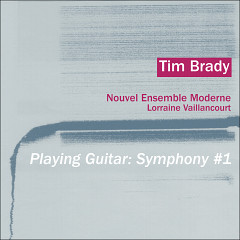
    Depuis un mois, je suis confronté à ce second dilemme, tournant autour de Playing Guitar: Symphony # I (Ambiances Magnétiques/SRI), de Tim Brady, fascinante composition pour guitare électrique et orchestre de chambre (le Nouvel Ensemble Moderne, sous la direction de Lorraine Vallancourt).

    Un mois que cette œuvre polymorphe me suit, servant de trame sonore à mes errances tororatoises, et la seule analogie qui me soit venue à l’esprit est la suivante: si le génial Bill Trisell, lui-méme guitariste sans frontières, s’était emplayé à réconcilier l’urgence rythmique du Sacre du printemps et la lumineuse transparenœ de La Mer, le tout pour les besoins d’un film de Hitchcock, il aurait peut-être pondu quelque chose qui ressemble à Playing Guitar.

    Mais là, on tombe en pleine conjoncture, comme disait l’autre, ce qui ne vaut guère mieux qu’une critique ratée…

    Playing Guitar: Symphony #1 dans AllMusic

    «Review», François Couture, AllMusic, 1 octobre 2004
    vendredi 1 octobre 2004 Presse

    Did Tim Brady plan his first three albums for Ambiances Magnétiques as a trilogy? 20 Quarter Inch Jacks featured his studio, sampler/overdub-heavy work; Unison Rituals focused on his “real” compositions for ensembles; and now Playing Guitar: Symphony #1 pairs both directions: a score for real instruments (the musicians of the Nouvel Ensemble Moderne, conducted by Lorraine Vaillancourt) and samplers playing back stacks of overdubbed guitars. This 45-minute symphony in five movements represents Brady’s most ambitious recorded work to date. It is also one of the most convincing attempts ever made at integrating the electric guitar to a “classical” music group (and not turning it into one, as with Glenn Branca’s symphonies), in this case a 15-piece contemporary chamber ensemble. One doesn’t detect the slightest distance between guitar and orchestra, both entities talking the same language, which is neither rock nor classical, but Brady’s. And Brady’s language stems from Glass’ velocity, Reich’s sense of interlocking rhythms, Stravinsky’s grandeur, and Goebbels’ cross-stylistic approach — yet it is also more flexible than the first one, less hypnotic than the second, more rapturing than the third and definitely warmer than the latter. The first movement is extremely dense and fast, walking a fine line between complexity and cacophony. It is obviously meant to nail the listener to his or her seat, while offering a lot of melodic and harmonic material to assimilate all at once. Things settle down a bit afterwards, especially in the second and fourth movements. The samplers help blur the distinction between orchestra and guitars, composition and manipulation, performance and treatment. The second half of the last movement lacks panache and brings the piece to a slightly disappointing conclusion, but otherwise this is a very impressive work that manages to shake off the rigidity of (some) contemporary music while heartily embracing the pomposity of the symphonic genre. The stellar recording and lively mix are icing on the cake.

    Rounding up the program is Frame 1 — Resonance, a very different 12-minute piece for electric guitar, electronics and piano. More electroacoustics than anything else, the piece sticks to a gloomy atmosphere, hammered piano notes reverberating through large chambers of guitar soundscapes and treated echoes. The piece is interesting in itself, but doesn’t stand comparison to the preceding symphony and, truth be told, Ambiances Magnétiques should have ignored duration issues (46 minutes is still a respectable total duration) and limited the contents of this album to only Playing Guitar: Symphony #1.

    … one of the most convincing attempts ever made at integrating the electric guitar to a “classical” music group…

    Playing Guitar: Symphony #1 dans La Scena Musicale

    «Critique», Réjean Beaucage, La Scena Musicale, no 10:2, 1 octobre 2004
    vendredi 1 octobre 2004 Presse

    Le compositeur et guitariste (électrique!) Tim Brady offre avec cette Symphonie nº 1 une œuvre forte, qui se déploie sans concession et qui offre un bel exemple de ce que l’électricité a à offrir à la musique contemporaine. L’écriture peut rappeler par moments celle des minimalistes américains telle que revisitée par les européens, et le NEM, magnifiquement dirigé par Lorraine Vaillancourt, y est parfaitement à son aise. Pas beaucoup de répit dans cette musique plutôt nerveuse et percussive, mais pas d’ennui non plus. Le disque est complété par Frame 1 – Resonance, une pièce écrite pour un piano (Pamela Reimer) qui «résonne» au travers d’une guitare traitée électroniquement.

    Tim Brady offre avec cette Symphonie nº 1 une œuvre forte, qui se déploie sans concession et qui offre un bel exemple de ce que l’électricité a à offrir à la musique contemporaine.

    Playing Guitar: Symphony #1 dans Downtown Music Gallery

    «Review», BLG, Downtown Music Gallery, 24 septembre 2004
    vendredi 24 septembre 2004 Presse

    Featuring two extraordinary works: Playing Guitar is for electric guitar, sampler, live electronics and large chamber ensemble and Frame 1-Resonance is for electric guitar, electronics and piano. Symphony 1 is actually about “playing guitar” or sampled guitar with the fifteen piece large chamber group utilized here. This is Tim Brady’s 10th CD in print and this just might be his best yet. His symphonic writing is particularly strong, varied and adventurous. What makes this so special is the way his guitar fits perfectly as a part of the ensemble and as a soloist in the center of the action or story. The other thing that works so well here is the way Tim has programmed his sampler and filled it with a variety of strange guitar sounds, which often don’t sound like a guitar, but are used selectively to add sonic spices to his fascinating creation. Fripp fans will certainly be smiling as they listen to the Second Movement with its Frippish guitar solo. This is an absolutely fantastic work that I would hope would be perfect for next year’s Victo Fest. Frame 1-Resonance for piano, guitar and electronics is a more restrained and eerie work, in which the piano is echoed by sinister guitar sounds and weird samples.

    This is Tim Brady’s 10th CD in print and this just might be his best yet.
  • 1
  • 2
  • 3
  • 4