
Luminance
Marilyn Lerner
Le résultat est une aventure sonore pleine de variations de timbres et d’effets, servie par un jeu fin et volontaire. — Revue & Corrigée, France
Luminance is notable for its friendliness and inclusiveness. — Splendid E-Zine, ÉU
Luminance est le premier album solo de Marilyn Lerner chez Ambiances Magnétiques. Enregistré dans les studios d’Avatar à Québec, il s’agit d’une collection d’improvisations révélant la profondeur et l’étendue de la créativité de Lerner, un concentré de ses influences jazz et classiques additionné d’un petit quelque chose d’inhabituel
Constituée de 16 pièces, l’œuvre comprend des titres tels Wolfen et Rife (qui explorent des idées et des possibilités harmoniques inspirées des idiomes jazz et classique), mais Codec Moment, qui met à profit le micro minuscule du Palm Pilot de Casio pour déformer le son et ainsi imiter un vieil homme chantant la tyrolienne
L’approche pianistique de Lerner trouve sa raison d’être dans son amour pour l’espace, la densité et les qualités résonnantes de l’instrument. Sans effort, elle passe du simple au complexe et crée une œuvre toute en profondeur et en imagination.
- Compositeur·trice(s): Marilyn Lerner
- Image de couverture: Alan R Chandler
- Graphisme: Jean-François Denis
CD (AM 115, 2003)
- 1plucky (2002), 1:31
- 2deluge (2002), 2:26
- 3rife (2002), 7:36
- 4tiny (2002), 1:55
- 5bordeaux (2002), 3:34
- 6codec moment (2002), 2:58
- 7attends (2002), 3:39
- 8ombre (2002), 1:25
- 9road tango (2002), 3:48
- 10cartoon fest (2002), 2:01
- 11wolfen (2002), 11:21
- 12boum (2002), 1:31
- 13la boxe (2002), 4:10
- 14black tulip (2002), 4:37
- 15glovys (2002), 3:36
- 16eerie (2002), 1:02
- Étiquette: Ambiances Magnétiques
- AM 115
- 2003
- UCC 771028111527
- Durée totale: 58:09
- Boîtier sympathique
- 126 mm × 126 mm × 5 mm
- 45 g
Sur le web
Quelques articles recommandés



La presse en parle
Critique
Kritik
Critique
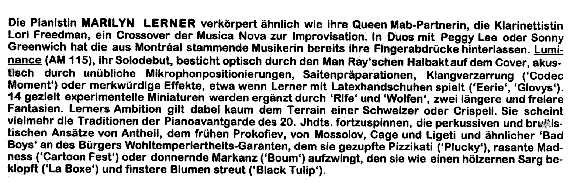
De son côté, la Montréalaise
Review
Francophone experimental/improvised music is not always the easiest sell. Even in these Freedom Fries days, I like to think that the reason for that difficulty rests with the “experimental” and “improvised” side of the description. If the preceding conjecture is indeed true, it’s hard to fault even the most open-minded listener for thinking long and hard before purchasing something like
On the other hand, however many times you’ve heard that old saw about music’s universal appeal, it’s nice when an instantly arresting yet thoroughly novel and interesting album reminds you of that concept’s veracity. Luminance is the kind of album that can, with proper exposure, gain converts to the improvisational and experimental side of music.
Warning
The best showcase for her balancing act comes with the album’s longest tracks. Rife, an exploration of a melody that seems constantly to be tripping its way toward a greater understanding of its underlying composition, incorporates chords that call to mind Cole Porter, scale passages that evoke Rachmaninov, and tonal meditations that could come from cool-period
There are many other fantastic moments here, including the interestingly miked and teasingly titled Codec Moment (see the audio clip
Review
The first time this writer heard
Review
Review
This Toronto-based pianist is comfortable in jazz, new music, Klezmer and Latin and lately has tried collaborations with poets, computers and video artists. Here are 16 improvised solos that experiment with sound, various microphones set up in different configurations that help create vivid musical images and highlight sonic options. She draws from jazz and classical styles, explores inside tbe piano, strokes strings wearing latex gloves, works pedals furiously and uses the instrument as a drum. Two relatively long pieces, Wolfen and Rife, let her expand ideas, Glovys is rock-ish and all of it is fascinating. One snippet witb the nifty title “Codec Moment” involves using tbe tiny mike of a Palm Pilot.
Critique
C’est dans les studios d’Avatar à Québec que fut réalisé ce nouvel opus de la pianiste canadienne
Review
Microphones have been integral to “acoustic” jazz since the 1920’s
It’s worth buying Luminance just to hear Codec Moment, which incorporates resonance from the tiny mike in a Casio PDA. And that’s not the only golden track. Other experimenters drum on their pianos, but La boxe goes further
Review
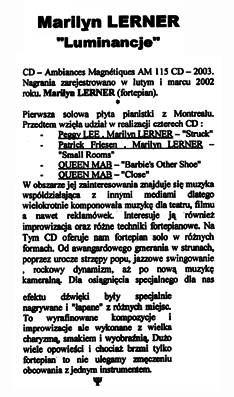
Piano’s Inner Life
Back in the ’60s and into the ’70s, there was a style of painting that came into popularity called hyperrealism. True to its name, it portrayed fairly mundane objects (cars, storefronts) in ferocious detail, paying obsessive attention to reflective surfaces and colour. The results were perspectives that the human eye could not reproduce if it looked at the same object, due to the physical limitations of the eye itself.
What inspired you to record an album this way
Do vou plan on taking a similar approach to live playing
Review
This first solo outing for Queen Mab pianist
Heard In
I was previously unfamiliar with