actuellecd

Blog

3585 results
  • 26
  • 27
  • 28
  • 29
  • 30
  • 31
  • 32
  • 33
  • 34
  • Joane Hétu, Ambiances Magnétiques in The New York City Jazz Record

    “Liberty, Equality and au courant”, Ken Waxman, The New York City Jazz Record, no. 263, March 1, 2024
    Friday, March 1, 2024 Press

    Keeping a record company functioning for 40 years is an achievement. Doing so with a label that is dedicated to releasing experimental music of all kinds is even more noteworthy. But since its founding in 1984, Montréal’s Ambiances Magnétiques (AM) has done just that and to date has put out almost 300 albums of ensemble, jazz, song, poetry, improvised, jazz, rock and noise sounds under the rubric of what the Québécois call “Musique actuelle.”

    Explaining AM’s genesis, which very quickly grew to include nine participating musicians, AM label director Joane Hétu says: “Those were the days we wanted to do something different. We were all musicians and we thought we were best-placed to manage our music.” Any other label that put out non-mainstream music was either affiliated with a university or produced straight-ahead jazz. “There was no opening for the music we did.” In fact, a couple of the collective’s members, who eventually included André Duchesne, Jean Derome, Robert Marcel Lepage, Diane Labrosse, Danielle Palardy Roger, Michel F Côté, Martin Tétreault and Hétu, had tried to release projects on two micro labels, which soon went bankrupt. Hétu, who is a saxophonist, vocalist and composer, has released 40 different albums on AM. Annually, the label puts out a certain number of CDs — a number that has increased and decreased over the decades — with physical product now distributed by Distribution Ambiances Magnétiques Etcetera Inc. (DAME), an affiliated company founded in 1991. Since AM is a non-profit enterprise, Hétu explains, the for-profit DAME allowed the company to apply for grants, first from the Canadian and then the Québec government.

    Individually, members of the collective can also apply for grants to help produce their albums. Each has the right to release albums on AM, while Hétu decides which non-members record for the imprint. Besides herself, the staff is limited and sometimes shared with a local electric-acoustic record company. Montréal percussionist/composer Danielle Palardy Roger, who has been part of the collective since 1985, and has 20 AM releases, had been involved in ongoing musical projects with Hétu even before that. “I belong entirely and voluntarily to this label,” she affirms. “Ambiances Magnétiques represents a very high-quality sound and musical experience and it has built up a superb reputation for producing and distributing its records.” While she has had discs released on other labels, she says,“I’ve stayed loyal to Ambiances Magnétiques because, in my opinion, it’s still the one that best meets my needs and objectives.” Adds Hétu: “artists are responsible for recording their music, mixing and editing. They provide their album master to us and DAME takes care of the mastering and production of the album such as cover design, printing and CD duplication. DAME also offers promotion and distribution services.”

    Since DAME now receives an annual grant from the provincial government, 50% of AM’s releases must be by Québécois artists. The few non-Québécois represented are what Hétu calls “friends and acquaintances.” DAME has never had the means to respond to all the requests to record from artists around the world. “Unfortunately, given our small team, I opted to never respond to these requests; it’s easier that way. It’s a shame, but DAME can’t do more,” she says. One person who has recorded for AM is Toronto-based pianist / composer Marilyn Lerner, who over the years has put out about 30 albums, mostly jazz-oriented discs on various imprints. On AM she’s represented by four sessions, a solo piano disc and three with different groups. “The artistic vision of Ambiances Magnétiques is superlative, the best experience I have had to date,” she asserts. “It’s a fabulous label, progressive, has a wonderful design team, is easy to work with and chock full of amazing talent on the roster.” Lerner adds that in her estimation, Hétu has promoted and fostered young talent beside presenting works by the more established artists. “I feel that Joane really appreciated my music and if the project I was doing felt right for the label she put a lot of effort into producing and promoting it,” Lerner adds. “There may be more value in considering the huge contribution Ambiances Magnétiques has made to the artistic and cultural life of Québec, Canada and worldwide in showcasing the phenomenally creative talent in the improvised or musique actuelle scene. It has provided international exposure for the many artists, myself included, who are fortunate enough to have projects on this label.”

    As for production and distribution, there’s a preference for CDs over other formats. As Hétu confirms: “CDs seemed so much better. Less expensive to produce, more music for each album and less expensive to post. We were excited to drop the vinyl format.” AM has released two LPs in the last few years, but its other main outlet is downloads. An agreement with digital distributor The Orchard has AM product on major services, and its music is also available on Bandcamp, currentcd.com, and its own actuellecd.com web shop. As far as sales go, 75% are from physical product. Hétu says her main job is making available via AM/DAME “great music” that is “so rich, particular, personal, avantgarde and alive by the strength of our community and by the strength of extraordinary musicians.”

    Since it’s the artist/leader on each album who chooses the ensemble and repertoire, she never interferes with their choices. However, she says “I’ve always had a concern for fairness that I’ve never really achieved. Women musicians in new music are still under-represented, and we’ve been promoting the place of women in our community for a long time.” She has tried to apply this credo to her own projects and makes sure to include female musicians as often as possible. The Ensemble SuperMusique, directed by Hétu and Roger, for instance, which is represented by twelve AM releases has, since its 1998 founding, included an increasing number of women in its ranks.

    Keeping a record company functioning for 40 years is an achievement. Doing so with a label that is dedicated to releasing experimental music of all kinds is even more noteworthy.

    Jürg Frey: String Quartet No. 4 in Bandcamp Daily

    “Review”, Peter Margasak, Bandcamp Daily, January 30, 2024
    Wednesday, February 28, 2024 Press

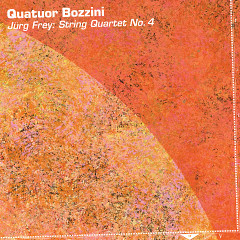
    The elevation of veteran Swiss composer Jürg Frey, a key figure of the post-Cagean Wandelweiser Collective, came after Montréal’s Quatuor Bozzini premiered Frey’s second string quartet back in 2001. In the decades since, they’ve continued to work together — most recently on last year’s sublime Continuité, fragilité, résonance, where they formed a gauzy, heavenly alliance with the reed ensemble Konus Quartett. The arrival of Frey’s fourth string quartet is grounds for celebration. The intensely intimate, gently voiced epic doesn’t necessarily unveil new procedures or ideas — the molasses-slow pace and harmonic grandeur of the early works felt radical at the time — but it does feel like a stunning refinement and a generous expansion of those sounds. Most of the five-movement work is hushed, the strings producing a faint glow of sound that radiates a gauzy rainbow of color. Naturally, in music designed to be relatively static and still, any change or shift carries weight. When the quartet raises the intensity, as in the opening passages of the third movement, the sound hits hard, like a sudden explosion cracking open new possibilities—including an arrestingly beautiful solo violin line drifting through the sorrowful tumble of stately chords. But when nothing is happening, that emptiness is exquisite, carving out a space for contemplation that creates the most ravishing place on earth during its placid unfolding.

    … carving out a space for contemplation that creates the most ravishing place on earth during its placid unfolding.

    Jürg Frey: String Quartet No. 4 in Morning Star

    “Review”, Ben Lunn, Morning Star, February 19, 2024
    Thursday, February 22, 2024 Press

    In 2023, Jürg Frey celebrated his 70th Birthday, and the modestly captivating Swiss composer had numerous celebrations across the globe. This new album released in Winter 2023, is a treasure which demonstrates the power a long-term relationship can have between a composer and an ensemble.

    Frey’s quartet is the third written especially for the Bozzini Quartet over the span of 20 years. In the five movements of the work time feels frozen, to the point that the almost grandiose final movement flies by, despite being three times longer than the preceding movements.

    Frey’s music can be naively described as simplistic as notes hang lost in space and time — but the music it is not “easy music.” The great contradiction in Frey’s work — complex simplicity — is what draws the ear in, and Bozzini’s ability to play this with passion and skill that it feels like they inhale and exhale Frey’s delicate tones.

    The great contradiction in Frey’s work — complex simplicity — is what draws the ear in, and Bozzini’s ability to play this with passion and skill that it feels like they inhale and exhale Frey’s delicate tones.
    ★★★★★

    Jürg Frey: String Quartet No. 4 in Free Jazz Blog

    “Review”, Eyal Hareuveni, Free Jazz Blog, February 17, 2024
    Thursday, February 22, 2024 Press

    String Quartet No. 4 is the third string quartet Frey composed for Canadian, Montréal-based contemporary ensemble Quatuor Bozzini (first violinist Alissa Cheung, second violinist Clemens Merkel, violist Stéphanie Bozzini and cellist Isabelle Bozzini) over twent years of collaboration (the first one, String Quartets, was recorded in 2004, Edition Wandelweiser Records, 2006). This 65-minute, five-movement composition was written between 2018 and 2020 (and completed before Frey composed Les signes passagers). It was first premiered — virtually — at the MaerzMusikl Festival in Berlin in March 2021 and performed live for the first time at the Only Connect Festival in Oslo in April 2022 and refined during the recording with Quatuor Bozzini in Montréal in May 2023.

    Frey describes this composition as “slow, sometimes static, often delicately shifting between standstill and movement. And yet, after more than an hour, this music has arrived at another place. Standstill, little happens, — it is this atmosphere from which my music emerges and to which it always returns. Sometimes it just stays there. This is my world”.

    String Quartet No. 4 is a calm and beautiful composition that radiates a rare sense of poetic weightlessness in search of silence in sound, with a profound emotional effect. It is developed slowly, with minimalist and slow shifts and almost transparent dissonances, always hinting about its deeper, secret wonders, evoking a musical garden that asks you to appreciate its delicate, changing colors as they blossom in their own accord. And, like all Frey’s compositions, it is performed masterfully by Quatuor Bozzini with precise sensitivity for color, sound and silence in Frey’s aesthetics.

    … performed masterfully by Quatuor Bozzini with precise sensitivity for color, sound and silence in Frey’s aesthetics.

    À pas de loup, Dédé Java Espiritu, La joie de l’éphémère in The WholeNote

    “Review”, Raul da Gama, The WholeNote, no. 29:4, February 1, 2024
    Wednesday, February 14, 2024 Press

    Marianne Trudel ascended the pinnacle of music 20 years ago, with formidable technique and breathtaking, innovative expression. Today, still atop that do-not-touch-me pinnacle, there’s an erudite quality to her pianistic approach, the lived-in character of her improvisations and phrase-making that is engaging, the fire and brimstone of youth now complemented by the well-honed values of experience. So, it is only natural to celebrate – yet again – with a set of three recordings: solo, a duo with drummer John Hollenbeck and a trio with Hollenbeck and contrabassist Rémi-Jean Leblanc.

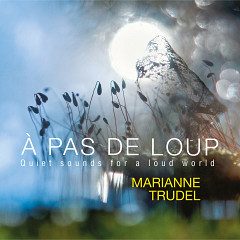
    Some discerning listeners may be tempted to hint at the fact that Trudel’s later music with small ensembles may be more adventurous given the interaction between musicians that affords improvised conversations and the possibilities of considerable development of ideas. The very act of playing solo on À pas de loup – Quiet sounds for a loud world is a pensive act of musicianship best enjoyed in similar quietude. That way, what is composed and improvised, often on keyboard instruments – including the gently wheezing harmonium – and percussion (instruments, individually played and/or overdubbed) offers a taste of Trudel’s sense of adventure to the solitary recesses of her brave creativity. It is in the very act of being in quiet conversation with herself, inside her own head, buzzing with ideas so to speak, that we find considerably venturesome music. Melodic beauty quickly ascends vertically with masterful harmonic development and passionate embellishments. When Trudel adds percussion – as on Chrysalide, for instance – her supple facility for ideation and articulacy reaches its much-vaunted apogee.

    Music embellished by the wondrous percussion colouration of John Hollenbeck is experienced truly memorably on Dédé Java Espiritu. Trudel has said that when she first played with Hollenbeck, she knew from “the first few notes” that they played together that there would be a musical reprise. Now comes this album featuring not simply breathtaking and daring adventure, but all of it featured in beautifully crafted arrangements of beguiling variety and sensuousness. Trudel’s love for – and mastery of – her instrument shines brightly. She and Hollenbeck seductively manipulate melody, harmony and rhythm in phrases that fly off the page on Coquillages. Meanwhile Trudel appears to bend notes while she and Hollenbeck masterfully sculpt the long inventions of Tension and Happiness. Clearly in the spacious arrangements and improvisations there’s not a semiquaver that has not been fastidiously considered.

    To complete the trilogy of recordings released to mark two decades in music, Trudel returns to the studio (and the soundstage} with Hollenbeck. This time it’s a trio on Time Poem — Le joie de l’éphémère and the duo is complemented by the elegant rumble of the contrabass played by the masterful Québécois veteran Leblanc. There is unlikely to be a more reliable guarantee of high-quality contemporary trio music than when these names appear on the cover. Trudel’s musicians are fully attuned to the vision and artistry of their fearless leader, whose pianism bristles with meaningful virtuosity. Hollenbeck delivers his melodious rolling thunder of drums and hiss of cymbals while Leblanc beguiles with the spacious growl of his bass. Check out everything here.

    You cannot have one of these three recordings without the other two, so, my best advice would be to indulge freely for untold moments of musical pleasure.

    … my best advice would be to indulge freely for untold moments of musical pleasure.

    Jürg Frey: String Quartet No. 4 in The Quietus

    “Review”, Vanessa Ague, The Quietus, January 23, 2024
    Friday, January 26, 2024 Press

    In Jürg Frey’s world, stillness is motion. Throughout the Swiss composer’s String Quartet No. 4, Quatuor Bozzini pull their bows so gradually that it feels as if each note is stopped in time. Yet they aren’t: With each reiteration, these tones gradually expand, taking up every inch of the quartet’s wooden instruments. Each slight change feels faint, but they accumulate; it’s like the shifting of a glacier over thousands of years. This is the world Frey has come to embody across his career, and his fourth string quartet continues to explore the engulfing atmospheres he crafts out of thin air.

    Quatuor Bozzini, a Montréal-based string quartet that comprises violinists Alissa Cheung and Clemens Merkel, violist Stéphanie Bozzini, and cellist Isabelle Bozzini, are expert interpreters of Frey’s conscientious works. The group has a twenty-year relationship with the composer. His second string quartet was also written for and recorded by them. First performed in a virtual premiere in 2021, the five-movement fourth quartet often deals in similar swaths as the second, venturing from moments of delicacy to broader, more expansive harmonies. But here, Frey allows the music to feel a little rougher around the edges. Each chord basks in its dissonances and a cloudy haze circles around every whispered note.

    While Frey often writes diaphanous music, the most striking moments of String Quartet No. 4 lean into bold dissonances. Though the piece opens in wisps, it blooms into piercing tones that interweave and clash. The quartet plays every hushed phrase with great attention to detail, but they shine in these moments of resonance, letting them hang wherever they are, even if they never resolve. Each note spirals into the next, giving the feeling of motion and standstill all at the same time. It’s similar to the way Frey’s most hushed sounds feel, yet amplified and expanded.

    But it’s when Frey’s music returns to quietude, that his world feels most intimate. Here, each moment invites close listening to the tiniest flutters. Towards the end of the piece, there are a series of rests that feel one in the same as the moments of sound; it ends where it began, emerging from nowhere and disintegrating into a pool of dust. Of the quartet, Frey writes: “Standstill, little happens — it is this atmosphere from which my music emerges and to which it always returns.” Music can be found where it might not have existed before, and Frey invites us to discover it with him.

    … his fourth string quartet continues to explore the engulfing atmospheres he crafts out of thin air.
  • 26
  • 27
  • 28
  • 29
  • 30
  • 31
  • 32
  • 33
  • 34