actuellecd
  • This website is also available in English.

Blog

3585 results
  • 116
  • 117
  • 118
  • 119
  • 120
  • 121
  • 122
  • 123
  • 124
  • La vie commence ici in Bird is the Worm

    “Review”, Dave Sumner, Bird is the Worm, November 19, 2014
    Wednesday, November 19, 2014 Press

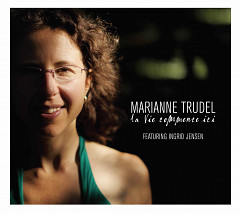
    An excellent new release from pianist Marianne Trudel. La vie commence ici comes off as being very centered. There’s a calm to the music even when things get a bit heated. Soloists are provided optimal conditions to express their thoughts, and the way in which their solos, more often than not, build on the group vision rather than focus on just their own individual perspective is the element that provides the album its sense of flawless completion. It’s one of those albums that resonates strongly by keeping things simple and honing its focus.

    The benefits of trumpeter Ingrid Jensen’s contribution can’t be overstated. On an album that radiates strength from a tightly bundled core, Jensen provides a necessary touch of a Big Sound on many of her solos. Jensen immediately takes to soaring on Soon, the powerful flap of wings a show of force on an album that has an abundance of elegance. That said, Jensen’s trumpet work is in no way detached from the ensemble’s predominant behavior. Deux soleils sees pianist Trudel and bassist Moore skipping along the surface of the tempo’s stream, and Jensen’s playful accompaniment fills right into the confluence of the ensemble’s direction.

    Of particular beauty on this recording is the way in which Jensen and saxophonist Stewart add harmonic passages to a strong melodic thrust. It adds a casual ease to moments when a tune is charging straight ahead. There’s also the intrigue from their cryptic conversations added to the brooding intensity of title-track La vie commence ici.

    The way in which Urge opens with murmurs and sighs before hitting the gas pedal is particularly enjoyable, especially in how Trudel and drummer Kuster bounce rhythmic ideas off one another as they fly down the road together, side by side. It’s a similar pattern to Le vent est une chance, which also adopts melancholy tones and stately motion as a precursor to a display of feverish volatility, and is in possession of an arresting lyricism at either speed.

    The album ends with Choral, reflecting the unassuming beauty and sharp focus that typifies this wonderful album.

    Your album personnel: Marianne Trudel (piano), Ingrid Jensen (trumpet), Jonathan Stewart (tenor & soprano saxes), Morgan Moore (bass) and Robbie Kuster (drums).

    An excellent new release from pianist Marianne Trudel. La vie commence ici comes off as being very centered. There’s a calm to the music even when things get a bit heated. Soloists are provided optimal conditions to express their thoughts, and the way in which their solos, more often than not, build on the group vision rather than focus on just their own individual perspective is the element that provides the album its sense of flawless completion. It’s one of those albums that resonates strongly by keeping things simple and honing its focus.

    La vie commence ici in Wondering Sound

    “Review”, Dave Sumner, Wondering Sound, October 29, 2014
    Wednesday, October 29, 2014 Press

    Marianne Trudel, La vie commence ici: Terrifically resonant recording from pianist Trudel, who doesn’t seem to be doing anything very complicated, and yet each song is supremely engaging to where it becomes nearly impossible to do anything other than sit back and listen. Modern pieces, but nothing that will scare the old-schoolers off. Most tracks keep to the quiet end of the spectrum, but radiate an energy that gives the songs a big presence. Joining Trudel is trumpeter Ingrid Jensen, saxophonist Jonathan Stewart, bassist Morgan Moore and drummer Robbie Kuster. Outstanding. Pick of the Week.

    Terrifically resonant recording from pianist Trudel, who doesn’t seem to be doing anything very complicated, and yet each song is supremely engaging to where it becomes nearly impossible to do anything other than sit back and listen.

    La vie commence ici in Le Droit

    “Critique”, Yves Bergeras, Le Droit, October 25, 2014
    Saturday, October 25, 2014 Press

    La pianiste Marianne Trudel a fait appel à une trompettiste de renom, la New-Yorkaise Ingrid Jensen, se glisse à pas feutrés, sourdine en main, au milieu des tableaux évocateurs, de La vie commence ici, sixième opus de la jazzwoman et compositrice québécoise, qui s’exprime cette fois en quintette.

    Berçant, son disque n’a pas besoin de la moindre parole pour résonner avec force; on pourra s’en rendre compte samedi soir, au Centre national des arts, où elle vient défendre l’album, accompagnée de Mme Jensen et de ses collaborateurs émérites. Entre elles, se faufilent la contrebasse légère et joueuse, de Morgan Moore; le saxophone enamouré de Jonathan Stewart; et les coups de baguette subtils de Robbie Kuster. Ça ressemble davantage à une longue trame sonore mouvante et «progressive» qu’à une série de pièces bien découpées, mais la technique est sans faille. Et ne cherche à se substituer ni à l’inspiration, ni à la sensibilité, ni aux mélodies, qui coulent de leur source organique.

    Undulating and soothing, the music on her album doesn’t need a single lyric to resonate powerfully […] Inspiration, sensitivity, and melodies all flow organically from the source.

    Holy Seven in Musicworks

    “Review”, Ken Waxman, Musicworks, October 21, 2014
    Tuesday, October 21, 2014 Press

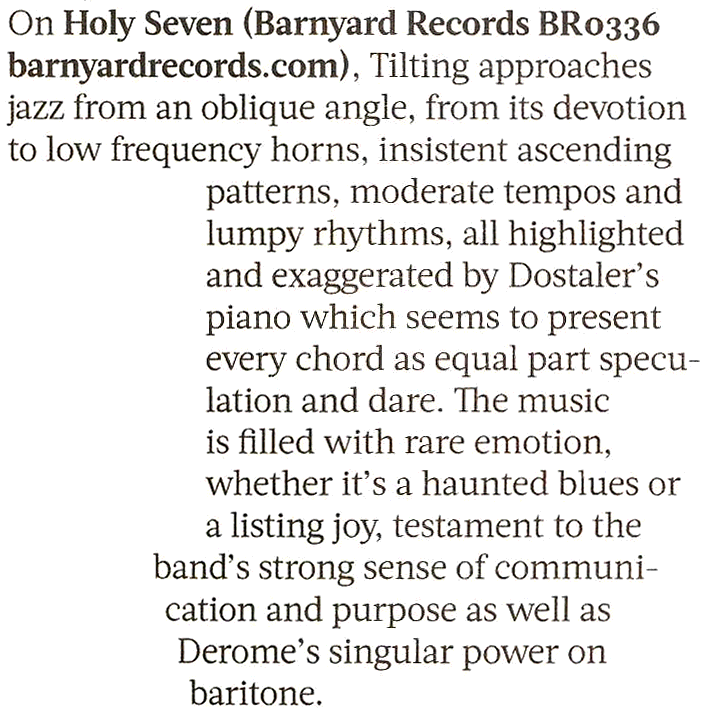
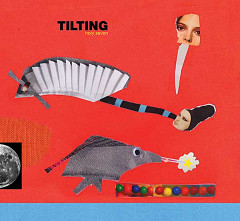
    One of the linchpins of Montréal’s Musique Actuelle potpourri, bassist Nicolas Caloia is, underneath it all, a jazz musician, and this session shows off his mastery of the idiom. With the group Tilting, he elaborates his take on jazz by utilizing the talents of fellow travellers baritone saxophonist Jean Derome, pianist Guillaume Dostaler, drummer Isaiah Ceccarelli, and — on one track each — bass clarinetist Lori Freedman and alto saxophonist Yves Charuest. What that means is that Caloia’s eight compositions tilt towards the freer side of free bop, without ever abandoning underlying rhythms.

    With Caloia’s bass sonority directing from behind, and Derome’s bulky low-pitched smears upfront, the band still works effectively to ensure that weightiness doesn’t turn into logginess. Dostaler is the key here, whether he’s outputting processional cadenzas or comping decorously to knit together seemingly disparate parts. Holy Seven Fields, the most traditional of the tunes, has a heavy Charles Mingus influence, with spirited piano timbres pushing Derome’s slurps upwards to middle-register expression.

    The title of Apart (for Conlon Nancarrow) must be an inside joke, since Nancarrow’s super-swift pianism isn’t referred to at all; instead, Apart is made memorable by a straightahead bass solo. “Wren” balances on Caloia’s fluid continuum as dramatic baritone smears take centre stage.

    Unsurprisingly, Freedman’s bass clarinet adds some needed buoyancy when harmonized with Derome’s sax on Flox, together attaining a climax of tremolo vibrations. As for Charuest, his peeps and judders on Locked are backed by spiccato string-pulls from the bassist that create the most dissonant track. Here, a frenzied reed counterpoint of shrieked notes finally reassembles amoeba-like into a shimmering whole.

    Tilting may be the band’s name, but it’s evident that the only direction it leans towards is one made up of unique compositions and performances.

    Tilting may be the band’s name, but it’s evident that the only direction it leans towards is one made up of unique compositions and performances.

    Grand groupe régional d’improvisation libérée (GGRIL), Ratchet Orchestra in Musicworks

    “30th Festival International de Musique Actuelle de Victoriaville”, Stuart Broomer, Musicworks, no. 120, October 21, 2014
    Tuesday, October 21, 2014 Press

    The Festival International de Musique Actuelle de Victoriaville (FIMAV) celebrated a milestone this year, presenting its 30th festival of musique actuelle — that unique French descriptor covering improvised music, chance, electronica, the avant edges of jazz, rock, folk, and world, and any other genre that has challenged expectations over the past few decades. That durability might seem unlikely for a festival of marginal music presented in a rural hamlet 160 kilometres from a major city, but FIMAV is persistent testimony to the vision and energy of its founder and artistic director Michel Levasseur, who has tirelessly maintained the festival in his hometown. […]

    A transcendent community was apparent in a concert by Montreal’s nineteen-member Ratchet Orchestra, celebrating the 100th anniversary of Sun Ra’s birth with special guest Marshall Allen — the long-time saxophonist with the Sun Ra Arkestra and that band’s current leader — nine days short of his 90th birthday. Begun as a Sun Ra tribute band twenty years ago, the Ratchet Orchestra has gone far beyond that, evident in the eighty-minute suite that merged Sun Ra themes with Ratchet leader, bassist, and arranger Nicolas Caloia’s own ideas. The music moved like a slow majestic blues, highlighted by contrasting explosions of instrumental colour (bass reeds, shouting brass, strings, electronic keyboards, and percussion), often surmounted by the explosive fury of Allen’s saxophone or the exotic flute of fellow Arkestra veteran Danny Thompson, and hitting its climax in Allen’s extended passage of orchestral conduction.

    That sense of orchestra as community also came across strongly with GGRIL (Grand groupe régional d’improvisation libérée), a fourteen-member collective from Rimouski. GGRIL is a kind of poststructuralist village band. During a program that included works by Robert Marcel Lepage and Jean Derome, leader and bassist Éric Normand and violinist Raphaël Arsenault engaged in a coconduction, in which the two exchanged orchestra halves and seemed to compete comically for authority and sound, taking the conductor’s role to the level of professional wrestling. […]
    The music moved like a slow majestic blues, highlighted by contrasting explosions of instrumental colour…
  • 116
  • 117
  • 118
  • 119
  • 120
  • 121
  • 122
  • 123
  • 124