actuellecd

Blog

66 results
  • 1
  • 2
  • 3
  • 4
  • 5
  • 6
  • 7
  • 8
  • 9
  • Holy Seven in Musicworks

    “Review”, Ken Waxman, Musicworks, October 21, 2014
    Tuesday, October 21, 2014 Press

    One of the linchpins of Montréal’s Musique Actuelle potpourri, bassist Nicolas Caloia is, underneath it all, a jazz musician, and this session shows off his mastery of the idiom. With the group Tilting, he elaborates his take on jazz by utilizing the talents of fellow travellers baritone saxophonist Jean Derome, pianist Guillaume Dostaler, drummer Isaiah Ceccarelli, and — on one track each — bass clarinetist Lori Freedman and alto saxophonist Yves Charuest. What that means is that Caloia’s eight compositions tilt towards the freer side of free bop, without ever abandoning underlying rhythms.

    With Caloia’s bass sonority directing from behind, and Derome’s bulky low-pitched smears upfront, the band still works effectively to ensure that weightiness doesn’t turn into logginess. Dostaler is the key here, whether he’s outputting processional cadenzas or comping decorously to knit together seemingly disparate parts. Holy Seven Fields, the most traditional of the tunes, has a heavy Charles Mingus influence, with spirited piano timbres pushing Derome’s slurps upwards to middle-register expression.

    The title of Apart (for Conlon Nancarrow) must be an inside joke, since Nancarrow’s super-swift pianism isn’t referred to at all; instead, Apart is made memorable by a straightahead bass solo. “Wren” balances on Caloia’s fluid continuum as dramatic baritone smears take centre stage.

    Unsurprisingly, Freedman’s bass clarinet adds some needed buoyancy when harmonized with Derome’s sax on Flox, together attaining a climax of tremolo vibrations. As for Charuest, his peeps and judders on Locked are backed by spiccato string-pulls from the bassist that create the most dissonant track. Here, a frenzied reed counterpoint of shrieked notes finally reassembles amoeba-like into a shimmering whole.

    Tilting may be the band’s name, but it’s evident that the only direction it leans towards is one made up of unique compositions and performances.

    Tilting may be the band’s name, but it’s evident that the only direction it leans towards is one made up of unique compositions and performances.

    Grand groupe régional d’improvisation libérée (GGRIL), Ratchet Orchestra in Musicworks

    “30th Festival International de Musique Actuelle de Victoriaville”, Stuart Broomer, Musicworks, no. 120, October 21, 2014
    Tuesday, October 21, 2014 Press

    The Festival International de Musique Actuelle de Victoriaville (FIMAV) celebrated a milestone this year, presenting its 30th festival of musique actuelle — that unique French descriptor covering improvised music, chance, electronica, the avant edges of jazz, rock, folk, and world, and any other genre that has challenged expectations over the past few decades. That durability might seem unlikely for a festival of marginal music presented in a rural hamlet 160 kilometres from a major city, but FIMAV is persistent testimony to the vision and energy of its founder and artistic director Michel Levasseur, who has tirelessly maintained the festival in his hometown. […]

    A transcendent community was apparent in a concert by Montreal’s nineteen-member Ratchet Orchestra, celebrating the 100th anniversary of Sun Ra’s birth with special guest Marshall Allen — the long-time saxophonist with the Sun Ra Arkestra and that band’s current leader — nine days short of his 90th birthday. Begun as a Sun Ra tribute band twenty years ago, the Ratchet Orchestra has gone far beyond that, evident in the eighty-minute suite that merged Sun Ra themes with Ratchet leader, bassist, and arranger Nicolas Caloia’s own ideas. The music moved like a slow majestic blues, highlighted by contrasting explosions of instrumental colour (bass reeds, shouting brass, strings, electronic keyboards, and percussion), often surmounted by the explosive fury of Allen’s saxophone or the exotic flute of fellow Arkestra veteran Danny Thompson, and hitting its climax in Allen’s extended passage of orchestral conduction.

    That sense of orchestra as community also came across strongly with GGRIL (Grand groupe régional d’improvisation libérée), a fourteen-member collective from Rimouski. GGRIL is a kind of poststructuralist village band. During a program that included works by Robert Marcel Lepage and Jean Derome, leader and bassist Éric Normand and violinist Raphaël Arsenault engaged in a coconduction, in which the two exchanged orchestra halves and seemed to compete comically for authority and sound, taking the conductor’s role to the level of professional wrestling. […]

    The music moved like a slow majestic blues, highlighted by contrasting explosions of instrumental colour…

    6 improvisations in The Squid’s Ear

    “Heard In”, Massimo Ricci, The Squid’s Ear, September 26, 2014
    Friday, September 26, 2014 Press

    The digital testimony of a trio composed of proven collaborators in several related projects, 6 Improvisations shelters the uncontaminated traits of a collective vibrancy which seems to entirely discard overt references. Interactional assurance and an impulsive will of attempting solutions beyond the safety net of inherited jargons and foreseeable choices transpire across 55 minutes. Two of the six tracks are Derome/Goldstein duos.

    In Saturnien, Wiens’ prepared guitar acts as an arrhythmic basis for Derome’s compressed shrieks and Goldstein’s tattered symbolization; in calmer waters, a tonic composure imbues the air, all musicians returning to a levelheaded demonstration of control on the conflictual aspects of the interplay. The first duo, aptly titled Silences habités, consists of concise ruptures of quietness with sounds whose dynamic and timbral range acknowledge scratched strings, awkward harmonics and elongated, if occasionally faltering pitches as equally valuable components. It must be told that Derome’s “objects” play an important subversive role through this and other moments in the album; bird calls and squeaking/quacking “things” are part of the equation. L’idée de nature is typified by Wiens’ kalimba turning the whole into a multicolor minimalist aggregation of wooden flutes (or ocarinas?) and singing/chattering violin in a bewitching pseudo-static semblance. The innumerable ideas churned out by the soloists in this setting work wonders in expelling cheaply exotic pictures from the listener’s psyche.

    Bamboche is another episode where humor and high quality become engaged: ludicrous blasts, coarse utterances and melodic twists by Derome, ungroomed arco action by Goldstein, Wiens using all he needs to make his axe sound as if someone stumbled and fell upon it while carrying a dozen tomato cans. Still, there’s room for fleeting glimpses of pensiveness amidst the frantic disruption of the instrumental framework. Impromptu is the second head-to-head between Derome and Goldstein: the brusqueness of fragmented bursts and the scissions among bilinear cells increase the gap separating our brain’s mnemonic possibilities from the saddening reality of its role as a deterrent in the urge-to-gesture connection. Glissements-souffles ends the program with the same lack of artificiality experienced throughout: aleatory structures, whimsical counterpoints and captious lucidity abound, the ears thankful for having been subjected to a trip to previously unseen lands. This time, the sweat on the shirt and the soil on the fingers were a delightful plus.

    This time, the sweat on the shirt and the soil on the fingers were a delightful plus.

    Cordâme, Jean Félix Mailloux in Le Devoir

    Cordâme, ou les rêveries sans lieux fixes”, Yves Bernard, Le Devoir, September 18, 2014
    Thursday, September 18, 2014 Press
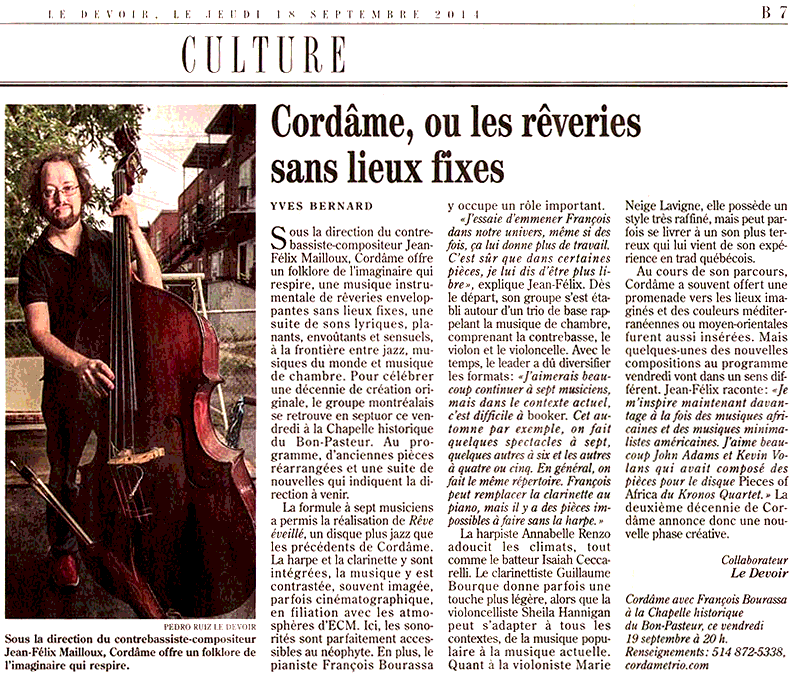
    Sous la direction du contrebassiste-compositeur Jean-Félix Mailloux, Cordâme offre un folklore de l’imaginaire qui respire.

    Holy Seven in Monsieur Délire

    “Listening Diary”, François Couture, Monsieur Délire, September 16, 2014
    Tuesday, September 16, 2014 Press

    Tilting is the jazz quartet of Montréal bassist Nicolas Caloia. This album was recorded in April 2013, and it just came out on the Ontarian label Barnyard. We have Caloia, Jean Derome, Guillaume Dostaler, and Isaiah Ceccarelli, plus Lori Freedoman and Yves Charuet appearing on one track each. Very jazzy though not typecasted, living music, with some mighty fine sideway skids — Derome plays only baritone sax and bass flute on this album, so there’s a lot going on in the bass range. The writing reminds me of Sun Ra — something about the immediacy of these melodies that are both rooted in jazz tradition and facing toward a better elsewhere.

    Very jazzy though not typecasted, living music, with some mighty fine sideway skids…

    Allochtone in Monsieur Délire

    “Listening Diary”, François Couture, Monsieur Délire, September 9, 2014
    Tuesday, September 9, 2014 Press

    A fine free improvisation session between guitarist Sylvie Chenard (also on vocals), doublebassist Alexandre Dubuc, sax player Cathy Heyden, and drummer Rémi Leclerc (yes, of Miriodor). All of them also use electronics. Trippy and granular improvisations in search of a balance between delicate noise-making and collective drive. Tracks are short, the album as a whole flows well, and it offers both immediate interest and listening depth. Recommended.
    Recommended.
  • 1
  • 2
  • 3
  • 4
  • 5
  • 6
  • 7
  • 8
  • 9