actuellecd

Blog

188 results
  • 18
  • 19
  • 20
  • 21
  • 22
  • 23
  • 24
  • 25
  • 26
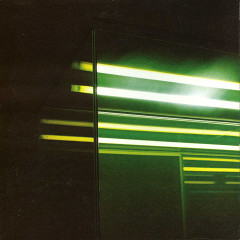
  • Télépathie in Ampersand Etcetera

    “Review”, Jeremy Keens, Ampersand Etcetera, no. 2003_f, May 24, 2003
    Saturday, May 24, 2003 Press

    This is part of the No Type single series (and the difference in numbering places them in sequence with the on-line offerings) some of which will be 10” vinyl, though this is full length, at EP price.

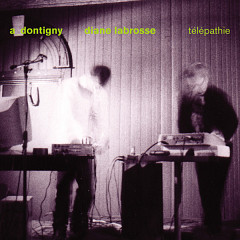
    Dontigny (computers) is a founder member of Napalm Jazz, half of morceaux_de_machines which has a No Type release and appears across the web-based catalogue, while Labrosse (samplers) has been in bands and is part of the Montréal music scene. This disk was recorded live at Casa del Popolo — the club reflected in the Montréal Free set.

    The sound is what you would expect from the listed instrumentation — shifting moving comprised of generally small elements manipulated and modulated. And thus it is in t.s.f. where scrabbles whooshes blurt over a base of looped/slowed/sped musical samples. There are lots of echoes and it is as if we are adrift in a sea of sounds. A rhythm enters midway through and settles the music down somewhat but movement is the focus.

    The second track antenne parabolique is in similar territory, with a soft thuddering, chittering, machine rumbles, squeaky scrapes with the tonal computer providing a basal stability. It continues with more elements — clattering percussive, computer music, long tones, whippoorwills and squeaky hiss. I was listening to this coming from the car where our horses are agisted and in the distance I could hear a wind pump creaking — and it fitted in beautifully.

    There is a lighter more immediately ambient feel to photo satellite with a hissing that has notes and tones through, a musicality. This sequence lasts for some minutes — a greater stability. Spirals emerge, whoozy whoops, a brief wind storm and deep music. Mechanical waves crash — or it could be a train — and a lovely long slowly changing period ensues, gradually building but never exceeding.

    Finally a more electroacoustic directness in média tactique as an extended vocal sample speaks through metal wash and deep throbs and bangs. Then choppy samples are woven together — disco beats, music fragments, some reggae dub — to create a dramatic rhythmic energy, over which some squeaky door electronics and growls swirl.

    I was impressed by the variety across this album — there was much more than I expected. This makes it an interesting album to listen to, and also one which can form surprising backdrops to the world around us in a lowercase manner.

    … clattering percussive, computer music, long tones, whippoorwills and squeaky hiss.

    Soshin, Antoine Berthiaume in Voo

    “Guitare du futur”, Anne-Marie Campbell, Voo, May 24, 2003
    Saturday, May 24, 2003 Press

    Vous êtes artiste en devenir? Imaginez l’opportunité de jouer dans un film avec Robert De Niro, ou bien de peindre aux côtés de Cézanne. C’est celle que vit présentement le jeune guitariste montréalais Antoine Berthiaume, qui sort cette semaine son tout premier album enregistré en collaboration avec deux légendes de la guitare électrique.

    Soshin, sur l’étiquette de musique actuelle Ambiances Magnétiques, se veut une exploration des possibilités infinies de la guitare. Sur toutes les pistes sauf une, Berthiaume improvise en duo tour à tour avec les guitariste britanniques Derek Bailey et Fred Frith. Soshin est une présentation de la démarche artistique du jeune musicien, le dévoilement de l’apprentissage en improvisation qu’il entreprend depuis des années.

    La musique actuelle, dite «free music» ou «instant music» dans le milieu, est l’aboutissement moderne des courants du jazz. Cette musique peut sembler dépourvue de sens et quelque peu cacophonique à première écoute. Pour l’oreille avertie, elle captive, obsède, et surtout elle fait vivre des émotions rebelles.

    Les carrières des anglais Bailey et Frith s’étendent sur plusieurs décennies déjà. Musiciens de jazz connus en Angleterre, Bailey a enregistré plus de deux cents albums tous genres, et Frith enseigne aujourd’hui au prestigieux Mills College en Californie.

    Bailey et Frith sont de grands innovateurs. Ils m’inspirent tant au plan musical que professionnel, ils sont tous deux généreux et humbles. Je n’étais donc pas nerveux lors des enregistrements» explique Berthiaume, lors d’une entrevue accordée à Voo. Malgré toute la fierté qu’Antoine Berthiaume ressent en collaborant avec deux grands musiciens, il affirme ne pas pouvoir s’enfler la tête. «Mes amis et ma famille ont aucune idée qui sont Bailey et Frith, les gens qui m’entourent ne sont pas impressionnés. Seules quelques personnes sont venues me féliciter» dit-il en souriant. À noter que la plupart des amis d’Antoine étudient à l’École Polytechnique.

    À 25 ans, Berthiaume jouit déjà d’un horaire bien rempli. Il étudie présentement à l’Université de Montréal en composition de la musique contemporaine, sous la direction de Denis Gougeon. Il se donne en spectacle plusieurs fois par semaines avec diverses formations de jazz traditionnel. Et il y a Soshin. Berthiaume explique «J’aimerais pouvoir éventuellement n’avoir qu’un seul projet et y inclure tous les styles musicaux que j’affectionne. Mais pour l’instant, c’est noir ou c’est blanc.» Pour plusieurs, Antoine Berthiaume deviendra une importante figure de relève de la scène montréalaise. Malgré cela, il ne voit pas toujours la métropole en rose. «La culture du spectacle n’est pas aussi forte ici qu’elle ne l’est en Europe, par exemple. Il n’y a pas beaucoup d’engouement pour les nouvelles choses. Généralement, ce sont les mêmes visages dans tous les spectacles. Cette réalité est un peu triste, mais j’ai tout de même confiance.»

    Antoine Berthiaume est un artiste intègre comme il en existe peu. Il est fidèle à sa complexité musicale et à son dévouement pour l’art véritable qui se retrouve dans la démarche et le travail intellectuel. Ses compositions souhaitent toujours innover, explorer et lutter contre le nivellement vers le bas. On comprend qu’il n’est pas toujours facile d’apprécier les compositions de Berthiaume. Pourtant il est certain qu’elles passionneront les adaptes du jazz nouveau.

    Soshin… se veut une exploration des possibilités infinies de la guitare.

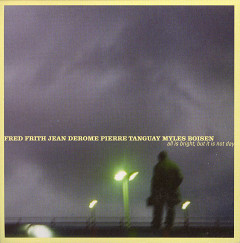
    All Is Bright, But It Is Not Day in The Squid’s Ear

    “Review”, Phil Zampino, The Squid’s Ear, May 23, 2003
    Friday, May 23, 2003 Press

    The album opens as a sinister laugh cackles and Fred Frith saying “That’s an interesting technique you have there.” The laugh becomes oddly infectious as Tanguay pushes the first improv off with a hearty beat, interrupted by a ruptured duck call, strange wind instruments and distant guitar strumming. Interesting technique is what defines this album, and it’s no surprise that three improvisers of this stature have created a series of works that are dynamic, encompassing, humorous, psychedelic and fascinating.

    Guitarist Frith and multi-wind instrumentalist Jean Derome are well known, and equally deserving of such attention is the excellent drummer Pierre Tanguay (Derome and Tanguay are each part of Montréal’s Ambiences Magnetiques collective). San Francisco-based engineer Myles Boise might also be little recognized, functioning here both as engineer and real-time sound manipulator. The musicians are all masters of their instruments and it shows as they pull off a sometimes introspective, sometimes dizzying, often melodic display of ideas. Boise intervenes, subtly shifting the sound quality of one or all of the musicians, panning and manipulating the image of the sound or even chopping the sound out to shake up the listener. Derome here would give John Zorn a run for his money, with a host of saxes, small wind instruments, hand percussions and game calls. He provides the most melodic moments of the release, generally on breathier instruments where he plays with a kind of naivety to good affect. Tanguay is very active, cutting up and holding together the improvisations, and also providing unusual percussive elements and “objets”. Frith is perhaps the most conservative on this session, more often creating underpinnings over which the ideas are developed. The works are neither predictable nor chaotic, and everyone is clearly listening closely as they move into adventurous territories or pull back to let the music surround.

    The entire album was realized in one day in a California studio, and one can’t imagine that any alternate takes exist of any of these works. They are as ethereal as they are interesting, and monumental as an almost telepathic display of master improvisers working together and having a good time of it. The music is dramatic, playful, frightening, complex, joyous, thoughtful, accessible and a little bit tilted. All improvisations should be so successful!

    The music is dramatic, playful, frightening, complex, joyous, thoughtful, accessible and a little bit tilted. All improvisations should be so successful!

    Télépathie, A_dontigny, Diane Labrosse in AllMusic

    “Review”, François Couture, AllMusic, May 22, 2003
    Thursday, May 22, 2003 Press

    It has been said over and over again, but it is true that improvisors develop a certain telepathic sense and that the stronger their link the better the music. In this set recorded live at the Casa del Popolo in Montréal (Canada), a_dontigny (aka Aimé Dontigny), one half of noisicians morceaux_de_machines) and Diane Labrosse display an engaging level of unspoken communication. But beyond the thrilling battle between computer and sampler, beyond its doomsday ambient music and menacing digital experiments, Télépathie takes a symbolic value. This is, after all, a first significant bridge (at least on record) to be thrown between two generations of avant-garde artists from two different spheres. A member of the Ambiances Magnétiques collective since the mid-’80s, Labrosse comes from an avant-rock background (she played in the seminal Montréal groups Wondeur Brass and Justine). The young Dontigny has been involved from the start with No Type, one of the first and most important internet-only experimental music labels. The set begins with the rumble of thunderstorm and crackles of electricity. The proceedings remain atmospheric, dragging the listener in rather gently. By the third track photo satellite), things are getting more raucous as weird feedback and outbursts of white noise take more space. média tactique begins with a recording of poet Denis Vanier reading one of the iconic texts of Quebec’s countercultural movement (which includes the line “Kraft fuck the cheese”). The way the two musicians react to the words, developing its sub-text, evokes René Lussier’s Le Trésor de la langue, but only briefly as the piece evolves into a noisy mutated dub. Things almost get out of hand as decibels escalate, but the pair stop in time — or have been stopped, since the abrupt ending screams of editing. Short, to the point and quite convincing.

    … doomsday ambient music and menacing digital experiments…

    Studio — Analogique — Numérique in Incursion Music Review

    “Review”, Richard di Santo, Incursion Music Review, May 19, 2003
    Monday, May 19, 2003 Press

    Beautifully packaged in a shimmering white jewellery box, the latest collaboration between improv innovators Martin Tétreault and Otomo Yoshihide (who released 21 situations together back in 1999, also on Ambiances Magnétiques) is an intense listening experience born from what we are told was an intense studio encounter.

    Disc one, Studio, was recorded direct to DAT with no remixing or reprocessing, a true collaborative session performed on turntables and electronics. Listening, it seems that the electronic elements (shifting drones, dissonant crossings of feedback and static) are the more dominant features in these four tracks, harsh and grating, surely, but also with a surprising sense of calm, of being grounded, as if on firm footing.

    Disc two, Analogique, is Tétreault’s analogue reworking of that live session into five new pieces, using old, “obsolete” tape recorders as his tools. Things become much more restless in Tétreault’s revision, with busying activity, in turns spacious and densely layered, with sounds that seem to have been torn apart at the seams fluttering to and fro. It’s an incredible exercise in tape manipulation with some surprising, challenging results.

    Disc three, Numérique, as one might imagine, is Yoshihide’s reconstruction, a single, continuous mix that was generated using purely digital tools. His treatment is charged with immense energy and momentum, a bomb ready to explode. Concrete and electronic elements collide in fierce clashes, and even as this piece remains dynamic from the first to the last, it also seems grounded by long drones behind the scenes that occasionally weave in and out of the mix, remnants of the original sessions, mere traces of the past. Dividing the release into three discs was an excellent decision for this project in particular, and not only for aesthetic reasons; the format also allows the listener a short break between sets, allowing each one to be more fully digested, thought about, remembered, before moving on to the next one. In all respects, an outstanding release.

    … an outstanding release.
  • 18
  • 19
  • 20
  • 21
  • 22
  • 23
  • 24
  • 25
  • 26