actuellecd

Blog

188 results
  • 15
  • 16
  • 17
  • 18
  • 19
  • 20
  • 21
  • 22
  • 23
  • Soshin in AllMusic

    “Review”, François Couture, AllMusic, June 2, 2003
    Monday, June 2, 2003 Press

    Derek Bailey accumulates collaborations, always eager to discourse with young improvisers through his guitar. Some of his choices may be disputable, but he sure had his ears in the right place when he stumbled upon Antoine Berthiaume. The Montréal guitarist was only 24 years old when he recorded a string of improvised duets with the British master at the latter’s home. Part of this session came out on Bailey’s Visitors Book, while two more pieces (13 minutes of music) end up on Soshin. ‘Seize the day’ the saying goes, so when Fred Frith made a rare visit to Montréal in December 2002, Berthiaume dragged him into the studio to record three inspired duets. The disc begins with the title piece, a multi-tracked solo number where Berthiaume explores delicate sonic textures. An interesting piece, earthlier than Oren Ambarchi’s forays in similar territory, it feels a bit out of place on this collection — a prologue of sorts. Of the duets with Frith, Wolf’s Wood is the keeper. Here a true dialog remains open throughout the duration of the piece — and Frith displays a fresh imagination instead of relying on his trusty bag of tricks. Berthiaume’s surgical playing is a marvel to follow. Morning Froth on the other hand doesn’t rise above Frith’s average output from the same period. It seems that Bailey will always be Bailey: challenging and frantic in his playing and yet opening up to welcome the input of his young friend. Pushing your own voice across between those two key figures of improvised guitar is no easy task and maybe Berthiaume would have been better served by a first album featuring lesser musicians. But if you are lured to Soshin by either of its big names, you might be surprised to find out that, in the end, the star player is not who you thought.

    But if you are lured to Soshin by either of its big names, you might be surprised to find out that, in the end, the star player is not who you thought.

    Montréal Free in The Wire

    “Soundcheck”, Julian Cowley, The Wire, no. 233, June 1, 2003
    Sunday, June 1, 2003 Press

    This is a hefty slab of free improvising from Montréal, and electric guitarist and arch-catalyst Sam Shalabi is in the thick of it. It’s less a compilation sampler than an archive of what’s current, featuring four groups, each occupying an entire CD. Shalabi plays on three discs and, although vestiges of his psychedelic excursions and modal flights with the group Shalabi Effect linger, it’s the metallic resilience, the non-porous, non-absorbent attack of his rock improvising that transfers most tellingly into these freer forms.

    The name Po stands for “provocative operations.” It alludes presumably to psychologist Edward de Bono’s concept of calculated jolts delivered to unsettle habitual ways of thinking and perceiving. As jolts go, these seven improvisations by Shalabi, fellow guitarist Rainer Wiens, double bassist Alexandre St-Onge and drummer John Heward are easy to take. The guitarists chip away, flecking the music’s surface with stuttering staccato sounds, or unwinding coiled lines in taut spirals. St-Onge slackens strings and works with springiness and the ebb and flow of tension. Heward scours his kit for complementary timbres. Wiens prepares his instrument for added metal edge. Typically the music proceeds with a kind of collective tumbling roll, a revolving mesh of curiously coordinated sounds.

    ’Gypt Gore is Shalabi with Napalm Jazz saxophonist Philémon. Double bassist Thierry Amar joins them on two tracks; Andrew Dickson adds second guitar to two others. As a duo they specialise in agitation, marking out parallel trails of nervous energy as they scuttle along without any audible goal. Amar and Dickson are more inclined to pause for reflection and ’Gypt Gore allow them that without any hint of introspection on their part. It’s easy to surrender to the pull of the duo’s slipstream but it has to be said that the presence of guests supplies necessary variety to their headlong extrovert chatter.

    Chris Burns plays electric guitar in a trio with bassist Nicolas Caloia and drummer John Heward. His sound is more yielding and expressive than Shalabi’s, referencing blues intermittently, and the music here is more open, unhurried and loose textured. Caloia’s accompaniment is subdued yet effective, attentively throbbing and loping or bowing with an ear to the grain. Heward again demonstrates his ability to fit in, to add percussive fibre and colouring that matches the overall feel. Their improvisation, in seven sections, bears the name Presence. At times it slows to a crawl. In the context of Montréal Free as a whole, that pace is welcome. Gentle friction between the instruments at such moments produces some of the most satisfying music in the entire set.

    Balai Mecanique put the seal on the collection, ostensibly a churning powerhouse ensemble in which Shalabi, Philemon and Amar are joined by Jesse Levine on keyboards, trombonist Jacques Gravel and drummer Will Glass. The horns relive free jazz memories and periodically stir up maybem. But Levine, using ring modulation and other electronic effects, edges out into the abstract and the group, subsiding from a boil to a simmer, repeatedly goes with him, sometimes for long stretches. The result is variegated music, shifting alignments of instruments, gradations of mood, carrying the threat of eruption even when most sedate. As with Po,’Gypt Gore and Burns/Caloia/Heward, this is improvising in which internal tension between contrasts and correspondences has a cohesive effect and simultaneously generates momentum, binding and driving the music. Shalabi’s sound is well integrated, although still hardboiled and unrelenting.

    … this is improvising in which internal tension between contrasts and correspondences has a cohesive effect and simultaneously generates momentum…

    Prairie orange in Revue & Corrigée

    “Disques”, Pierre Durr, Revue & Corrigée, no. 56, June 1, 2003
    Sunday, June 1, 2003 Press

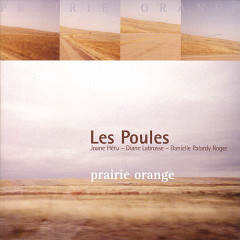
    Les Poules des Contes de l’amère loi furent à leur époque (milieu des années 80) un avatar passablement déjanté de Wondeur Brass, mais la structure d’ensemble restait peu ou prou rock, avec chansons et textes. Avec leur renaissance un peu plus d’une quinzaine d’années plus tard, l’auditeur se demande à quel caquetage il allait être soumis. Les musiciennes du trio, de Justine en île bizarre, de parasitages en tricotages divers, de perçage d’oreilles en accoutrement de castor, avec divers partenaires endogènes ou exogénes, ont ouvert leur horizon: la basse-cour s’ouvre sur une vaste prairie — orange, of course! — en cours de défrichement. Ici, il n’y a point de textes, ni de structure classique de la chanson rock, même iconoclastes, mais davantage un travail de confrontation sonore entre instruments et voix, entre sons acoustiques et sons synthétiques, de chuintements en frottages; au final, neuf peintures sonores impressionnistes convient l’auditeur à saisir des paysages qui, derrière une certaine uniformité apparente — les prairies canadiennes sont vastes — présentent une multitude de variations, au gré des saisons, des variations climatiques, voire de l’activité humaine (les glaneuses).

    … une multitude de variations, au gré des saisons, des variations climatiques, voire de l’activité humaine.

    Unison Rituals in Revue & Corrigée

    “Disques”, Pierre Durr, Revue & Corrigée, no. 56, June 1, 2003
    Sunday, June 1, 2003 Press

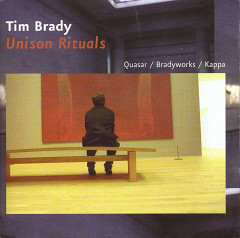
    L’autre enregistrement présente une sélection de cinq compositions écrites entre 1983 et 1999, qui relèvent de la musique de chambre. La pièce éponyme interprétée par Quasar (quatuor de saxophones) est énergique, charpentée. Plus mélodiques apparaissent les trois titres dévolus à l’ensemble de chambre dirigée par Tim Brady (Bradyworks): si Double Helix et même Escapement semblent assez conventionnels, Two Chords Less Than a Blues est plus intéressant, notamment par le jeu des diverses percussions. Plus ambitieuse toutefois, la pièce pour big band (13 cuivres, chacun retraité par superposition de bandes, 3 percussionnistes basses), Sound Off, originellement conçue pour une centaine de cuivres et 8 percussions, alterne de longs passages sous forme de drone et des phrasés plus nettement jazz créant ainsi une œuvre impressionnante, dont la version initiale (45 mn) devait également être spectaculaire.

    … différents styles musicaux propres à la guitare, passant de nappes harmoniques a des murs sonores…

    Twenty Quarter Inch Jacks in Revue & Corrigée

    “Disques”, Pierre Durr, Revue & Corrigée, no. 56, June 1, 2003
    Sunday, June 1, 2003 Press

    Transfuge du label Justin Time sur lequel il a produit huit CDs le compositeur et guitariste canadien rejoint le collectif Ambiances Magnétiques.

    Deux facettes de son travail nous sont livrées à quelques mois d’intervalles. Twenty Quarter Inchs Jack reflète son travail de compositeur/guitariste, tandis que Unison Rituals s’attache davantage à la composition, l’interprétation des œuvres (5) y étant dévolue a un quatuor de saxophones, un ensemble et un big band, Tim Brady lui-même n’y officiant que sur un titre.

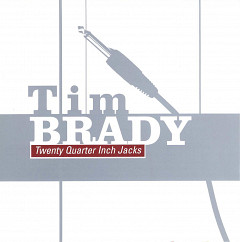
    L’œuvre principale du premier enregistrement, qui lui donne son titre, fut à l’origine une création pour une vingtaine de guitaristes ados, dans le but implicite de décloisonner leur(s) approche(s) de l’instrument. L’enregistrement a cependant été réalisé en studio par Tim Brady. Cette suite en huit sections aborde donc différents styles musicaux propres à la guitare, passant de nappes harmoniques a des murs sonores que ne renieraient ni Rhys Chatham, ni Sonic Youth, ainsi que différentes techniques: glissando, accords, répétitions, grattages… Au passage (section 6 an alphabet of guitarists), il évoque les mânes de quelques guitaristes.

    Les deux autres pièces relèvent davantage d’une approche électroacoustique de l’instrument, la guitare y étant associée à des bandes magnétiques. Music Box Bell Curves (“Hello Paris!”) fut présentée au festival Présence de Radio France en janvier 2001: elle met en jeu une guitare un peu plaintive, évoquant parfois quelques ambiances floydiennes de l’époque More, traversée par des effets électroniques variés et fortement rythmés, créant une ambiance inquiétante. Plus courte, Sauchichall Street est une pièce d’une facture plus courante: progression d’une interaction guitare/bandes d’abord sur un mode calme, presque atmosphérique puis peu à peu plus rythmé, voire agressif pour s’achever à nouveau dans la quiétude.

    … différents styles musicaux propres à la guitare, passant de nappes harmoniques a des murs sonores…

    Who’s Playing in Musicworks

    “A showcase of pianistic versatility”, Mark Sutherland, Musicworks, no. 86, June 1, 2003
    Sunday, June 1, 2003 Press

    One of the more compelling aspects of postmodernism is found in the hybridization of style, media, and the cross-pollination of disparate cultures. In particular, the fusion of the oriental and THE occidental in tandem with the dialectical tension between formal composition and improvisation has proven to be a fertile breeding ground for those venturesome artists aspiring to make it new.

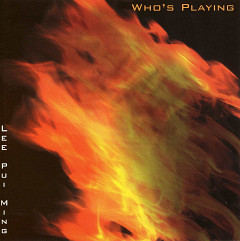
    As a classically trained pianist in the Western tradition, who integrates jazz, Chinese music, and free improvisation in her protean performances, Lee Pui Ming more than satisfies the contemporary desire for novelty. Her latest CD, entitled Who’s Playing, captures the energetic and inventive musician live at the Music Gallery in Toronto on two separate occasions; March and October of 2001. This CD features seven solo pieces as well as three improvisational duets with saxophonist-vocalist Joane Hétu.

    The human body and its various motor functions constitutes the conceptual conceit inspiring and informing Lee’s recent performances and this CD. Following a very brief and playful vocal duet with Hétu, entitled Greetings, Ming unleashes her considerable talents on the aptly titled Steps. Syncopation, underscored by a muscular stride rhythm in the left hand, propels this composition forward into half-time and melodic enjambments that achieve an unstable resolution in an extended ritardando. On Silica, Ming explores the interior of the piano, plucking and sweeping the strings to create harp-like glissandi and sonic washes, punctuated by a single koto-like tone. Bones is an eighty-eight-key tour de force: quicksilvertrills and chromatic runs occur in rapid succession, from one end of the piano to the other, with the keyboard lid being opened and closed for added percussive resonance.

    The physical and material presence of the piano is a pervasive theme in Lee’s creative practice, and the track entitled Torso is exemplary of the full body-contact pianowork that is quickly becoming her creative signature. Torso begins with Lee using her hands (or maybe mallets) to percussively probe the wooden body of her grand piano. The composition suddenly explodes in an exuberant display of pianistic dexterity and harmonic intricacy, and then breaks into a series of obtuse rhythms created by the pianist stamping her feet.

    Belly of The Beast shifts the emphasis from the artist’s feet to the foot pedals of her piano. In this composition the full reverberation of a depressed sostenuto pedal disguises the tonic note as a rumbling drone that anchors a flurry of dense chord clusters. Delicate subtleties of Satie-like modalities are subsequently jolted into the twenty-first century by Lee’s aggressive use of fortissimo.

    For the final cuts of this CD, Lee focuses her attention on voicework and, in the process, tempers the sturm unddrang of her previous solos for spatially discursive duets with Joane Hétu. Vocables, whispers, shouts, and incantations, mixed with saxophone and piano accents, are the sonic materials used in the construction of these mysterious and expansive improvisations.

    While Who’s Playing is a veritable showcase of Lee’s artistic versatility and ingenuity, it is her infectious energy and enthusiasm that engages the listener and ensures that the nomenclatural postmodern is not simply a euphemism for post mortem.
    … a veritable showcase of Lee’s artistic versatility and ingenuity…
  • 15
  • 16
  • 17
  • 18
  • 19
  • 20
  • 21
  • 22
  • 23