actuellecd

Blog

188 results
  • 14
  • 15
  • 16
  • 17
  • 18
  • 19
  • 20
  • 21
  • 22
  • Asymétries in AllMusic

    “Review”, François Couture, AllMusic, June 19, 2003
    Thursday, June 19, 2003 Press

    This album doesn’t come from an expected outlet — after all, Bertrand Denzler and Hans Koch appear to have no ties to the Ambiances Magnétiques collective prior to this CD — but it stands as a peak in the discography of both of these Swiss improvisers. Denzler (Hubbub, Chamaeleo Vulgaris) and Koch had been going down a path of gestural abstraction, digging ever deeper within themselves and the materiality of their instrument (here respectively tenor sax and bass clarinet, Koch also plays soprano sax) to find unheard sounds and develop a new musical vocabulary. Their search parallels that of John Butcher, Wolfgang Fuchs and Axel Dörner. Working as a duo, they apply this new vocabulary in conversation, articulating squeaks, burps and key clicks into an eery jungle-at-nightfall soundtrack. Tongue stabs, multiphonics and circular breathing represent only the tip of the iceberg of their extended techniques. The set is short (37 minutes), but thoroughly captivating. The highly challenging nature of this album is balanced by a wide diversity in textures and dynamics. Asymétrie 1 sees both musicians alternately listening minutely and stubbornly ignoring each other over 17 minutes of subdued pyrotechnics and brilliant creativity. But the highlight is Asymétrie 3, full of fluttering tongues and clattering fingers. The duo’s direction is less clear in the last piece, but it represents a minor flaw considering what came before it. In Asymétries, Denzler has pushed his art further into abstract, so-called non-idiomatic improv. It is one of his most difficult records.

    In Asymétries, Denzler has pushed his art further into abstract, so-called non-idiomatic improv.

    Télépathie, A_dontigny, Diane Labrosse in Jade

    “Critique”, Julien Jaffré, Jade, no. 12, June 18, 2003
    Wednesday, June 18, 2003 Press

    Certains lecteurs de cette chronique n’étaient encore qu’à l’état de leur conception lorsque Diane Labrosse exaltait déjà (début 1980) avec énergie sa musique au sein de groupes féminins talentueux (Wonder Brass, Justine). Quelques années plus tard, on la retrouve négociant son talent avec génie en compagnie des marchands du temple de chez Tzadik (Ikue Mori, Martin Tétreault, Zeena Parkins). Vingt-cinq ans de proses musicales / combat, vingt-cinq ans d’une intraitable fougue de création pour venir jusqu’à nous sous la forme de ce duo, orchestré en compagnie de A_dontigny (membre de Napalm Jazz et morceaux_de_machines) pour un traité autour des perturbations électroniques et des effluves atmosphériques. Un ordinateur, un échantillonneur et voilà nos deux Canadiens disposés à refaire le monde à la mesure de leurs attentes et de leur talent. Un mille-feuille atmosphérique composé de nappes pesantes d’ambiant dark et d’entrelacs d’effets anesthésiants et où se superposent dans un croustillement auditif jouissif une floraison de glitchs abstraits, de disjonctions de strates mélodiques, de flux en inhalation, d’aspérités et de fractures numériques entraînantes. Une télépathie qui développe à bien des égards l’idée d’empathie entre les musiciens et avec le public tant chacun semble anticiper les réactions de l’autre, pressentir les mouvements et inclinaisons qu’ils souhaitent donner à leurs climats spectraux. Quand la musique devient un langage universel qui se suffit à elle-même sans avoir recours aux mots. Profond et exigeant.

    … une floraison de glitchs abstraits, de disjonctions de strates mélodiques, de flux en inhalation, d’aspérités et de fractures numériques entraînantes.

    Montréal Free in Jade

    “Critique”, Julien Jaffré, Jade, no. 12, June 18, 2003
    Wednesday, June 18, 2003 Press

    Le label canadien passe à l’offensive, se décidant à construire un système d’irrigation complexe, chenaux d’alimentation pour les marais bosselés du free-jazz, les réseaux méandriques de l’improvisation, les plans d’eau infinis de la folk et du post-rock pastoral. En fédérant la quintessence de ces courants, No Type se fait l’écho d’un travail de terrain entamé par la Casa del Popolo (lieu de concerts, de rencontres humaines, initié par Mauro Pezzente, GSY!BE). L’occasion de croiser et de retrouver les étoiles naissantes, les étoiles filantes, naines noires et autre supernovas de la scène montréalaise, parmi lesquels Sam Shalabi et Alexandre St-Onge, de Shalabi Effect (les amateurs de rock spectral type FSA-Roy Mongomery et les habitués de Kranky ou Drunken fish rec apprécieront ce retour), mais également Thierry Amar (God Speed), etc. Une corrélation de talents, répartis tels des points cardinaux entre: Po, ’Gypt Gore, C. Burns/N. Caloria/J. Heward et Balai Mécanique. Quatre introspections dans le free et l’improvisation qu’il convient de développer.

    Po avec sa Provocative Operations (à ne pas confondre avec Tô, le jeune improvisateur de chez Savoir-Faire 53) et la rencontre de deux couples mythiques de la scène improvisée et atmosphérique. Deux trajectoires pour deux «générations» de musiciens. John Heward et Rainer Wiens, anciens brisquards et pionniers des musiques indépendantes sur la scène montréalaise; Sam Shalabi et Alexandre St-Onge, plus connus sous le pseudonyme de Shalabi Effect, groupe mythique pour tout amateur de FSA ou Kranky qui se respecte, et auteurs d’albums miraculeux. Ils délivrent à quatre des pistes plus que des voies pavées, des interrogations davantage que des affirmations autour du rapprochement d’une pratique free et d’une approche «préparée» de l’instrumentation. Un questionnement constant, fluet et ondulant qui laisse beaucoup d’intéressantes interrogations à l’auditeur (attentif). Un ouvrage incertain, lapidaire, cyclothymique…

    ’Gypt Gore, c’est davantage l’école Naked City-Borbotemagus-Painkiller que les clairières lumineuses de Po. Une énergie de la destruction, et de l’improvisation qui a pour paradoxe d’être complexe et construite dans ses schémas «d’attaques». Une ondée sonique, étincelante et féroce qui ravage beaucoup de choses sur son passage, y compris nos oreilles. Les oto-rhinos ne leur disent pas merci. Une approche radicale pour une écoute fructueuse mais éreintante dont on sort anéanti, mais en paix avec soi-même, comme d’avoir vécu une expérience hors du commun. Entre parcours du combattant et attentat sonore. Le sax de Philémon virevolte et les guitares de Dickson et Shalabi viennent en écho de ce tourbillon. Des terroristes à guitares.

    Le Trio Burns/Caloia/Heward a longtemps été un duo construit autour de Heward/Caloia auquel est venu s’adjoindre la guitare exaltée et combative de Burns. Une modification de tracé qui opère de nouvelles voies de réflexion et de création dans leurs jeux respectifs. Sans doute moins d’intimité, mais comment les chuchotements d’un trio pourraient-ils rivaliser avec les susurrements d’un ménage à deux?! Plus liée et mélodique, la partition s’autorise quelque fois des chemins défendus. Ce trio guitare-basse-batterie impose un rythme pondéreux à la composition, installant un climat lourd avant d’introduire de petites déclivités arpèges, incertitudes frottées. Puissant.

    Enfin, Balai Mécanique, le boys band le plus prisé de la côte est du Canada, comptant pas moins de six piliers de bars (La Casa del Popolo) mais surtout, éminences grises de la scène moderne montréalaise, parmi lesquels Philémon (de Napalm Jazz, ’Gypt Gore), Thierry Amar, Sam Shalabi (Po, Shalabi Effect…), Jacques Gravel et Will Glass. À première vue, au regard du line-up, on pourrait imaginer une compression sonore entre les différents groupes pré-cités, comme si la nature n’opérait que par addition. Or, il n’en est rien, les lois de la physique ont leurs raisons que la raison ne connaît pas. Balai Mécanique dépeint au contraire un univers très en retrait des autres, plus expansif et aérien, plus prompt à régénérer notre attractivité pour la matière. On sent que chaque intervenant, en plus de se faire plaisir, trouve ici un terrain de jeu exaltant, une occasion de mettre en pratique avec passion, ingéniosité et complicité son savoir-faire respectif. Par phénomène de vases communicants, on trouve un plaisir équivalent à écouter leurs divagations. Extraverti et énervé.

    … un système d’irrigation complexe, chenaux d’alimentation pour les marais bosselés du free-jazz, les réseaux méandriques de l’improvisation…

    Montréal Free in Splendid E-Zine

    “Review”, Dave Madden, Splendid E-Zine, June 12, 2003
    Thursday, June 12, 2003 Press

    This box set should include a warning sticker — something along the lines of “Caution: if you’re already on the verge of giving up your career to bask in the glow of Montréal’s music scene, proceed with caution.” It’s already too late for me. Consider yourselves warned.

    Perhaps you’ve dismissed it as a bunch of perpetual wrong notes, compensation for poor technique or just a glorified warm-up, but free improvisation is not leaving our universe any time soon. It’s a “style” that demands your attention, as it can be beautiful, brash, cold, confusing, spiritual, frightening and soothing all at once — and regardless of whether he likes it or not, every self-respecting jazz musician must react to its gulf at some point in his life.

    This four-disc collection from Montréal label No Type is a beyond-stellar example of the “genre” — there’s that attempt at description once again. Culled from the work of regular performers at Montréal’s Casa del Popolo (managed by Godspeed You! Black Emperor’s Mauro Pezzente and Kiva Stimac), the discs represent four different experimental ensembles — each of whom, though they generally adhere to an acoustic instrumentation and aesthetic, explore the furthest possible reaches of their instruments, essentially eschewing any bit of history and tradition that existed before the first note hits the practice space. Oh, it’s obvious that everyone involved knows his theory and exactly what he should play, but they’ve rid their systems of conformity and convention and replaced them with instinct.

    To the uninitiated, this music may sound similar; you have to experience all four discs back-to-back in order to really appreciate, understand and experience each act’s subtlety, sublime nature and uniqueness. That might seem like lethal hazing, but if you don’t suffer a psychotic episode, you’re officially in the club.

    The first disc introduces PO (“Provocative Operations”), a quartet of drums, contrabass, electric guitar and (!) prepared guitars (i.e. putting screws in the strings, tuning down to C with rubber shoved under the nut, soaking them in turpentine then throwing them down a hill into a swamp, etc.), who offer a minimalistic performance and a focus on color. I sounds as if everyone were given a bow and told to not play his instrument in any previously-established manner. A semblance of style becomes evident on the bluesy III: there is an actual developing rhythmic ostinato and fixed tempi for a great deal of the tune, but it’s dark jazz in the vein of… no, it’s too skewed for even a David Lynch film. VII presents a complex weaving of strong gamelan overtones, including windchime-like sounds and microtonal string squeaks and melodies — a la something out of George Crumb’s Black Angels.

    Duo ’Gypt Gore (also featuring Godspeed’s Thierry Amar and guitarist Andrew Dickson) open disc two with Angular Momentum, a complete shift from the previous disc; a duet of sax and guitar skitters in a series of scales that become increasingly busy and intricate over the course of eight and a half minutes. As with a number of tracks on this collection, Flakes combines and parodies several elements of what we’ve heard from the past: Wes Montgomery style octaves with hyperactive-and-hopped-up-on-smack Coltrane performances. ’Gypt Gore’s lack of skinned percussion is a bit unnerving at first, but after a spell seems natural — you’ll find yourself wondering why more artists don’t ditch their drummers.

    The Chris Burns, Nicolas Caloia, John Heward trio is like nothing you’d expect from a guitar/bass/drums trio outfit — even after submitting to the previous discs. There are shades of rockabilly, Joe Pass’s legacy, Bossa, rock and funk that emerge, disappear within seconds and repeat over the course of tracks such as presence #2. presence #3 and presence #4 present themselves in a sly, unassuming sort of way: it’s as if the band wants to fool you into thinking they’re not actually playing, but simply tinkering in the studio. Both tracks have the power to send you into a trance. After fifteen minutes you might not have noticed the sparse bass bowing or occasional plucked guitar swirling around your skull, but you’ll remember that it was a good experience, and one that you want to repeat.

    The honor of ending this set goes to Balai Méchanique, and what a bombastic finish it is. This sextet is heavy on actual fixed rhythms and locked grooves, blasting pure noise over the top in a very aggressive manner. Les élephants n’oublient jamais borrows twenty minutes of your life and returns the favor with a history of 20th century performance techniques — Stravinsky through Carter through Cage through Varèse through Nono and so on. Racines, the disc’s climax, builds with the elegance of a football team in a swirl of horn splats, otherworldly electronics, distorted guitars and manipulated pianos, then gradually exits in a cloud of ether.

    A conclusion for the masses: Admittedly, a box set of this type of material is daunting. The lack of boundaries and anything concrete to grasp, as far as such traditional elements as harmony and meter are concerned, can be intimidating for even five minutes — and you have 228 minutes here. But isn’t music supposed to be a new experience that challenges your way of thinking? Hopefully indie rock and The Beatles and the melting pot of music you’ve sampled through the years has prepared you to handle it.

    A conclusion for the converted: Buy it. I mean it. I’ve said enough and hopefully pushed the right buttons so you’ll understand that this is the shit. You’ll be hard-pressed to find a more talented and knowledgeable group of musicians in the field of free improv — guys who live and breathe this stuff. And yes, you’ll wish there was more time in the day to listen to it while you daydream about eking out a living as part of Montréal’s glorious improv scene…

    Buy it. I mean it. I’ve said enough and hopefully pushed the right buttons so you’ll understand that this is the shit.

    Soshin in Ici Montréal

    “Compact!”, François Couture, Ici Montréal, June 12, 2003
    Thursday, June 12, 2003 Press

    Ouand on est un jeune guitariste-improvisateur inconnu, s’afficher en compagnie de légendes vivantes du genre et de l’instrument peut être dangereux. Heureusement pour lui, Antoine Berthiaume possède l’imagination et la candeur néssaires pour sortir de ce disque gagnant. Soshin présente deux duos avec Derek Bailey, trois avec Fred Frith et une pièce solo multipistes. Si son jeu angulaire et désincarné manque un peu de personnalité, Berthiaume en demeure pas moins fascinant à suivre, poussant Frith hors de ses trucs habituels dans Wolf’s Wood et s’engageant à fond dans un échange philosophico-musical avec Bailey. Pour une première carte de visite, c’est réussi.

    Pour une première carte de visite, c’est réussi.

    Bozzini Quartet in The Buffalo News

    “Over The Weekend”, Mary Kunz, The Buffalo News, June 2, 2003
    Monday, June 2, 2003 Press
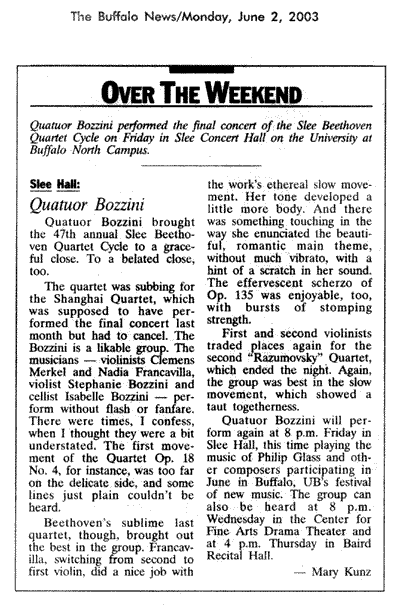
    Quatuor Bozzini brought the 47th annual Slee Beethoven Cycle to a graceful close. The Bozzini is a likable group. The musicians… perform without flash or fanfare… Francavilla was touching in the way she enunciated the beautiful, romantic main theme, without much vibrato, with a hint of a scratch in her sound… the slow movement (of the second “Razumovsky” Quartet) showed a taut togetherness.
  • 14
  • 15
  • 16
  • 17
  • 18
  • 19
  • 20
  • 21
  • 22