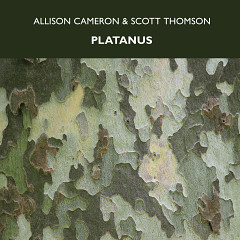
Toronto composer, performer, and improviser Allison Cameron has carved out a distinctive niche in Canadian new music since the mid-1980s, her work marked by an instrumental kaleidoscope and gentle waywardness that tends to elude quick summary. Born in Edmonton and trained at the University of Victoria and York University, she settled in Toronto in 1989, eventually earning a Bang on a Can All-Stars commission that brought her piece November to Lincoln Center in 1994. Montréal trombonist Scott Thomson needs little introduction in these circles: co-founder of AIMToronto, former head of the Guelph Jazz Festival, current Artistic Director of FIMAV, and a player whose allegiance to open improvisation runs bone-deep. The two first crossed paths in 2007 in a trio with the late Toronto polymath Nobuo Kubota. It took the better part of two decades for a proper duo record to materialize. Better late than never.
The instrument at the center of Platanus is not the trombone. It is a plywood-cased, homemade crackle synthesizer that once belonged to Kubota and eventually made its way to Cameron. When Thomson heard her playing it in 2022, he promptly dubbed it the “Cadillac Cracklebox” — a name that does most of the descriptive work on its own. The album is dedicated to Kubota’s memory, and something of his restless, mischievous spirit seems to have followed the instrument into the studio.
Three extended pieces work through Platanus with deliberate arboreal logic, moving from grounded rumble to more exposed terrain. Thomson coaxes breaths, squeaks, and near-melodic smears from his horn with the patience of a player who treats silence as a viable option. Cameron’s arsenal — Cracklebox, additional keyboards, and scattered tapes—answers with clicks, white noise, timbral eruptions and Thomson’s multiphonics that arrive on their own schedule. What sets Cameron and Thomson apart from the broader electroacoustic free improvisation pile is the quality of listening between them—genuinely responsive, at times conversational, elsewhere resembling a quiet disagreement between people who respect each other too much to raise their voices.
Platanus is prickly, patient, and not for the faint of ear—which is precisely what recommends it. Cameron and Thomson have waited nearly twenty years to make this record, and the restraint that shaped that timeline shows up in the music itself. Nothing here is rushed, nothing overstated. It is a small ensemble by any measure, but the sonic world these two construct is anything but.