actuellecd

morceaux_de_machines

47 results
  • 1
  • 2
  • 3
  • 4
  • 5
  • 6
  • 7
  • 8
  • liberum arbitrium, morceaux_de_machines in Blow Up

    “Recensione”, Nicola Catalano, Blow Up, no. 52, September 1, 2002
    Sunday, September 1, 2002 Press

    Animatori dello show radiofonico Napalm Jazz presso l’emittente quebecoise CKIA-FM, presto mutatosi in vero e proprio progetto musicale, Aimé Dontigny e Érick d’Orion hanno da qualche anno mutato denominazione in morceaux_de_machines mantenendo peraltro inalterata l’energia apocalittica della band originaria. Lo dimostra nitidamente l’album d’esordio liberum arbitrium che, prendendo le mosse dall’opera di Anthony Burgess e Luigi Russolo, si distende o piuttosto si aggroviglia in un infernale impasto impro-rumorista di ferocia inaudita. Un urticante attacco massimalista via carta vetra all’apparato uditivo, ed era da tempo che non se ne sentiva di così convincenti. (7/8)
    … un infernale impasto impro-rumorista di ferocia inaudita.
    7

    liberum arbitrium, morceaux_de_machines in AllMusic

    “Review”, François Couture, AllMusic, July 25, 2002
    Thursday, July 25, 2002 Press

    This noise duet is definitely of the maximalist persuasion. Aimé Dontigny and Érick d’Orion sculpt samples, digital noise, and miscellaneous sounds into thrilling oversaturated pieces. There is almost always a lot going on, yet the pair eschews harsh noise for its own sake. The eight improvisations on morceaux_de_machines’s debut CD liberum arbitrium have that sense of form and purpose one finds only in the works of the best noisicians. One could even say they approach the style from an academic electroacoustic point of view. No matter how noisy, dense, or harsh things get, they don’t reach the level where it would be cluttered and always seem to follow a greater plan. cut-up opens the disc with a brutal sound collage. multivisión espacial contains the harsher moments, Merzbow-esque, while rothko tends to be more pensive and restrained. digisex concludes with an orgiastic maelström, the perfect way to end.

    This music is not for the faint at heart, but fans of intelligent noise — the kind that doesn’t take the listener for a brick wall you can throw anything at — will recognize in this album the spark of genius that occasionally sets an artist aside. And the final good news: liberum arbitrium is a class-A production (recorded while the group had a residency at Avatar in Quebec City) and is beautifully packaged with drawings by cartoonist Guy Boutin. A serious contender for best noise album in 2002, highly recommended.

    liberum arbitrium is a class-A production… A serious contender for best noise album in 2002, highly recommended.

    liberum arbitrium, morceaux_de_machines in Splendid E-Zine

    “Review”, George Zahora, Splendid E-Zine, July 25, 2002
    Thursday, July 25, 2002 Press

    This is one of the most disorienting and abrasive CDs I’ve ever heard.

    That’s not an award I hand out lightly. I’ve heard more than my share of noiseartsoundsculpture stuff in the last few years, and while many memories of those listening sessions have been reduced to panic-stricken hindbrain rantings (“Ears Hurt. Brain Hurt. What Noise? Why Loud? Why Hurt? Must Run Away!,” etc.), I’d like to believe that I’m as capable of finding beauty in eardrum-bursting cacophony as anyone can reasonably be expected to be. But I don’t recall having heard any other “improvised computer music” that’s as disjointed, disassociate and relentlessly disquieting as the work of Érick d’Orion and Aimé Dontigny.

    Imagine listening to three different CDs on three different portable CD players at the same time. Now imagine doing it while falling down an endless flight of stairs, the tracks cutting in and out, overlapping and merging as you tumble arse-over-tip. That’s cut-up, liberum arbitrium’s opener, and one of the disc’s most benevolent moments.

    Looking for something a little more invigorating? Try multivisión espacial, a thirteen-minute epic that sounds like nothing so much as a welding torch fight in a jack-in-the-box factory. Or if you’d like something a little more immediate, try the jolting sonic jabs, needle-sharp noise bursts, overmodulated white noise and excessive reverb of spencer; listen carefully, and you’ll discover a catchy little rock rhythm in the depths of the mix… unless you have an aneurysm first.

    If prime shake is a gentle lullaby sung by a solid steel whale to its aluminum and polycarbon children, métal scrap might be an auditory close-up of the sound your car’s engine makes when you don’t change the oil for 30,000 miles. But if you really want to up the ante, skip straight to the closer, digisex. What does it sound like? Imagine a backhoe pushing a combination kitchen garbage disposal/56K modem into a giant glass cistern full of razor blades and styrofoam packing peanuts — oh, and you’re watching and listening to it over a 28K video stream. Makes you want to run right out and buy the disc, doesn’t it?

    The mad thing is, it actually might. If you’ve ever taken a whack at creating improvised processed-noise pieces on your home computer, you know that making them interesting — even making them painful for an extended period of time — takes some serious thought and real creativity. It’s one thing to turn the distortion and the reverb all the way up and leave the room for half an hour; it’s another matter entirely to sit there, in the eye of the storm, fine-tuning the wind and the rain and the lightning. Once you’ve made it through liberum arbitrium a few times, assuming you accomplish such a feat, you’ll develop a legitimate appreciation for d’Orion and Dontigny’s work; they rip sounds apart at an almost genetic level, scrunching them and tearing them and twisting them and hacking at them and carving them into little potato-peeler-curlicues with the ravenous relish of sonic serial killers.

    Realistically, though, there aren’t many people who’ll buy a disc like this, and even fewer who’ll listen to it on a regular basis. This is one of those albums that defines one of the polar “ends” of your record collection. It can’t be listened to casually; simply withstanding it eats up far more mental CPU cycles than the average active listening experience. You can’t ignore it, and you certainly can’t tune it out.

    I figure there are three types of people who’ll buy it:

    1. Academic, wire-rimmed-spectacle-wearing intellectual types who grew up on death metal and have spent their later years seeking out increasingly extreme thrills, attempting to trump other members of their social circle in the difficult listening stakes;
    2. People seeking sonic armament. For instance, I’d love to play digisex at 5:00 a.m., at very high volume, for the cocksucker with the weapons-grade subwoofer who drives past my house with his car stereo blaring at 3:00 a.m., or for the workmen at the town home development down the street who fire up their earth-moving equipment at 6:30 to get a head start on the day;
    3. Random buyers attracted by the cover art and Latin title.

    Regardless of which category suits you, rest assured that you’ve never heard computers make noises like these before (no, not even when you tried to play the OS X install CD). There’s something so resolutely non-musical about liberum arbitrium — despite the brief, unrecognizable song snippets (i.e. the one at the beginning of digisex) that bleed through its pink-noise shell — that its most intractable moments will be like siren songs to those musical explorers who are driven to the polar extremes of sound. You can’t sing along to it, you sure as hell can’t dance to it — hell, you can barely think to it — but you need to hear an album like liberum arbitrium at least once in your life, if only to define your boundaries.

    … they rip sounds apart at an almost genetic level, scrunching them and tearing them and twisting them and hacking at them with the ravenous relish of sonic serial killers.

    liberum arbitrium, morceaux_de_machines in Vital

    “Review”, Brian Lavelle, Vital, June 13, 2002
    Thursday, June 13, 2002 Press

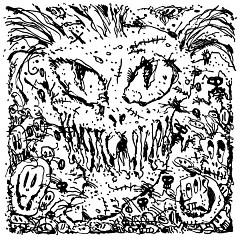
    Swathed in the closest I have yet seen to a Savage Pencil-esque liquefying demon sleeve — a truly fitting representation in pen and ink of this Canadian duo’s music — morceaux_de_machines’ debut CD is an insanely free journey into the possibilities of live laptop performance. Aimé Dontigny and Érick d’Orion’s improvisations are nothing less than startling in a context where the debate often centres mundanely around the merits or otherwise of watching individuals perform the digital equivalent of tape-based works. There is dripping sweat in this music; there is a refreshing ferocity and brutal dynamism in abundance. It seems even at times that the ghost of Coltrane’s 1966/67 interstellar live work pervades the proceedings. The resulting brew is a primordial mix of cut-ups, lifts, uncategorisable loops, acrid and acidic soundscaping and more, all the components reaching half-life at similar points in the fray. Like the sound of the multitude of layers being stripped internally from the walls of the atom, this is pure jazz fission. The penultimate track on liberum arbitrium is entitled rothko and the choice is apt, even as a generalised pointer to the sonic landscape of this disc: oversized slabs of dense, textural colour juxtaposed in an end-to-end fashion, exaggerated, confrontational, surprising — all essential qualities of a difficult but completely mesmerising sonic soup.

    There is dripping sweat in this music; there is a refreshing ferocity and brutal dynamism in abundance. It seems even at times that the ghost of Coltrane pervades the proceedings.

    liberum arbitrium, morceaux_de_machines in Ampersand Etcetera

    “Review”, Jeremy Keens, Ampersand Etcetera, no. 2002_7, May 20, 2002
    Monday, May 20, 2002 Press

    The evil face embedded in the doodlish ghoulish cover illustration by Guy Boutin juxtaposed with Sophie Dowse gentle watercolours on the inner sleeve is somewhat suggestive of direction, and is furthered by the Anthony Burgess quote (which is the only part of the extensive liner notes in English) about “two kingdoms… the eternal and luminous one of the divine lord’s own making, and the noisome stinking pit of pain and horror… of god’s enemy.” Within those notes “fragilité… construction de tension… danger… source des textures” all support the impression gained from the cover and delivered by the music.

    Aimé Dontigny and Érick d’Orion, morceaux_de_machines, create some of the hardest ambient-noise I’ve heard recently, teetering between the pit of despond and the beautiful city. I thought cut-up would be the end of me – there is an on-going click-pop “melody” which sounds like the soundtrack to a sci-fi battle with choppy cd/tape samples below (either some rap of just aggressive people). As it continues, there is a surprising melodic aspect and a shattered stability. The disconcert continues in multivisión espacial with more rapid pops shoots bloops plips and more over samples, which sound like jazz with guitar flute etc. As time passes the aural assault continues, sharp needles of sounds, more noises, and eventually the surface noises become a merged buzz of sounds, brief dropouts, voices in there, to a quieter final minute.

    When you think it will all be overwhelming, lo-fi soundscape eases the impact a little, with lighter whizzy surfaces over piano and sax, again easing to a quieter end. Or spencer’s percussive bursts melded with loose-cable crackle, all echoed slower and quite visceral. Voice pulses enter, it builds and distorts, and then there is a reverbed voice briefly talking to us (an unexpected directness) before a big layered end. And we are caught quite unaware by the lightness of prime shake: gentle pips and burrs, like a computer control room, soft rhythms and crackles, a distant tone melody: the crackle builds, it is all dense restraint into a percussive end.

    métal scrap is well named as a scraping melody weaves through crackles drums and building noises over a soft solid bed, joined by a voice – possibly Hitler or a Dada-esque speech, hard to say – solid and directed. The squeaks clicks and soft tone pulses that open rothko are almost pastoral, electro-frogs, a slow echo-drum running through and slight increased density and pace, the samply-jump behind providing subtle noise, a little more desperate to the end before a crackle-pop fade. The final track digisex swings back to the more oppositional strategy, here a degraded distant pop sample provides some vocals and a rhythm, the bleeps and peeps over increase, subsumed by a soft and rumbly futz – a sort of bolero – and all breaks down again in the last minutes.

    The beginning of this album threw me onto the back foot, and seemed all noise and aggression, but as I listened through it and on replay I actually warmed to it. m_d_m do achieve the straddling of the inferno and paradise suggested in the notes, creating a surprising and satisfying combination of electro-noise with subtler elements weaving through. Intriguing.

    morceaux_de_machines create some of the hardest ambient-noise I’ve heard recently… a surprising and satisfying combination of electro-noise with subtler elements weaving through. Intriguing.
  • 1
  • 2
  • 3
  • 4
  • 5
  • 6
  • 7
  • 8