actuellecd

Ensemble SuperMusique (ESM)

73 results
  • 5
  • 6
  • 7
  • 8
  • 9
  • 10
  • 11
  • 12
  • 13
  • March 16 – 18, 2006: Filature, Hétu’s Sound Theatre Premieres in Montréal

    Tuesday, March 7, 2006 In concert

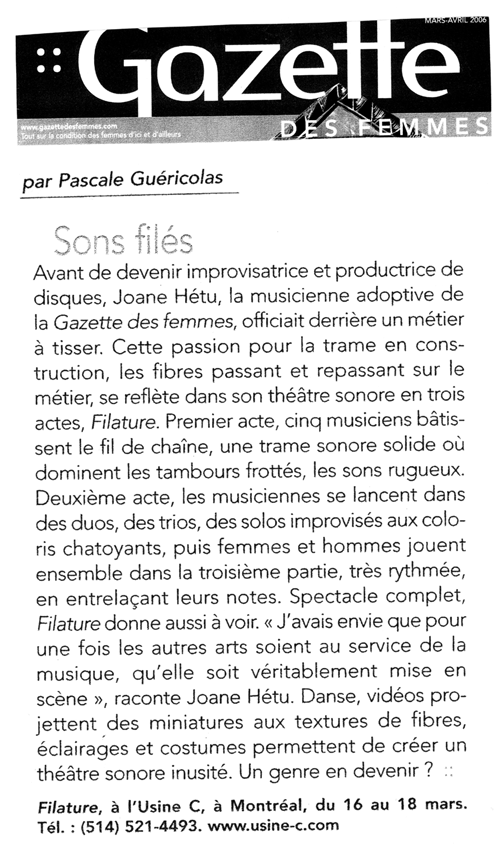
    Saxophonist/vocalist Joane Hétu’s latest work — Filature, a “sound theatre” in three acts — will be presented at Usine C (Montréal) on March 16, 17, and 18, 2006. Filature is a musical allegory on the materials weavers use: warp, weft and pattern. {nbio:hetu_jo} unveils creative fabrics of sound and visuals, where music, dance, video art and lighting intertwine.

    Filature will be interpreted by the Ensemble SuperMusique (Joane Hétu, musical direction, saxophone alto, vocals; Mélanie Auclair, cello; Guido Del Fabbro, violin, electronics; Jean Derome, saxophones, flutes, vocals; Claire Gignac, saxophones, flutes, vocals; Normand Guilbeault, double bass; Diane Labrosse, digital sampler, vocals; Danielle Palardy Roger, percussions; Pierre Tanguay, percussions, vocals; Némo Venba, trumpet).

    Ensemble SuperMusique (ESM), Joane Hétu in La Scena Musicale

    Joane Hétu’s Filature: Theatre of Sound”, Paul Serralheiro, La Scena Musicale, no. 11:6, March 1, 2006
    Wednesday, March 1, 2006 Press

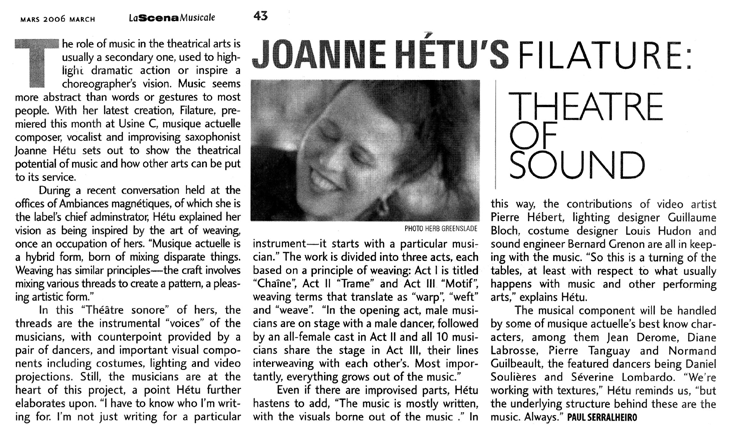
    The role of music in the theatrical arts is usually a secondary one, used to highlight dramatic action or inspire a choraographer’s vision. Music seems mone abstract than words or gestures to most people. With her latest creation, Filature, premiered this month at Usine C, musique actuelle composer, vocalist and improvising saxophonist Joane Hétu sets out to show the theatrical potential of music and how other arts can be put to its service.

    During a recent conversation held at the offices of Ambiances Magnétiques, of which she is the label’s chief adminstrator, Hétu explained her vision as being inspired by the art of weaving, once an occupation of hers. “Musique actuelle is a hybrid form, born of mixing disparate things. Weaving has similar principles — the craft involves mixing various threads to create a pattem, a pleasing artistic form.”

    In this “Théâtre sonore” of hers, the threads are the instrumental “voices” of the musicians, with counterpoint provided by a pair of dancers, and important visual components including costumes, lighting and video projections. Still, the musicians are at the heart of this project, a point Hétu further elaborates upon. “I have to know who I’m writing for. I’m not just writing for a particular instrument — it starts with a particular musician.” The work is dividad into three acts, each based on a principle of weaving: Act I is titled Chaîne, Act II Trame and Act III Motif, weaving terms that translate as “warp”, “weft” and “weave”. “In the opening act, male musicians are on stage with a male dancer, followed by an all-female cast in Act II and all 10 musicians share the stage in Act III, their lines interweaving with each other’s. Most importantly, everything grows out of the music.”

    Even if there are improvised parts, Hétu hastens to add, “The music is mostly written, with the visuals borne out of the music.” In this way, the contributions of video artist Pierre Hébert, lighting designer Guillaume Bloch, costume designer Louis Hudon and sound engineer Bernard Grenon are all in keeping with the music. “So this is a turning of the tables, at least with respect to what usually happens with music and other performing arts,” explains Hétu.

    The musical component will be handled by some of musique actuellets best know characters, among them Jean Derome, Diane Labrosse, Pierre Tanguay and Normand Guilbeault, the featured dancers being Daniel Soulières and Séverine Lombardo. “We’re working with textures,” Hétu reminds us, “but the underlying structure behind these are the music. Always.”

    Musique actuelle is a hybrid form, born of mixing disparate things. Weaving has similar principles — the craft involves mixing various threads to create a pattem…

    actuellecd.com at the Opus Prizes

    Thursday, December 8, 2005 General

    Many actuellecd.com artists are nominated for the 9th Opus Prizes, awarded since 1996 by the Conseil québécois de la musique. The concert Palimpseste d’orchestre, revisiting the musics of Joane Hétu, Diane Labrosse and Danielle Palardy Roger is nominated for “Concert of the Year — actuelle and electroacoustic musics.” Playing Guitar: Symphony #1 by Tim Brady and Portrait Montréal by the Bozzini Quartet will face-off in the category “Disc of the Year — Modern and contemporary musics.” Canevas «+» by the Ensemble SuperMusique and Estrapade by morceaux_de_machines are both nominated for “Disc of the Year — Musique actuelle, Electroacoustics.” Finally, Mingus Erectus, by the Normand Guilbeault Ensemble is nominated for “Disc of the Year — Jazz and World music.” Winners will be announced on January 22, 2006.
    Jean Derome, Ensemble SuperMusique (ESM) in Le Devoir

    “En bref — Escale artistique au Vieux-Port”, Le Devoir, September 23, 2005
    Friday, September 23, 2005 Press

    Demain et dimanche, la deuxième édition des Escales improbables prend d’assaut le quai King Edward du Vieux-Port de Montréal.

    L’événement éclectique conjugue cette année autant de disciplines diverses que le théâtre de marionnettes, le chant lyrique, le cinéma et surtout la musique. Des musiciens-performeurs interprètent des œuvres du compositeur Michel Smith à partir de machines-instruments ambulants. Nicolas Brault fait tomber des baleines du ciel dans un film-conte animé. Jean Derome et SuperMusique proposent une expédition de canot-camping allégorique le long d’une rivière imaginaire. Les côtes gaspésienne et italienne se croisent dans Cargo, théâtre d’image et de marionnettes. On découvre ces performances extravagantes et audacieuses en déambulant au bord du fleuve, comme une invitation au voyage.

  • 5
  • 6
  • 7
  • 8
  • 9
  • 10
  • 11
  • 12
  • 13