actuellecd

More from the blog

16 results
  • 1
  • 2
  • 3
  • Steve Reich: Different Trains in Sonomu

    “Review”, Stephen Fruitman, Sonomu, March 10, 2006
    Friday, March 10, 2006 Press

    A new recording of Different Trains (1988), one of the most significant pieces in composer Steve Reich’s canon, as well as in the œuvre of works dealing with the undealable, the Nazi’s Final Solution.

    Reich explores the Holocaust in a highly personal manner, by juxtaposing his relatively comfortable childhood in the US, being shuttled between his divorced parents across the American continent, with the tape recorded recollections of survivors who had been forced to travel across the European continent on entirely different sorts of trains. A groundbreaking aspect of the piece is the manner in which Reich takes the vocal snippets and has the string quartet imitate the rhythms and cadences of the voices, thereby rendering them in themselves musical. The piece has deservedly received innumerable awards and the World Premiere recording by The Kronos Quartet is simply superb. A devastating acheivement.

    Quatuor Bozzini from Montréal (Clemens Merkel and Nadia Francavilla, violin; Stéphanie Bozzini, viola and Isabelle Bozzini, cello) were encouraged by Reich to attempt their own interpretation. The quartet reinvigorate the piece with its intense playing and attention to detail, and appear even to have inserted some samples of the recorded testimonies which do not appear on the original.

    Different Trains is one of the strongest works of the postwar era. So which to buy? Why not Quatuor Bozzini’s? Aside from the fact that it is every bit as good as Kronos’ version, you will be supporting a new group at the beginning of what promises to be a brilliant career (Kronos hardly need an introduction), own a very nifty little package, all folds and flaps, and spare yourself the tedious second piece on the Nonesuch release, Electric Counterpoint with Pat Metheny on guitar.

    Collection QB is the quartet’s personal imprint under the DAME label umbrella in Quebec, which has already released a previous CD, Portrait Montréal, interpretations of works by their most immediate contemporaries.

    The quartet reinvigorate the piece with its intense playing and attention to detail…

    Steve Reich: Different Trains in Revue & Corrigée

    “Disques”, Pierre Durr, Revue & Corrigée, no. 67, March 1, 2006
    Wednesday, March 1, 2006 Press

    Different Trains est probablement une des œuvres fondamentales de Steve Reich, prélude à ses opéras-vidéos, en introduisant dans la trame répétitive divers effets, collages, voix (la bande magnétique complémentaire superpose trois quatuors à cordes, servant de repère à la prestation scénique du Kronos Quartet). Sur scène, pour peu que la scénographie, la répartition des enceintes acoustiques soient à l’unisson, l’œuvre permet une visualisation sonore à la fois ouverte et ciblée.

    Plusieurs versions en ont été enregistrées depuis celle du Kronos Quartet en l988, sans oublier celle, plus récente (2003) de l’orchestre national de Lyon et ses 48 cordes. Le Quatuor Bozzini, dont c’est ici le second enregistrement, ne pouvait qu’integrer à son répertoire cette œuvre majeure du vingtième siècle finissant. Présenté en public il y a plus d’un an, Different Trains, évoquant la Seconde Guerre mondiale, était associé à Black Angels — thirteen images from the Dark Land (relatif au Vietnam) de George Crumb, lors d’un récital titré «in tempore belli» (en temps de guerre). Le Quatuor à cordes canadien s’est particulièrement impliqué à retravailler l’œuvre de Steve Reich, allant jusqu’à réenregistrer lui-même la bande magnétique complémentaire, ce qui permet aux quatre musiciens de jouir d’une liberté d’exécution et de sonorité que les différents quatuors interprètes n’avaient pas en utilisant la bande préenregistrée initialement par le Kronos. Une manière donc de s’approprier, avec le consentement de Steve Reich lui-même, une heureuse et dynamique relecture de l’œuvre.

    … une heureuse et dynamique relecture de l’œuvre.

    Steve Reich: Different Trains in The WholeNote

    “Review”, Margles, The WholeNote, no. 11:5, February 1, 2006
    Wednesday, February 1, 2006 Press

    Different Trains, from 1988, remains Reich’s most moving work to date. Reich recorded the voices of a Pullman porter who worked the NY – LA line that Reich traveled to visit his mother when he was a child, the governess who accompanied him, three Holocaust survivors, and train sounds. Each quartet pre-recorded three separate tracks to accompany it in performance. The Quatuor Bozzini, based at Concordia University in Montréal, has produced a vivid, gutsy recording. Closely miked, it clearly differentiates the prerecorded tracks from what’s being performed live in the studio. When a taped voice says ‘Black crows invaded our county’ the solo cello responds with hair-raising effect. But the cute cover art and unwieldy packaging don’t appeal to me, and much as I object to choosing a disc for its playing time, 27 minutes seems stingy — as does the lack of information about the piece. At least they give the texts correctly (though without punctuation).

    The Quatuor Bozzini… has produced a vivid, gutsy recording.

    Steve Reich: Different Trains in Splendid E-Zine

    “Review”, Sarah Zachrich, Splendid E-Zine, December 29, 2005
    Thursday, December 29, 2005 Press

    Quatuor Bozzini (the Bozzini Quartet) have tackled both experimental and traditional music in their fairly brief career, but for their second recording, they’ve chosen a piece that falls decisively into the former category.

    Composed in 1968, Different Trains addresses several themes, all steeped in history both personal and cultural. Experimental composer/icon Steve Reich spent much of his childhood shuttling between his estranged parents on opposite coasts of the US. During the late 1930s and early ‘40s, when he grew up, this meant lots of time on trains. Reich is also Jewish; in addition to travel, distance and the romanticism of train travel, Different Trains is colored by a deep-rooted awareness of World War II and the spectre of the Holocaust. The war is what divides Different Trains into its three movements: America — Before the War; Europe — During the War; After the War.

    The Quartet do an amazing job of evoking train sounds, from the inexorable cycles of the wheels to the shrill whistle blasts. Samples of actual trains from the relevant era are layered beneath the strings, and cut-and-pasted voice recordings reminisce disconnectedly about train routes and the war. The vocal samples are wrangled into a truly musical state, mostly by association; the strings echo the voices’ pitch and tone — going strong and staccato for a male’s clipped accents, legato for a softer, slower female.

    Different Trains does what any good piece of music should do: addresses the personal in a larger cultural context. Quatuor Bozzini have done an excellent job of bringing it to life.

    Quatuor Bozzini have done an excellent job of bringing it to life.

    Steve Reich: Different Trains in L’Express

    “Quand la musique est bonne”, Dominique Denis, L’Express, December 20, 2005
    Tuesday, December 20, 2005 Press

    Un des quelques chefs-d’œuvre du minimalisme américain qui sévissait il v a une trentaine d’années, Different Trains illustre le singulier génie de Steve Reich, qui a utilisé les inflections mélodiques de la parole comme point de départ à la composition.

    Hypnotique et paradoxale, cette œuvre en trois mouvements se veut une réflexion quasi-documentaire sur l’holocauste (avant, pendant et après) pour quatuor à cordes (à la fois live et pré-enregistré et bandes magnétiques) avec, comme fil conducteur, l’idée et le rythme du train. On peut remercier le Quatuor Bozzini d’avoir revisité cette partition à la fois mouvante et émouvante, qui n’avait jamais été reprise depuis que le célèbre quatuor Knonos l’avait enregistrée en 1988.
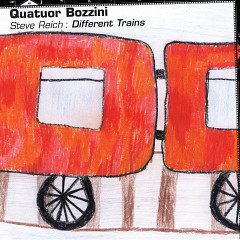
    On peut remercier le Quatuor Bozzini d’avoir revisité cette partition à la fois mouvante et émouvante…

    Steve Reich: Different Trains in Blow Up

    “Recensione”, Gino Dal Soler, Blow Up, no. 91, December 1, 2005
    Thursday, December 1, 2005 Press

    Different Trains è una delle composizioni più celebrate di Steve Reich, per nastro magnetico e quartetto d’archi, dove sono proprio i nastri di brani parlati a dar vita al materiale per il quartetto d’archi. In quei nastri Reich (ebreo) mixava le proprie memorie d’infanzia tra New York e Los Angeles con quelle dei sopravvissuti all’olocausto, una rete densa di voci, suoni di treni, ritmi. Per quest’occasione il quartetto Quatuor Bozzini ha registrato quattro parti per archi di cui una suonata live e le altre provenienti da nastro. Different Trains per quanto acclamata non è onestamente tra le mie composizioni preferite di Steve Reich, ma al Quatuor Bozzini va il merito di averla ripescata 15 anni dopo quella del Kronos Quartet e molti fans so che gradiranno. (6/7)

    Quatuor Bozzini va il merito di averla ripescata 15 anni dopo quella del Kronos Quartet e molti fans so che gradiranno.
  • 1
  • 2
  • 3