actuellecd

More from the blog

13 results
  • 1
  • 2
  • 3
  • Chansons de la belle espérance in Revue & Corrigée

    “Disques”, Pierre Durr, Revue & Corrigée, no. 69, September 1, 2006
    Friday, September 1, 2006 Press

    Associés au début des années 80 au sein de Conventum, membres fondateurs du collectif québécois Ambiances Magnétiques et tous deux en rupture de ban, André Duchesne et René Lussier se retrouvent ici associés dans une chronique commune. Non pas parce que leur parcours fut longtemps commun, mais parce que les deux guitaristes, chacun de leur côté, se tournent vers la chanson. Pour le premier, il s’agit plutôt d’un retour, plus de vingt ans après le “temps des bombes”. […]

    André Duchesne reprend le monde là où il l’a laissé au milieu des années 80, et la situation n’a pas véritablement changé. Constat plutôt amer d’un monde toujours en proie aux “bruits de guerre” certes, mais aussi aux tragiques “faits-divers” locaux, laissant à peine quelques ouvertures plus optimistes avec quelques titres plus humoristiques (Le vieux matou, On est dans la merde). L’accompagnement instrumental (André Duchesne, à la guitare et au piano, est épaulé par Jean Derome, flûtes et saxes, Pierre Tanguay, batterie et Patrick Hamilton à la basse électrique) oscille, selon les pièces, entre hargne, vigueur et nonchalance, privilégiant l’efficacité à l’expérimentation sonore. […]

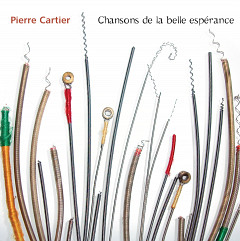
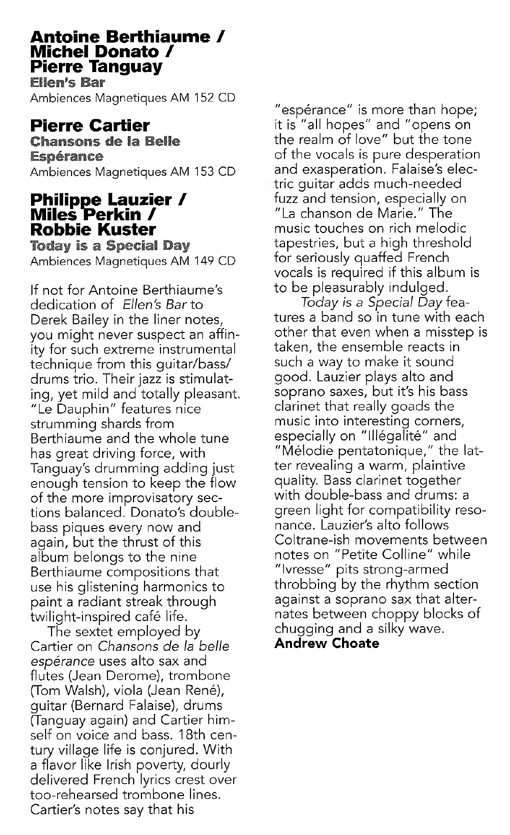
    Bassiste de son état, Pierre Cartier est lui un familier de l’univers de la chanson. Après les Chansons de Douve, puis de celles du “transsibérien”, voici celles de la “belle espérance”. Son propos, ici, est de transcrire certains poèmes québécois (mais aussi Apollinaire) évoquant notamment l’amour, en un jazz vivant et énergique. Le résultat fait preuve de subtils arrangements, toutefois dominés par des approches langoureuses, dues aussi bien à l’alto de Jean René ou au jeu discret de la guitare de Bernard Falaise.

    Ellen’s Bar, Chansons de la belle espérance in Vital

    “Review”, Dolf Mulder, Vital, no. 538, August 9, 2006
    Wednesday, August 9, 2006 Press

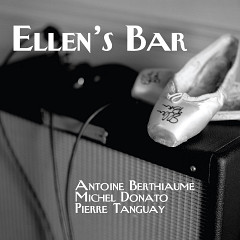
    With Ellen’s Bar guitarist Berthiaume delivers his third album for Ambiances Magnétiques. He debuted with Soshin, a free improvised record with duos with Derek Bailey and Fred Frith. His second one was also a free improvised record with some young musicians of Berthiaume’s generation. For Ellen’s Bar Berthiaume formed a trio with Pierre Tanguay on drums and Michel Donato on bass. No free improvised explorations this time, but a true jazz album. And a very nice one too. Nicely grooving from beginning to the end. Tanguay and Donato turn out to be perfect partners for Berthiaume who does some nice solowork with great control. Most pieces are the same in mood and tempo, not fast, not too slow. But always very captivating. No loose ends on this one.

    Pierre Cartier also returns for his newest cd to the classic jazz period. With Jean Derome (sax and flutes), Jean René (viola), Tom Walsh (trombone), Bernard Falaise (guitar) and Pierre Tanguay (drums), Pierre Cartier (voice and bass) offers a new collection of jazz-inspired songs. As in earlier song cycles Cartier uses poems from diverse french-speaking poets. For his new album, he choose poems from Québécois poets (Michel Garneau, Gaston Miron, Pierre Perrault, Paul-Marie Lapointe), plus one by Apollinaire and another one by himself. To be more precise, for this new cycle of songs Cartier sought inspiration by jazz standards and Broadway love songs. Nevertheless his songs have a definitely french flavor, and not that typical american character of the predecessors that Cartier inspired. They are for example not so smooth, because Cartier has his very own way of placing accents in his singing style that is sometimes close to dissonance. Most ballads continue in their own slow tempo giving plenty of room for nice solowork by Derome, Walsh and the others.

    … a true jazz album. And a very nice one too.

    Chansons de la belle espérance in AllMusic

    “Review”, François Couture, AllMusic, July 1, 2006
    Saturday, July 1, 2006 Press

    Chansons de la belle espérance is Pierre Cartier’s third song cycle, his second with this line-up and his most achieved work to date. The bassist’s intention was to produce a set of love songs in continuity with the French jazz standards. But Cartier being the unique artist that he is, the resulting music outgrows its original concept. What Cartier offers here is a delightful set of moving songs anchored in jazz ballad, Baroque counterpoint, (extremely well controlled) avant-jazz dissonances, and improbable melodies. Yes, improbable, because the man has a very personal sense of melody favoring unusual intervals and a certain solemnity that inscribes this album in direct filiation with «Dis, Blaise…», his previous effort. Supporting Cartier is the equivalent of an Ambiances Magnétiques All-Star band, with Jean Derome (sax and flutes), Jean René (viola), Bernard Falaise (guitar) and Pierre Tanguay (drums), all brilliantly executing and extrapolating on Cartier’s scores. Highlights include Dédicace de la belle espérance and its striking melody that immediately sets the tone for the whole album; the lament La chanson de Marie, the song coming closest to the plain chant stylings of «Dis, Blaise…»; and the devastatingly beautiful Mirabeau, the pinnacle of Cartier’s songwriting to this date. Portrait, more overtly jazzy, is the only weaker track on the album, and only because it sticks too close to the artist’s original idea. Cartier had based his previous two projects on the works of French poets (Yves Bonnefoy for Chansons de Douve, Blaise Cendrars for «Dis, Blaise…» chanson du Transsibérien). This time, he selected poems from a number of Québécois poets (Michel Garneau, Gaston Miron, Pierre Perrault, Paul-Marie Lapointe), plus one by Apollinaire and another by himself — a first. English-speaking listeners can rely on Cartier’s short analysis of each poem to get the gist of it. But in the end, and even though these poems rank among the best in Quebec literature, these songs will move you, whether you understand them or not. Cartier’s soft, fragile tone and Gregorian solemnity probably make him a case of love-him-or-hate-him; honestly, this reviewer would not know. Highly recommended.

    But in the end, and even though these poems rank among the best in Quebec literature, these songs will move you, whether you understand them or not.
  • 1
  • 2
  • 3