actuellecd

More from the blog

16 results
  • 1
  • 2
  • 3
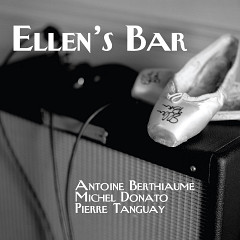
  • Ellen’s Bar in Voir

    “Critique”, Réjean Beaucage, Voir, October 26, 2006
    Thursday, October 26, 2006 Press

    Ceux qui ont découvert le guitariste Antoine Berthiaume par ses deux premiers disques seront surpris: pas de triturations des textures ou d’improvisations totalement abstraites ici, mais plutôt un retour aux racines du jazz. Berthiaume, qui a fait ses premières armes dans le genre avec le prof Ben Charest au Cégep de Saint-Laurent avant d’aller s’éclater à Londres avec Derek Bailey, s’entoure ici de deux solides acolytes: Michel Donato à la contrebasse, et Pierre Tanguay sans autre instrument qu’une batterie bien standard. Le trio de base. Le guitariste signe 9 des 11 titres en se souvenant de ses gigs à l’air du temps. C’est bluesy par moments, enfumé malgré les règlements, et ça s’écoute le soir venu. (4/5)

    C’est bluesy par moments, enfumé malgré les règlements, et ça s’écoute le soir venu.

    Ellen’s Bar in The WholeNote

    “Review”, Ken Waxman, The WholeNote, no. 12:1, September 1, 2006
    Friday, September 1, 2006 Press

    Forty years after he arrived on the scene, Michel Donato is still Montréal’s first-call jazz bassist. These CDs demonstrate why Donato, 64, who has backed everyone from chansonier Gilles Vigneault to pianist Oscar Peterson, is in such demand. […] On Ellen’s Bar, for instance, he adds his rock-solid rhythm to 11 originals otherwise featuring two players better-known for their commitment to musique actuelle: guitarist Antoine Berthiaume and drummer Pierre Tanguay. […] Here the guitarist’s supple fills and soloing lie within parameters set by Herb Ellis and Bill Frisell, giving the CD a country-ish vibe. […] Similar teamwork is apparent on the other CD, although the guitarist takes most of the solos. In this smaller setting Donato is more sensed than heard, though his oblique, sturdy piloting remains. The nub of Tanguay’s accompaniment is rim shots and ratamacues, unique additions to the guitarist’s lapidary solos. Using chiming runs, Berthiaume shines with a natural romantic bent. Prime instance of this is Nose Worthy. Sprinkled with C&W licks, the straightforward melody skirts ordinariness due to drum rolls and pops plus a walking bass line. Tough plucking from Donato rescues other tunes where the guitarist’s finger-picking threatens to move into supper club territory. […]

    Berthiaume shines with a natural romantic bent.

    Ellen’s Bar in La Scena Musicale

    “Au rayon du disque”, Félix-Antoine Hamel, La Scena Musicale, no. 12:1, September 1, 2006
    Friday, September 1, 2006 Press

    Étiquette emblématique de la musique actuelle, Ambiances Magnétiques est sur le point de devenir la référence en matière de jazz contemporain au Québec. Pour son troisième album pour ce label, le guitariste Antoine Berthiaume offre un programme de neuf de ses compositions, soutenu par le maître-contrebassiste Michel Donato et le «batteur-maison» de l’étiquette, Pierre Tanguay, ces derniers contribuant chacun d’un morceau de leur cru. Alors que les projets précédents de ce jeune guitariste étaient plutôt expérimentaux (son premier album Soshin nous permettait de l’entendre avec nuls autres que Derek Bailey et Fred Frith), ce récent disque se situe tout droit dans la lignée des trios à la Pat Metheny ou John Abercrombie. Parmi les pièces, La Betterave, un calypso de Tanguay auquel seul le ténor de Sonny Rollins semble manquer, offre un contraste bienvenu au sein d’un répertoire résolument moderne. Berthiaume démontre un exceptionnel contrôle de son instrument, jouant dans un style complexe mais fluide, alors que ses acolytes lui donnent un appui idéal et se montrent flexibles dans leurs accompagnements. Impressionant!

    Impressionant!

    September 6 – 24, 2006: Berthiaume’s Ellen’s Bar Live in Montréal

    Tuesday, August 22, 2006 In concert

    Antoine Berthiaume will present the latest compositions from his album Ellen’s Bar in various venues across Montréal. {nbio:berthiaume_an} will play with Robbie Kuster and Clinton Ryder at Casa del Popolo on September 6 2006, and at the Quai des Brumes on September 11.

    {nbio:berthiaume_an} and {nbio:kuster_ro} will also play alongside Michel Donato at La Mesure du Temps (L’Assomption) on September 15, at La Chasse Galerie (Lavaltrie) on September 16, and at the Upstairs Jazz Bar & Grill on September 24.

    Ellen’s Bar, Chansons de la belle espérance in Vital

    “Review”, Dolf Mulder, Vital, no. 538, August 9, 2006
    Wednesday, August 9, 2006 Press

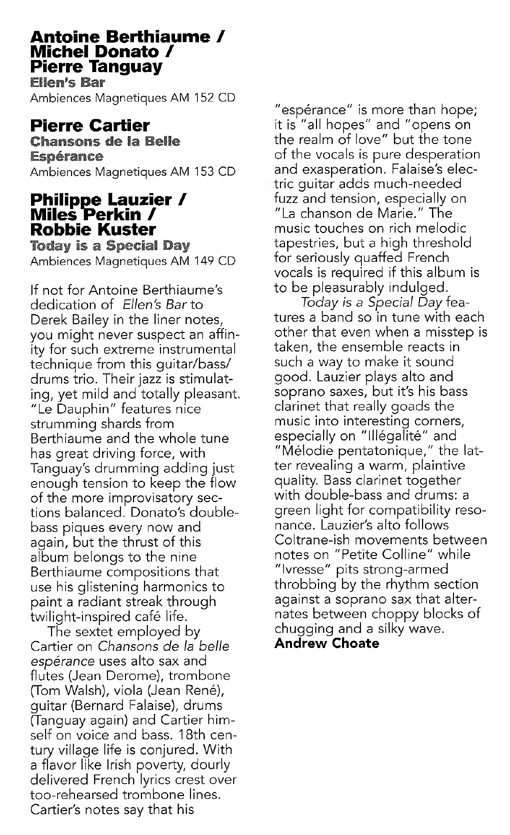
    With Ellen’s Bar guitarist Berthiaume delivers his third album for Ambiances Magnétiques. He debuted with Soshin, a free improvised record with duos with Derek Bailey and Fred Frith. His second one was also a free improvised record with some young musicians of Berthiaume’s generation. For Ellen’s Bar Berthiaume formed a trio with Pierre Tanguay on drums and Michel Donato on bass. No free improvised explorations this time, but a true jazz album. And a very nice one too. Nicely grooving from beginning to the end. Tanguay and Donato turn out to be perfect partners for Berthiaume who does some nice solowork with great control. Most pieces are the same in mood and tempo, not fast, not too slow. But always very captivating. No loose ends on this one.

    Pierre Cartier also returns for his newest cd to the classic jazz period. With Jean Derome (sax and flutes), Jean René (viola), Tom Walsh (trombone), Bernard Falaise (guitar) and Pierre Tanguay (drums), Pierre Cartier (voice and bass) offers a new collection of jazz-inspired songs. As in earlier song cycles Cartier uses poems from diverse french-speaking poets. For his new album, he choose poems from Québécois poets (Michel Garneau, Gaston Miron, Pierre Perrault, Paul-Marie Lapointe), plus one by Apollinaire and another one by himself. To be more precise, for this new cycle of songs Cartier sought inspiration by jazz standards and Broadway love songs. Nevertheless his songs have a definitely french flavor, and not that typical american character of the predecessors that Cartier inspired. They are for example not so smooth, because Cartier has his very own way of placing accents in his singing style that is sometimes close to dissonance. Most ballads continue in their own slow tempo giving plenty of room for nice solowork by Derome, Walsh and the others.

    … a true jazz album. And a very nice one too.
  • 1
  • 2
  • 3