actuellecd

More from the blog

15 results
  • 1
  • 2
  • 3
  • Carré de sable in Informator “Ars” 2

    “Review”, Henryk Palczewski, Informator “Ars” 2, no. 39, March 1, 2004
    Monday, March 1, 2004 Press

    Solowe wydawnictwo przedstawiciela mlodego pokolenia skupionego wokól Ambiances Magnetiques. Urodzony w 1980 roku muzyk gra na skrzypcach od czwartego roku zycia. My znamy go z udzialu w takich przedsiewzieqciach jak: Fanfare Pourpour, L’hôtel du bout de la terra, Rouge ciel oraz mozemy zobaczyé go na kasecie video “Confidences d’une Fanfare” Richard Lavoie. W latach 2000-2001 wspólpracowal z Gaetan Leboeuf tworzac muzyke do tanca w choreografii Magie Gillis.

    Jego podstawowym instrumentem sa oczywiscie skrzypce ale tym razem daje sie nam poznac jako multiinstrumentalista a takze znalazca nowych dzwiekow tworzonych przez uzywanie przedmiotów. Ten CD wypelnione jest miniaturkami, prawie ze szkicami krókich chwil, mgnien i emocji z nimi zwiazanymi. Dominuje tradycja nowej elektrycznej muzyki kameralnej wzbogacona w awangardowy jezyk wspólczesnej muzyki elektro-akustycznej i preparowanej. Przewazaja pogodne, nieco zamyslone, nostalgiczne opowiadania, chociaz w paru momentach robi sie zlowieszczo, groznie i tajemniczo. Nawet brudne dzwieki preparu nie burza, glównego nastroju muzyki. To abstrakcyjna pozycja ale poprzez zdecydowane opisywanie namietnosci konkretyzuje sie, w nas bardzo jednoznacznie. On sam mówi, ze tworzyl muzyke zachowujac sie jak dziecko w piaskownicy i nie szukal wyrafinowanych struktur. I rzeczywiscie jego muzyka jest prosto bodowana ale przez charyzmat osobowosci twórcy uzyskuje potezna magie, i rytual stajac sie wazna w kazdym momencie, nie traca przy tym wspomnianej pozytywnej prostoty i poruszajac sie w przestrzeni wielu kolorów i odleglosci
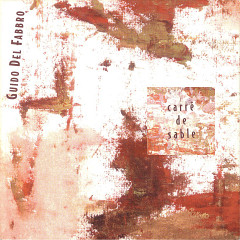
    Carré de sable in SOCAN — Paroles & Musique

    “Critique”, Gilles Boisclair, SOCAN — Paroles & Musique, no. 11:1, March 1, 2004
    Monday, March 1, 2004 Press

    Violoniste de la Fanfare Pourpour et de Rougo Ciel, Guido Del Fabbro s’aventure pour son premier projet solo dans l’univers du bruitisme et de l’électroacoustique. Le titre Carré de Sable n’est pas un hasard, puisqu’il y joue avec les ambiances sonores et les improvisations multi-pistes, mariant instruments acoustiques (violon, flûtes, banjo), tourne-disque et cafetière. Un voyage insolite traversé par des mélodies envoûtantes. Âgé de 23 ans, Guido Del Fabbro nous étonne par son originalité.

    Un voyage insolite traversé par des mélodies envoûtantes.

    Carré de sable in Exclaim!

    “Review”, Glen Hall, Exclaim!, February 27, 2004
    Friday, February 27, 2004 Press

    Youthful Montréal composer/improviser Guido Del Fabbro wilfully and playfully — the CD’s title means “sandbox” — flouts the music industry’s Big Rule: keep your music consistent (often to the point of dumbing it down). Del Fabbro, a marketing department’s worst nightmare, clearly doesn’t give a damn about the Big Rule as his 19 pieces, ranging in length from 52 seconds to a hair over five minutes, break it with gleeful abandon. The tunes — all multi-tracked by the composer playing a welter of instruments (violin, coffeepot, turntable, living room organ, telephone, etc.) with two guests, vocalist Marie-Claude Lamoureux and bass clarinettist Pierre-Emmanuel Poizat—wistfully wander from musique concrete, Mahavishnu skronk and ambient grooves to exotica. Some pieces like Jaka and especially Ipp Tv, which shows a highly developed ear for sound colours, felt like they could go on longer. While Del Fabbro could be criticised for not developing his pieces, what seems clear is that his approach is focussed on creating musical aphorisms not detailed novels. Not that he never develops an idea, but expansion is merely one strategy in his modus operandi. The label’s chief Joane Hétu is to be applauded for supporting the beautifully recorded work of this adventurous iconoclast’s aural bravado.

    Carré de sable in Solénoïde Radio

    “Radiobalisage”, Solénoïde Radio, February 22, 2004
    Sunday, February 22, 2004 Press

    Après quelques apparitions remarquées dans diverses formations locales (Rouge Ciel, L’hôtel du bout de la terre), le Montréalais Guido Del Fabbro sort ce premier opus en solo. Un album cocasse et raffiné composé, selon les termes de l’auteur, de «19 pièces de musiques de chambre… d’hôtel»! Vous l’aurez compris, ce violoniste de formation possède plus d’une corde à son arc, dont celle de l’humour. Dans ce disque, l’énergumène module, bricole et emboîte sans distinction éléments populaires et savants. Sans véritable fil conducteur, mais avec une vraie malice créative, il se montre aussi bon sculpteur de fantaisies digitales que compositeur de berceuses ethniques. Multi-instrumentiste touche-à-tout, Del Fabbro utilise tout ce qui lui tombe sous la main, passant allégrement du darbouka à la cafetière ou encore du téléphone à la flûte à bec. Filant avec brio la métaphore infantile, voici un album qui séduira à coup sûr les amateurs de valses des étiquettes… musicales!

    … avec une vraie malice créative, il se montre aussi bon sculpteur de fantaisies digitales que compositeur de berceuses ethniques.

    Carré de sable in Ici Montréal

    “Compact!”, François Couture, Ici Montréal, January 22, 2004
    Thursday, January 22, 2004 Press

    Violoniste de Rouge Ciel et de la Fanfare Pourpour, Guido Del Fabbro se révèle homme orchestre sur son premier album solo. Il y joue de 29 instruments: cordes, vents, percussions et électroniques. Ce joyeux fouillis bourlingué d’une chambre d’hôtel à l’autre (l’album a été enregistré sur deux ans, à la maison et en tournée) se reflète dans l’éclectisme des styles abordés: éléments de musique traditionnelle, d’électronica lo-fi, d’ensembles de jouets et de détritus, en plus d’une influence provenant du courant néopsychédélique de l’underground américain (Jewelled Antler Collective, Tower Recordings). Et de cet univers complexe et fragmenté se détachent des mélodies séduisantes.

    De cet univers complexe et fragmenté se détachent des mélodies séduisantes.

    Carré de sable in AllMusic

    “Review”, François Couture, AllMusic, January 15, 2004
    Thursday, January 15, 2004 Press

    Known for his participation to the Fanfare Pourpour (an avant-garde street fanfare) and Rouge Ciel (a hyper-complex avant-prog group), violinist Guido Del Fabbro reveals his inner sound world with Carré de Sable (or Sandbox). Truly a one-man band, he is credited for playing 29 different instruments ranging from his trusty violin to banjo, recorder, turntable, outdated keyboard, various hand-held percussion instruments, voice, even water. Each one of the 19 tracks features a different instrumentation and the music itself shifts from one style to another, eluding classification. There are elements of Quebec and Irish folk (Del Fabbro’s other projects are all influenced by folk music to some degree), bedroom electronica, the naive junk/toy ensembles of Frank Pahl or Pascal Comelade, and home-brewed sound experiments reminiscent of the Jewelled Antler Collective. The whole thing is a bit dizzying at first and can be seen as a case of hit and miss. The track list occasionally jumps out of hand: for instance, the beautiful pastoral overture La Bergerie I is followed by Jaka, a rather miserable attempt at lo-fi techno (even if it is meant as an ironic take on the genre, and it may very well be). Other sections on the other hand are obviously the result of careful attention to editing. Adventurous listeners will find gems buried in this pile of fragile melodies and strange textures, and they will differ for each person. But the best moments arise when Del Fabbro throws everything into the pot, like when an elegant duet between violin and bass clarinet (Pierre-Emmanuel Poizat, a rare guest) is backed by gritty guitar drones in Gaviscon. These short pieces recorded while on the road give the impression of a little meddler (to pursue the childhood metaphor developed by Del Fabbro in the booklet). The album has the pros and cons of a scrapbook: variety, lots of imagination, but a lack of organization and cohesion.

    … variety, lots of imagination…
  • 1
  • 2
  • 3