
La boulezaille
Pierre Langevin, Pierre Tanguay
Their creativity is nonstop, quickly moving from instrument to instrument and style to style, creating a form of twenty-first-century folk music. — Musicworks, Canada
Pierre Langevin etPierre Tanguay , transforment cet enregistrement en une symbiose d’éléments disparates qui n’aurait pu voir le jour sans leur immense talent… — SOCAN — Paroles & Musique, Canada
Hard at work in many projects released by Ambiances Magnétiques, Pierre Tanguay introduces a new duo, this time with Pierre Langevin, known for his tenure in the group Strada. As on Tanguay’s solo album La musique de mon disque, the instrumentation on “La Boulezaille” consists of a merry blend of traditional and invented instruments, a blend that aims at understanding the past to better our understanding of the future.
Here’s Pierre Tanguay’s album, in his own words
- Composer(s): Pierre Langevin, Pierre Tanguay
- Performer(s): Pierre Langevin, Pierre Tanguay, Jean Derome, Jean René
- Graphic design: Fabrizio Gilardino
CD (AM 114, 2003)
- 1Ne partez pas sans être heureux (2003), 6:19Pierre Langevin, clarinet, duduk, bagpipes
; Pierre Tanguay, whistles, box of crickets, alarm bells, book toy, thrush duck call, tuned bottles, Béarn drum, saw, madriophone, metal brush - 2Le chalumeau de la paix (2003), 6:05Pierre Langevin, mouth harp, blowtorch, voice, double recorder
; Pierre Tanguay, mouth harp, voice, box tabs, drum bowl, small tambourine, alarm bells, teapot, horse collar bells, guiro plastic pipe, water bowl, tourniquet, corrugated iron - 3Voilà! (2003), 5:32
- 4Le grand bonhomme de chemin (2003), 8:11
- 5Danse du vent comme dans le temps (2003), 4:41
- 6La scie voleuse (2003), 5:52
- 7Mon ami (2003), 6:36
- 8La boulezaille (2003), 0:05
- Label: Ambiances Magnétiques
- AM 114
- 2003
- UCC 771028111428
- Total duration: 43:53
- Sympathique case
- 126 mm × 126 mm × 5 mm
- 45 g
On the web
Some recommended items

In the press
Critique
Respectivement clarinettiste (mais aussi joueur de cornemuse ou de chifonie) et percussionniste (doué quand même pour la boîte à languettes ou l’harmonica),
Playful Québécois Innovation
This CD reminds me that some of the most innovative and playfully experimental music in Canada regularly comes from Quebec. Here, two seasoned multi-instrumentalists draw on their vast experiences in musique actuelle, jazz, folk, early, new, and world music to create a playground for the ears. Their creativity is nonstop, quickly moving from instrument to instrument and style to style, creating a form of twenty-first-century folk music. Fascinating
Kritik
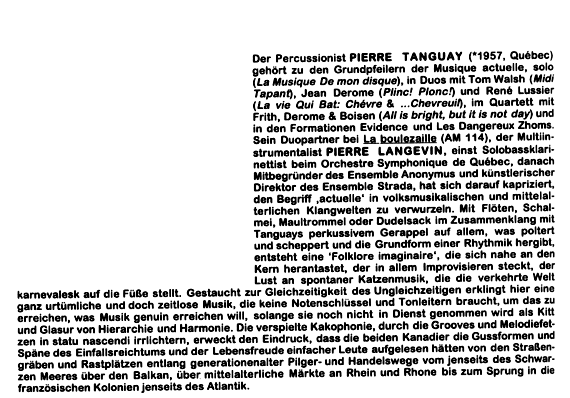
Critique
Fin mélange d’instruments anciens et modernes ainsi que de différents bruits naturels et de sons synthétiques
Critique
Pendant ses vingt premières années d’existence, le collectif éditait principalement les réalisations de ses membres, à la rigueur celles de certains de leurs collaborateurs occasionnels. Ce n’est qu’au tournant du millénalre que peu à peu Ambiances Magnétiques décida d’ouvrir son catalogue à de nouvelles entités. C’est ainsi que l’auditeur découvrit peu à peu des musiciens tels que
Plutôt que de sortir une énième compilation des œuvres plus ou moins inédites des artistes
Mais l’écoute d’une seule traite de l’ensemble des titres ne permet pas — c’est le lot de la plupart des compilations — d’entrer pleinement dans l’univers respectif de chaque proposition et l’auditeur, selon son état d’esprit du moment, ne retiendra qu’une ou deux propositions qui d’emblée le feront réagir. Je citerai personnellement In Vitro pour ses sonorités d’harmonica traitées, créant une atmosphére quelque peu étrange ou encore le duo Cléo Palacio Quintin &
Sang 9 reste cependant un témoignage intéressant de la relève (générationnelle
Ambiances Magnétiques consacrent justement une de ses récentes productions à un musicien présent sur Sang 9.
Review
Modern Composition
Don’t be misled by the “Pierres” and the “
Modern Folklore
When I was asked to dive into DAME’s catalog in search of intersecting points or recurring themes that would sketch discovery trails, the trad connection stood out immediately. Not only because of the importance of traditional folk music in the development of avant-garde music in Quebec, but also because the albums belonging to this line usually speak to us in a more immediate way and are easier to grasp.
It may seem a bit paradoxical, but tradition and innovation often go together hand in hand. When a culture’s avant-garde artists look for ways to overstep the rules of the music industry, they often turn their attention to roots — theirs and others — to find new paths to explore. Traditional folk music often holds at his core treasures of stylistic freedom and improvisation. Furthermore, its festive outlook can make it easier for an audience to accept and appreciate the introduction of new rhythmic, melodic or improvisational parameters. That’s what happened and continues to happen in Quebec. Here’s a listening trail in three parts, three original ways DAME artists approach the tradition
Revisited folk
Late 1970s
In Ambiances Magnétiques, René Lussier has continued to explore a rereading of Quebec’s music history. His discography is peppered with folk tunes stripped naked and dressed anew. On his three albums with Les Granules (a duo with Jean Derome) he exaggerates the Dionysian character of the music (
Reinvented folk
The folklore of a nation is not limited to a body of songs, it is also a state of mind, a substratum from which many artists in DAME’s catalog dig to reinvent our traditional folk music (and others too). On La Boulezaille, Pierre Tanguay and Pierre Langevin (masters of many European folk music in the group Strada) mix up traditional and modern instruments in search of a new, “actuel” folk freed from the cage in which all kinds of traditionalists would like to preserve it. Groups like Interférence Sardines and La Fanfare Pourpour shape their original pieces in ways that bring to mind the Devil’s fiddler or street fair music (music of the people, the prime definition of “folk” music). Joane Hétu’s Musique d’hiver doesn’t have that festive side to it, but it nevertheless redefines the folklore of our Quebec winters with much more precision and evocative strength then Nelligan’s famous poem.
Made-up folk
Traditional folk music refers to an instinctive form of music-making, music created outside the institutions and their codes, everyday music. And what if one wants to step out of the everyday
Translated from French.
Review
Wydaje sie ze ie mniej znana, nam postacia jest
Duet
Review
In his duo with
Compact!
9
Review
Disques
Drôle de couple que celui-là, qui relie musique médiévale et musique, actuelle pour en faire une tapisserie sonore sans âge, grouillante d’une faune de bruits et de sons qui n’ont pas l’habitude de fréquenter les mêmes pistes. Les clarinette, chifonie ou cornemuse de
Review
Opening with a discordant flute, this disc initially leads the listener to expect the mind-bending found-sound experiments for which Ambiances Magnétiques are deservedly known. Instead, this pair of Pierres take listeners on a relatively grounded exploration of classical Indian music. The eight compositions abound with drones and delicately shaded textures, combining low-pitched wind drones with melodies just foreign enough to induce thought, but not confusion. I find it particularly pleasing that many of the disc’s soft sounds mimic those just outside my door. For example, the low pan flute notes that open
This repetition serves to bring out the subtle textures of the recording itself. The slow, insinuating introduction of a tabla in
Although the disc offers little of the frantic playing that tends to attract Western ears to Eastern music, there are nevertheless a number of wonderful, thoughtful moments to be experienced here. True, this music comes by way of two French Canadians, but the tradition and intent behind La Boulezaille are derived directly from India.