
Musique d’hiver
Joane Hétu
… at times engaging in a Satie-like sense of melancholy isolation… — Rubberneck, UK
… such a tranquillity that it becomes almost immortal music from past ages with a dada attitude. — Sztuka Fabryka, Belgium
A recent release from the ever-prolific Joane Hétu, the work “Musique d’hiver” (winter music) pays tribute to the frisky Nordic winds, the blinding luminosity of winter, the February moon, and the craziness of March, in order to communicate the emotional effervescence of winter.
A 66-minute piece in four scenes (La chute, On se les gèle, Lumière de février, J’ai perdu le nord), “Musique d’hiver” is arranged for acoustic instruments — piano, voice, flutes, alto sax, accordion, percussion — and electric instruments — synthesizer, sampler, and tape manipulation.
It is an invitation to a music ritual for a season of frost and high winds
You will be charmed by the freshness of this winter poetry and by this picturesque scene highlighted by acoustic and metaphorical sonorities.
- Composer(s): Joane Hétu
- Writer(s): Joane Hétu
- Performer(s): Jean Derome, Guillaume Dostaler, Diane Labrosse, Pierre Tanguay
- Cover image: Jean Derome
- Graphic design: Luc Beauchemin
- This item is also included in the Tryptique musique d’hiver box set (AM 904).
CD (AM 091, 2001)
- 1Musique d’hiver (1999-2000), 66:06
- 1La chute, 15:45
- 1La chute [sub-movement], 3:51
- 2La joie, 2:48
- 3La plus froide, 4:40
- 4Le silence de la tempête, 4:27
- 5On s’les gèle, 17:24
- 5On s’les gèle [sub-movement], 4:34
- 6Christaux cristalisés, 2:01
- 7Bourrasque, 2:44
- 8Nord / ouest, 1:49
- 9Épaisse la couverture, 3:05
- 10Tension on gèle, 3:11
- 11Lumière de février, 17:12
- 11Bleu ciel, 5:47
- 12Blanc sur terre, 6:03
- 13Nuits d’hiver, 3:07
- 14Danse de chandelle, 2:16
- 15Perdu l’nord, 15:44
- 15Hémisphère nord, 5:07
- 16C’est trop long, 4:11
- 17Perdu le nord, 1:47
- 18Je dors, 4:37
- Label: Ambiances Magnétiques
- AM 091
- 2001
- UCC 771028109128
- Total duration: 66:06
- 125 mm × 125 mm × 7 mm
- 50 g
On the web
Some recommended items
-
-
-
-
-
 Various artists
 -
-
 Various artists
 -
-
 Various artists
 -
-
-
In the press
Modern Folklore
When I was asked to dive into DAME’s catalog in search of intersecting points or recurring themes that would sketch discovery trails, the trad connection stood out immediately. Not only because of the importance of traditional folk music in the development of avant-garde music in Quebec, but also because the albums belonging to this line usually speak to us in a more immediate way and are easier to grasp.
It may seem a bit paradoxical, but tradition and innovation often go together hand in hand. When a culture’s avant-garde artists look for ways to overstep the rules of the music industry, they often turn their attention to roots — theirs and others — to find new paths to explore. Traditional folk music often holds at his core treasures of stylistic freedom and improvisation. Furthermore, its festive outlook can make it easier for an audience to accept and appreciate the introduction of new rhythmic, melodic or improvisational parameters. That’s what happened and continues to happen in Quebec. Here’s a listening trail in three parts, three original ways DAME artists approach the tradition
Revisited folk
Late 1970s
In Ambiances Magnétiques, René Lussier has continued to explore a rereading of Quebec’s music history. His discography is peppered with folk tunes stripped naked and dressed anew. On his three albums with Les Granules (a duo with Jean Derome) he exaggerates the Dionysian character of the music (
Reinvented folk
The folklore of a nation is not limited to a body of songs, it is also a state of mind, a substratum from which many artists in DAME’s catalog dig to reinvent our traditional folk music (and others too). On La Boulezaille, Pierre Tanguay and Pierre Langevin (masters of many European folk music in the group Strada) mix up traditional and modern instruments in search of a new, “actuel” folk freed from the cage in which all kinds of traditionalists would like to preserve it. Groups like Interférence Sardines and La Fanfare Pourpour shape their original pieces in ways that bring to mind the Devil’s fiddler or street fair music (music of the people, the prime definition of “folk” music). Joane Hétu’s Musique d’hiver doesn’t have that festive side to it, but it nevertheless redefines the folklore of our Quebec winters with much more precision and evocative strength then Nelligan’s famous poem.
Made-up folk
Traditional folk music refers to an instinctive form of music-making, music created outside the institutions and their codes, everyday music. And what if one wants to step out of the everyday
Translated from French.
Chicks and Other Barnyard Fauna
With the notable exception of sugary pop, all music styles are dominated by the male. Whether he’s grunting into the microphone, strumming his guitar, or blowing his lungs out on the saxophone, the manly man monopolizes the image of the musician, be it in corporate rock or on the new music scene. When women venture into his domain, they are often coerced into fitting the mold of the industry.
That’s why it is so surprising to find this many creative, challenging, talented women in DAME’s catalog. But one should not forget that early in its lifetime the collective Ambiances Magnétiques welcomed three artists whose musical activities, organizing minds and determination provided a force of attraction for other women. Of course, I am talking about
Our three protagonists met at the turn of the ‘80s in
Soon after the release of Langages fantastiques, the three girls launched their solo careers. Linguistic marvel and a rough delivery keep singer and saxophonist Joane Hétu close to the field of outsider art. First she formed her own group
Toward the end of Justine’s life, Diane Labrosse traded in her keyboard for a sampler. After a solo album,
Since the disbanding of Justine, Danielle Palardy Roger’s discography has been growing slowly — she’s very busy organizing concerts as head of Productions SuperMusique. Her children’s tale
In 1986, Joane, Diane and Danielle took a vacation away from Wondeur Brass to investigate the limits of the pop song format under the name Les Poules — The Chicks (
The presence within Ambiances Magnétiques of these three creators has attracted to the label other female artists with similar interests. The first one to join the roaster was
So, is musique actuelle a man’s world
Translated from French.
Review
More interesting noises from the excellent French Canadian label, Ambiances Magnétiques, this time a concept album about winter. Each of the four tracks is intended to represent one of the four months of winter (December to March) and all the various guises of cold, ice, snow, social interaction, isolation and visual imagery that this entails. The usual crew of the AM company are here with
Review
Joane Hétu (alto saxophone & vocals) is assisted with 4 other musicians who plays several instruments. This resulted in a very intimate CD. The music is a combination of improvisation music and contemporary classical music. The large compositions are build on tunes and melodies repeated several times, with in between short interruptions of sounds. All in such a tranquillity that it becomes almost immortal music from past ages with a dada attitude. The piano and the vocals are the main instruments which gives to the music its atmosphere. In the enclosed booklet you find the text of the vocals. Vocals in French language which fits very carefully with the music highlighted with the same intimate atmosphere as the music is.
Translated from French.
Chamber Rock & Avant-garde Music
Disques
Joane Hétu nous avait plutôt habitués à des pièces fortement expressives, tant par le travail instrumental que par les textes et chants. Sans renier tous les aspects de cet expressionnisme (contenus surtout dans les textes), Musique d’hiver use aussi de touches plutôt impressionnistes, en particulier les deux premières pièces La chute et On s’les gèle. Avec leurs sonorités suggestives, les timbres colorés et variés des différents instruments, Joane Hétu et ses partenaires créent, tel un Signac abandonnant ses paysages maritimes, un quadriptyque d’espaces hivernaux marqués aussi bien par la rigueur du climat que par la chaleur des rapports humains.
Review
Reviews
Musique d’hiver (winter music) is an evocative four-movement work intended to portray various aspects of the coldest season of the year. It is imaginative stuff, more delicate than Ms. Hétu’s usual spastic fare. The music is made by a small group of musicians playing a bevy of instruments (among them accordion, saxophone, Jew’s harp, prepared piano, foot tapping and “soundscapes”), with Hétu covering sax and vocals. Her vocal style is as affected and mannered as ever, consisting of growls, whistles, shivering, screeching etc — bel canto it is not
Lancements
Les Scandinaves ont leur étiquette de Jazz ECM pour rendre hommage à l’hiver, ici nous avons Joane Hétu avec Musique d’hiver. Son plus récent album présente une seule pièce comprenant quatre mouvements (La chute, On s’les gèles, Lumière de février, Perdu l’nord). Joane Hétu s’y est entourée d’excellents collaborateurs qui ont fait la marque de l’étiquette Ambiances Magnétiques, soit Jean Derome, Pierre Tanguay et Guillaume Dostaler. Des compositions signées Joane Hétu qui nous rappellent les rafales de neige, entremêlées de sa poésie hivernale, à déguster maintenant qu’il fait chaud.
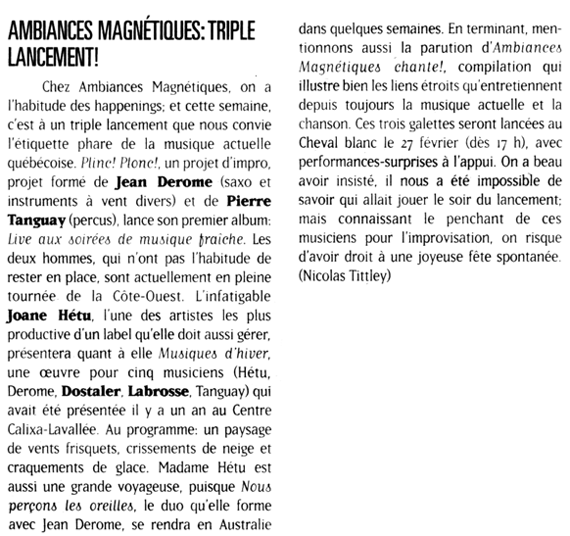
Ambiances Magnétiques: triple lancement
Review
This album stands aside in Joane Hétu’s discography. Even though the lineup is similar to the one in her avant rock group Castor et Compagnie (Jean Derome, Diane Labrosse, Pierre Tanguay, plus Guillaume Dostaler), Musique d’hiver (Winter Music) showcases a very different approach. Pianist Dostaler was brought in so that usual samplist/keyboardist Diane Labrosse could concentrate exclusively on her accordion. Alto saxophone (both by Hétu and Derome), flute (Derome), percussion (Tanguay), vocals (Hétu), and various tapes (situational recordings) complete the all-acoustic instrumentation. Musique d’hiver is a cycle of four pieces, one for each month from December to March, each about 16 minutes in duration. They are delicately crafted, slow-paced compositions for improvisers and include short sections with lyrics in the middle. Themes and melodies are spartan, slow, and reminiscent of Phillip Glass, and mostly played on flute and/or accordion. The atmosphere of snow, ice, and cold always remains tangible. La chute (“The Fall”) opens on a light, serene cascading motif announcing the arrival of winter, while Perdu l’nord (“Lost the Way”) is the craziest piece, with themes running into each other and free improvisation taking more room, picturing the relentlessness of one’s soul as spring (and with it deliverance) approaches. The maturity found in Musique d’hiver recalls the softer passages on Mets ta langue, Hétu’s second CD with Castor et Compagnie. But here her approach takes a whole new dimension as she eludes any extremes, taking the listener on a one-hour trip into Québécois winter, music that oscillates between sound art, minimalist songwriting, and composition for improvisers. Strikingly beautiful, this CD could very well become Joane Hétu’s finest hour. The booklet includes English translations of the lyrics. Very strongly recommended.
Critique
Voilà certainement un album pour les initiés. Joane Hétu nous présente une œuvre poétique sur le thème de l’hiver. Une poésie musicale hivernale sans parole, un tableau pittoresque pigmenté de sonorités acoustiques et métaphoriques. Une musique actuelle explorative. Une pièce en quatre mouvements qui rend hommage aux vents du nordet, les bourrasques de neige, la luminosité étincelante de l’hiver, la lune cristalline de février, les grands froids, l’ennui et la folie de mars, pour laisser transparaître l’effervescence émotionnelle de l’hiver.
Elle s’est entourée de Jean Derome au saxophone alto, flûtes, ambiances sonores, voix
Ce n’est certainement pas une musique aux harmoniques traditionnelles et aux constructions mélodiques auxquelles nous sommes quotidiennement conviées. L’univers sonore et musical de Joane Hétu provoque, suggère des ambiances, des couleurs et des sentiments. Dissonances, explosions, sons, amalgame complexe. Voilà ce que vous propose Musique d’hiver.
Bonne écoute
Ambiances magnétiques:triple lancement!
L’infatigable Joane Hétu, l’une des artistes les plus productive d’un label qu’elle doit aussi gérer, présentera quant à elle Musiques d’hiver, une œuvre pour cinq musiciens (Hétu, Derome, Dostaler, Labrosse, Tanguay) qui avait été présentée il y a un an au Centre Calixa-Lavallée. Au programme
Musique d’hiver entre deux bordées
On vous l’a déjà dit, les Productions Super-Mémé roulent cette année sur des quatre saisons. Les Musiques d’automne ont été un franc succès au Centre culturel Calixa-Lavallée, on enchaîne ce soir et demain avec Musique d’hiver, gracieuseté de Joane Hétu.
Musique d’hiver est une pièce comportant quatre mouvements
Il y aura peu d’improvisation au menu de Musique d’hiver.
Autodidacte, Joane Hétu a construit son affaire lentement. Au fil des ans, au fil de Wondeur Brass, Les Poules, Justine, Nous Perçons les oreilles, Castor et compagnie, elle a fait sa petite bonne femme de chemin pour atteindre une certaine maturité.
Progression
Joane Hétu présente Musique d’hiver
Année après année, les productions SuperMémé défendent leurs visions de la musique actuelle. Un nouveau projet, Les Saisons, se poursuit avec Musique d’hiver les 17 et 18 février.
Joane Hétu signe cette œuvre en quatre mouvements. Elle y décrit le dépouillement, la lumière blanche, la lenteur, le silence, le bruit blanc inhérents à cette saison nordique.
Depuis plus d’un an, Joane Hétu avait cette musique en tête. Elle a passé plusieurs mois à composer la pièce.
Cette œuvre sera interprétée par Joane Hétu elle-même, Jean Derome, Guillaume Dostaler, Diane Labrosse et Pierre Tanguay au Centre culturel Calixa-Lavallée au cœur du parc Lafontaine. On y accueillera les gens à compter de l9h avant chaque concert. Un feu de foyer extérieur y sera allumé sur le parvis.
En première partie, trois D. J. feront une démonstration de
La semaine prochaine, quelques jours après les exécutions publiques de l’œuvre, les musiciens entreront en studio, profitant du momentum, à Radio-Canada, pour l’enregistrement de Musique d’hiver.
Tempête de sons
En deuxième partie sera créée Musique d’hiver, une œuvre de Joane Hétu pour voix et instruments acoustiques
More texts
- Maurice Dielemans, KindaMuzik, June 8, 2001
- Le Devoir, February 14, 2000