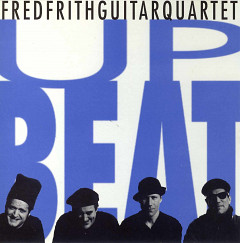
Upbeat in Splendid E-Zine
Just about anyone with some degree of musical awareness has heard of

Just about anyone with some degree of musical awareness has heard of
If you’re a fan of avant-garde music from the last 25 years, progressive cross-genre performer and composer Fred Frith has most assuredly wowed you in one form or another. Combining guitar forces, this quartet engages in a variety of styles, from intricately delicate, lush compositions, to noisy, experimental beasts that seem barely tamed by the axes of Stewart, Lussier, Didkovsky and Frith. You practically have to wipe Spitty Boy off of your face, as its quick-tempered excitement sprays forth in a mere 52 seconds. No Bones is a noisy concoction that presents several layers of riffs and leads that smartly intertwine, manifesting in a composition that’s on the verge of a nervous breakdown, and comparable to, dare I say, Naked City’s most sparkling, definitive moments. However, the FFGQ also harnesses space, as it guides several tunes through periods of tranquility and fragility that are sure signs of musical maturity. Frith’s considerable creativity and tenure are apt guides, as the variety and complexity of these 13 tracks show that you’re not dealing with some flippant “nuvo-guitar-artiste” but rather the exalted Fred Frith, with guitar surgically attached to hand and creative juices that are always simmering with fresh ideas.
Experimental legend Fred Frith once again combines the talents of guitarists Nick Didkovsky, René Lussier and Mark Stewart and comes up with 13 pieces that manage to breath new life into the six string. Repetitive lines play underneath free guitar noise as experimentation and discipline are comfortably intertwined. 8,5/10
The live recordings from the 1997 European tour include compositions by all FFGQ members. Nearly thirty-year musical career of Fred Frith has always distinctly confirmed his consequent attitude of breaking the fossilized conventions of rock music. One cannot help noticing that this attitude serves as the example for other rockmen, especially guitarists who since The Beatles’ times have been considered the most attractive figures on the rock scene.
While it is obvious that each decision on abandoning deep ruts of any behavioral pattern is always painful, any effort aimed at changing rock music habits is nearly destructive for the apostate. I can tell out of my own experience that to break the conservatism of rock fans is almost impossible
When ten years ago Fred presented his electric guitar quartet for the first time (the idea itself being not new, cf. Glenn Branca, Robert Fripp or Fred’s experiments of the Seventies) his fans bore a grudge against it and complained that he did not choose to simply continue the old Henry Cow or Skeleton Crew line instead. But Frith insisted on systematic developing new skills of interaction in music on electric instruments. The original expression, so characteristic of rock music, was now to excite listeners’ emotions through giving them an opportunity to follow the clear four-person teamwork relations and preferably to implement the organization samples in their private lives. Any solos, duos, trios and quartets that might have resulted from the given composition depicted some emotional relations borrowed from real social and political life. It is clearly visible in a live situation when we can see how the musicians communicate with each other by way of some special gestures or face expressions, how they share instruction and leadership waiting until the right time.
With this CD Frith’s quartet evokes a slightly different atmosphere. Since its members willingly participate in various projects, which stylistic range can make any purist dizzy, their individual experiences naturally influence the quality of the music they create together. The leader stays as the most influential among them taking advantage of his arsenal of unorthodox playing techniques still improved since the mid-Seventies. Stewart and Didkovsky are characterized by the rare ability to keep balance while zapping between desperately discordant genres, which not devoid of distance and humor enables the group to tell its stories with impressive sprite and eloquence. Lussier, somewhat “hidden” or “blended” into the quartet sound, seems happy to go on as the masterly precise reader of the group’s scores. His full capabilities are better demonstrated only in his solo of Tout de suite.
C’est un deuxième album pour cette formation, le Fred Frith Guitar Quartet, qui, à l’instar des 4 guitaristes de l’Apocalyspo bar, rassemble quatre éminents membres de la chose guitaristique