actuellecd

Blog

65 results
  • 1
  • 2
  • 3
  • 4
  • 5
  • 6
  • 7
  • 8
  • 9
  • Spam Me in Le Soleil

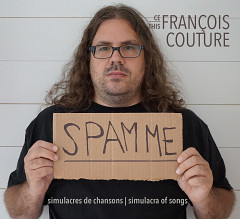
    “Spam Me: si les pourriels pouvaient chanter”, Nicolas Houle, Le Soleil, August 23, 2016
    Tuesday, August 23, 2016 Press

    Les pourriels peuvent-ils être source de poésie et de musique? Voilà la question que s’est posée CE François Couture avec Spam Me. Le musicien, qui a aussi été journaliste musical, s’est en effet amusé à bâtir des environnements sonores et des musiques autour de courriels non sollicités qu’il a pu recevoir afin d’en tirer des chansons.

    Improvisations bruitistes, enregistrements de terrain, rock progressif, rock in opposition ou post rock sont autant d’approches mises à contribution, en anglais ou en français.

    Évidemment, ce n’est pas pour toutes les oreilles, mais c’est ficelé adroitement et, aussi complexes que puissent être certains passages, il y a une dose d’humour inhérente à ces spams (y compris l’inévitable «penis enlargement») qui vient décontracter le tout.

    Magie rouge offre une très belle progression, si bien qu’on oublie entièrement le vide et l’absurdité du texte entonné. Idem avec la pièce-titre et ses diverses pistes vocales ou encore Moncier Uomo, qui met de l’avant le chant de Couture au service d’une mélodie complexe doublée à la guitare. Et comme Couture s’efforce de varier les propositions, Taxi Insurance s’échafaude avec la manipulation d’une bande sonore au magnétophone.

    À cela il faut ajouter qu’il y a un bon équilibre entre segments éclatés et passages davantage structurés.

    Une œuvre inclassable, plus accessible qu’elle ne le paraît, et qui mérite qu’on s’y attarde.

    Une œuvre inclassable, plus accessible qu’elle ne le paraît, et qui mérite qu’on s’y attarde.
    Simon Martin: Hommage à Leduc, Borduas et Riopelle in The Sound Projector

    “Whither Canada? Part 2”, Ed Pinsent, The Sound Projector, August 20, 2016
    Saturday, August 20, 2016 Press

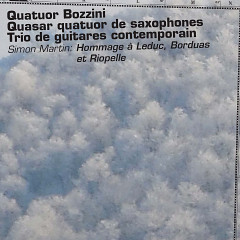
    The composer Simon Martin was highly taken with an art exhibit he saw in 2005 and tried to convey his feelings in music. On Hommage à Leduc, Borduas et Riopelle (CQB 1616), he’s expressly paying his tribute to the Canadian painters Paul-Émile Borduas, Borduas’ tutor Ozias Leduc, and the sculptor / painter / lithographer Jean-Paul Riopelle, and he’s engaged three different Canadian ensembles to realise his visions. The Trio De Guitares Contemporain play L’heure mauve, and they pluck and strum single notes on their classical guitars with a certain single-mindedness which to my ears is an attempt to recast the pointillist technique into music; like seeing the brushstrokes of Seurat dot themselves onto the canvas one by one. In fact, the composer is trying to recapture the effects of light on foliage, to get to the heart of one of the things that motivated Leduc to paint in the first place. Next, Quasar quatuor de saxophones blow an impressionistic breeze on Projections libérantes, producing many subtle and pleasing overtones in their slightly dissonant overlapping drones. This piece is attempting to say something about the voyage of self-discovery undertaken by Borduas, and proposes 11 minutes of gradual dawning realisation in sound. Lastly, the Quatuor Bozzini raise their violins, viola and cello in the most dramatic piece on the album, called Icebergs et Soleil de minuit — Quator en blanc. That title alone is evocative enough, and the nerve-shredding tautness of this icy, minimal piece is served well by it. Isabelle Bozzini and her team create astonishing atmospheres and microtonal contrasts in this 17-minute chiller of dissonance and Beckettian emptiness. Simon Martin’s intention here was surprisingly literal — he simply wanted to represent Riopelle’s Iceberg paintings in sound, a series the painter worked on in the 1970s. Worth seeking out images of these stark monochrome oils with their sharp strokes of black, white and grey. And if you want to hear more of the Quatuor Bozzini, they’ve also made records of James Tenney, John Cage, and Steve Reich.

    Worth seeking out images of these stark monochrome oils with their sharp strokes of black, white and grey

    Les accords intuitifs in The Sound Projector

    “Whither Canada? Part 2”, Ed Pinsent, The Sound Projector, August 20, 2016
    Saturday, August 20, 2016 Press

    Calling yourself Ensemble SuperMusique is bound to raise high expectations in your audience, but the team of Jean Derome, Bernard Falaise, Joanne Hétu, Danielle Palardy Roger et al are clearly consummate musicians. Perhaps they mean that the music they play is some form of “hyper-music”, or “meta-music”, rather than implying they have super powers. On Les accords intuitifs (AM 222 CD), the players perform in various combinations with woodwinds, electric guitar, percussion, synths, violin, piano, bass guitar, and the human voice. The turntablist Martin Tétreault joins them for two pieces. Together, they play their interpretations of compositions by Malcolm Goldstein, Raymond Gervais (avant-garde conceptaluist and creator of multi-media pieces), Yves Bouliane (bass player in Le Quatuor de jazz libre du Québec), Bernard Falaise, and Joanne Hétu (noted in the last batch) — all of whom are Canadian, with the exception of Goldstein who is half American. All of the works are quite challenging to listen to, full of dissonances, tensions, and yawning gaps; I kind of like the way that classical modernism, free improvisation and contemporary rock noise all seem to meet up in the same room, but the conversations they hold are very forced and mannered, as if they were total strangers trying to be stiffly polite to each other.

    I kind of like the way that classical modernism, free improvisation and contemporary rock noise all seem to meet up in the same room…

    Mikrokosmos Sz 107 in The Sound Projector

    “Whither Canada? Part 1”, Ed Pinsent, The Sound Projector, August 19, 2016
    Friday, August 19, 2016 Press

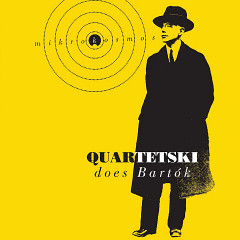
    Mikrokosmos: Quartetski Does Bartók (AM 224 CD) is a much more successful instance of the cross-fertilisation and bridge-building which I assume Nicolas Caloia is aiming at. This Montréal five-piece (confounding expectations raised by their name that they might be a four-piece) strive to reinterpret classical music in a contemporary setting, and on the evidence of this release they do it very well, producing a listenable and entertaining experience. Pierre Yves-Martel (bass, synth) and Philippe Lauzier (woodwinds) are present, along with the electric guitarist Bernard Falaise, the violinist Joshua Zubot, and the drummer Isaiah Ceccarelli. Images of their stage set make Quartetski look like a cross between a chamber ensemble and a rock group, and their music delivers precisely that — original melodies and arrangements reshuffled into accessible modernistic arrangements, with a jazzy swing feeling, dissonant noises and scrapes from the violin, loud rockist segments from the guitarist, and even free improv elements from the woodwind section. A lot of stop-starts, quick changes, and poised dynamics allowing each musician to shine; the brevity of these pieces, and the slight air of genial clunkiness in the playing, also made me think of Maher Shalal Hash Baz. I’m not at all familiar with the works of Bartók, and a purist classical buff might give a more cautious reception to this album (or even retreat from it in horror), but ignorance is bliss and I’m finding this a pleasant spin today. When Michal Libera does cultural mashups for his Bolt Label, he’s trying to get the audience to ask deep and searching questions about the meaning of things we previously took for granted; Quartetski are simpler, and they just want us to enjoy good music in a new setting, with fresh ears. If you want more of this, they “did” a Prokofiev album in 2007 for Ambiences Magnétiques. Fine work.

    I’m finding this a pleasant spin today

    Aldo Clementi: Momento in The Sound Projector

    “Whither Canada? Part 1”, Ed Pinsent, The Sound Projector, August 19, 2016
    Friday, August 19, 2016 Press

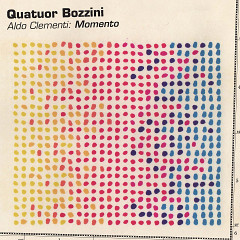
    More desiccated modernism by Quattor Bozzini as they perform Momento (CQB 1615) by the depressing post-serialist Aldo Clementi. This Italian composer who died in 2011 seems to have regarded his work in purely academic terms, measuring his success as a series of “contrapuntal exercises”; critics, when attempting to summarise it, apparently tend to reach for metaphors of decay. Clementi strove to compose music that describes its own gradual extinction. One imagines he was happiest when watching the sands run out of an hourglass, and then retiring to bed replete with the satisfaction that another day had been wasted. These various canons and other pieces, ranging in date from 1968 to 2005, brought a deathly pallor to my skin, induced short breathing, and made me dream of wandering 19th-century parlours with no windows and heavy green wallpaper everywhere.

    These various canons and other pieces, ranging in date from 1968 to 2005, brought a deathly pallor to my skin, induced short breathing, and made me dream of wandering 19th-century parlours with no windows and heavy green wallpaper everywhere.

    Émilie préfère le chant in The Sound Projector

    “Whither Canada? Part 1”, Ed Pinsent, The Sound Projector, August 19, 2016
    Friday, August 19, 2016 Press

    Speaking of Pierre-Yves Martel, I was reminded of his astonishing record Continuum when I heard Émilie préfère le chant (AM 223 CD), a solo release by Émilie Girard-Charest, and wondered if this talented violoncello player had spun in his orbit or come under his influence to some degree. Her self-composed S’offrir is an exquisite dream of near-silence: as with Continuum, there’s the same concern with maintaining a rigid posture while playing and doing nothing to disturb the enchanted mood. The other interpretations of works by contemporary composers are slightly more “busy” and would veer towards the now-conventional dissonance and randomness, were it not for the exciting electro-acoustic effects (I think) in evidence on such strange weirdies as Espoir squelettique, written by Maxime Corbeil-Perron. Altered Gray by Frederik Gran is another one that seems to have electronic elements bundled in the package, and is equally puzzling in its uneventful, hard-to-follow structure. Arid spiritual journeys await the listener here, with only a few drops of cold water offered for relief along the trail, and it’s never clear what the destination is or when we’ve actually arrived. Joane Hétu (see above) composed the title track, an angular and unpleasant piece that requires much dragging and stabbing of the strings to perform it.

    Her self-composed S’offrir is an exquisite dream of near-silence
  • 1
  • 2
  • 3
  • 4
  • 5
  • 6
  • 7
  • 8
  • 9