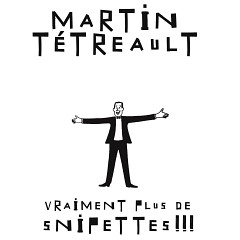
Vraiment plus de Snipettes!!!, the third in free improviser Martin Tetreault’s’ Snippets’ series, is a reminder of his solo work after many recent collaborations. It uses recordings that date between 1984 to 2023 to create a 78-minute ride — not a smooth ride; more of a ’toboggan ride’. One that may use material from the eras of Snipettes! and Plus de Snipettes!!
Don’t know him? Want to hear him? Preparation is key. The uninitiated should check him out on You Tube, and perhaps consider the Five Comments which follow below. This may put his found sound, spoken vignettes and turntablism within an understandable context. 24 tracks of Vraiment are manageably short, but conclude with a 27-minute finale that, for many, may be a challenge. I was hooked, anyroad, and not only because of his use of Yoko Ono’s Why deep in the mix.
It uses French-Canadian sources that are over a half century old, which means that intertextual references may escape non-Francophones. But there are entry points for admirers of all audio bricoleurs. The sleeve notes help us discover the source of the samples, and help us distinguish between sounds from distorted samples and sounds from deconstructing turntables. (This would be clearer in live performances, where he has played standard DJ sets alongside ’deconstruction’ ones.)
My initial interest was more conventional in that I’ve always used snippets in audio recordings. Snippets to foreshadow or to make abrupt changes. Snippets to cushion or to confound. But Vraiment plus de Snipettes!!! is a considerable body in itself and has an arched air. It is distinct. It isn’t hip-hop (but I likedd it) despite his chopping up and slicing up of vinyl prior to putting the needle on the record. Sprinkling decks with sand, covering parts in plastic, he manages to maintain grooves.
The album covers (and quotes) in the sleeve notes could be an entrance point to his work or be an added communicative text to accompany the sounds. Much of it comes from a past Canada through MOR, How To, and Relaxation LPs of the 1970s. But the overall effect transcends time and geography. The air is quirky and subversive, holding back on overt calls for change, yet perhaps inspiring more bricoleurs of the world to arise and unite (if not to take over).
Five Comments:
- The Turntablist As A Young Artist
The germs of these songs may have begun decades ago. Is ‘Vraiment’ a condensing of his early ideas? It may be. Tango enthousiaste has “at 65, what happened to the enthusiasm of a 25-year-old?” I wonder how Tetreault would answer? He is older. He seems enthusiastic. Does he have a secret? - Irreverence is everywhere
Do I hear brays, roars and grunts? Is that a moose sampled in GusChickMousse? The music is certainly adapted from something by Ti-Gus Et Ti-Mousse. I laughed. I learned. It’s fun to trace these links. He makes horse galloping sounds from damaged records and turntables. Who can’t respect this? - Big Issues are tackled, jokily
Tétreault uses Tittley et Barker’s L’Art De Dépenser in at least five tracks. It leads to quotes on materialism, the soul, and free will. God knows if we improvise is used in another song (after which we hear what I thought were horse galloping sounds). It makes me want to see him perform. - Scientific advice can contradict common sense
Edward Teller’s words may be sampled in Bonjour fromwhere. A warning not to talk about space and time separately. Science may contradict common sense. Communication, offers this timely sample: “(M)achines can have experiences, apparently, and transfer them to another.” - There is a Lumpy Gravy aesthetic
This is apparent in the later tracks, and in one with Zappa in the title.
It is not unwelcome.
What lies beyond these snippets? New avenues appear.