Sauter au contenu principal
actuellecd

Blogue

3585 résultats
  • 24
  • 25
  • 26
  • 27
  • 28
  • 29
  • 30
  • 31
  • 32
  • Long Gradus: Arrangements dans Pitchfork

    «Review», Vanessa Ague, Pitchfork, 7 novembre 2023
    mercredi 17 juillet 2024 Presse

    The first few notes of Long Gradus (strings) are so fragile that they might break at any moment. Each member of string quartet Quatuor Bozzini bows one long tone without any vibrato or other ornamentation, stretching it out until it becomes paper thin. It’s like a skeleton of a Sarah Davachi piece — just the notes, none of the reverb. To write Long Gradus, the Los Angeles-based composer draws on many of the ideas that have shaped her work over the years — slow tempos, just intonation, harmonies inspired by Medieval and Renaissance polyphony. But where her previous albums felt cavernous, Long Gradus strips her music down to its bones, zeroing in on the timbre of each individual note.

    In the album version, Davachi shows the composition’s adaptability by presenting recordings of string quartet, woodwinds, brass and organ, and choir and electronics, demonstrating how the piece translates across instrumentations. Davachi has never shied away from writing long pieces — her albums often run an hour or more — but Long Gradus takes her work to a new extreme. Its four discs spread out over four and a half hours, examining the contours of the work from seemingly every angle.

    Throughout, tones enter and fade with the ease of breathing. Each movement creeps from low to high pitches almost unnoticeably, save for some occasional clashes between frequencies, and ample pauses between notes give the music a glacial quality. Davachi has always explored measured, subtle motion: Her stretched-out progressions often seem to exist outside of time, moving at a pace that’s guided by intuition. But that’s a zoomed-out picture, and Long Gradus shows the granular: With this composition, Davachi invites us to take stock of every tone in the minutest detail.

    The four iterations take on strikingly different qualities. When notes get close together in the string quartet version, there’s pronounced beating; when woodwinds play, there are soaring overtones. The strings often sound ghostly, while the woodwinds are bright and feathery; organ and brass feel deep and resonant while choir and electronics take on a Medieval air. Those changes are so subtle that listening to each feels repetitive—this is the same piece, after all, just played by a different set of tools. But the four versions of Long Gradus do show how the work transcends the particularities of a given adaptation. No matter the instrumentation, Davachi’s music is still evolving.

    Davachi has always explored measured, subtle motion: Her stretched-out progressions often seem to exist outside of time, moving at a pace that’s guided by intuition.

    Long Gradus: Arrangements dans Boomkat

    «Review», Boomkat, 1 septembre 2023
    mercredi 17 juillet 2024 Presse

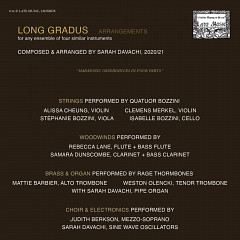
    A stunning four disc epic, Long Gradus: Arrangements reveals the sheer depth of her process by presenting work in four separate arrangements: strings, woodwinds, brass & organ and choir & electronics. Glacially slow to encourage the deepest possible listening, it’s an immersive, psychoacoustic delight.

    We’re always impressed by Davachi’s music, and somehow she keeps finding a way to one-up herself, taking a studied process and well-developed concepts to new places each time. A “gradus” is a kind of manual that was used in classical education to help students write in Greek or Latin verse; Davachi considers Long Gradus a way to help listeners familiarise themselves with her techniques, teaching active listening by immersing us in sound, not just theory.

    Davachi started work on the album back in 2020 when she was invited to participate in Quatuor Bozzini’s ensemble’s Composer’s Kitchen residency; for obvious reasons, the session was delayed for a year, but this gave Davachi the time to to consider the piece more rigorously. So while it was written for string quartet, it developed into a four part exploration of horizontal shifts and chordal suspension that could be mapped to any four instruments capable of producing a seventh harmonic. “Substitution of the string quartet with other instruments as desired or imagined, both acoustic and electronic, is entirely acceptable and indeed encouraged,” the accompanying press release reads.

    On the ’strings’ version, Davachi’s process is at its most pure, with each player’s sustained tones gently rubbing against each other, illustrating the gradual changes in pitch and texture. Her relatively open structure allows each musician a certain level of freedom, letting each performance shift as seamlessly as the tones themselves. Although this recorded version is fixed in time, its instinctively paced movements are so hypnotic that it can feel slightly different each time you listen. You should know just how much we love woodwind over here if you’ve noticed our appreciation of Mary Jane Leach and Laura Cannell, and Davachi’s version for flute, bass flute, clarinet and bass clarinet is almost predictably celestial, performed by Rebecca Lane and Samara Dunscombe in Berlin. The music takes on a completely different character when performed on such different instruments — with strings, it’s easier to bend, hold and manipulate the notes; using woodwind, the shifts seem more convulsive somehow, and the tones are all the more magical for it. Hearing both performers’ breaths is an additional texture that lends flavor and encourages a very different level of attention.

    Davachi plays Berlin’s Emmaus Kirche’s pipe organ on the ’brass & organ’ version, alongside Rage Thormbones, aka Weston Olencki on tenor trombone and Mattie Barbier on alto. We’re not sure if it’s just because we’ve been so accustomed to hearing just intonation drone music performed on pipe organ, but the tonality here seems much more stark, with the organ picking out the wavering fluctuations and almost vibrating against the brass. But our favorite iteration has to be the final one, ’choir & electronics’, with Sarah Davachi playing sine wave oscillators and mezzo-soprano Judith Berkson handling the vocals. This version harks back to some of Davachi’s most affecting recordings (such as last year’s divine ’Two Sisters’), and marinates in its own restraint. Davachi’s gentle processing is particularly notable; the vocals sound almost like they’re being rendered from a dream or a hazy memory, brushed and sculpted so they drape over the pure sine tones like silk.

    Clocking in at four and a half hours, Long Gradus: Arrangements isn’t for the faint-hearted, but anyone who’s fascinated by tone, pitch and patience will be rewarded for their time. Whether you’re interested in Éliane Radigue, La Monte Young, Kali Malone or Ellen Arkbro, this is a crucial, poetic handbook that grows with each moment.

    We’re always impressed by Davachi’s music, and somehow she keeps finding a way to one-up herself…

    Long Gradus: Arrangements dans Juno

    «Review», Juno, 1 septembre 2023
    mercredi 17 juillet 2024 Presse

    With Long Gradus, Sarah Davachi seizes the opportunity to take one idea and explore it from as many angles as possible. The celebrated composer and ambient artist is consistently investigating musical possibilities from a learned, authoritative perspective and so this latest project finds her expanding on an initial invitation to the Composer’s Kitchen residency in the Netherlands. Fundamentally scored for a string quartet, Davachi’s intention with the stirring, sustained tension of Long Gradus was that it could be performed on a number of different instruments, and this expansive four-CD edition on her Late Music label presents the piece performed on woodwinds, brass and organ and choir and electronics alongside the fundamental string version.

    Sarah Davachi seizes the opportunity to take one idea and explore it from as many angles as possible.

    Ch’val dans ProgCensor

    «Critique», Auguste, ProgCensor, 30 juin 2024
    samedi 6 juillet 2024 Presse

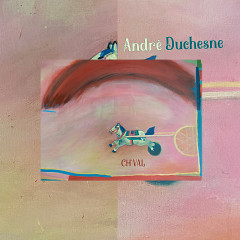
    Une poésie mélancolique traverse, avec des circonvolutions et à son rythme, les 13 morceaux de Ch’val, l’album du guitariste montréalais André Duchesne, patiemment construit en solitaire chez lui, entre marches matinales et évocations poignantes de sa sœur disparue — c’est elle qui «rêvait de chevaux». La guitare est à l’avant-plan, aux parties pas toujours écrites, mais Duchesne y ajoute basse, batterie — et, en de rares occasions, sa voix, plus récitante que chantante —, groupe virtuel à lui tout seul: le résultat est tendre, débutant par un échevelé Ch’fal ch’fal, suivi du mélodique À celle qui rêvait de chevaux, avant que l’inspiration ne se perde dans des pérégrinations plus jazzy (Rêves de chevaux).

    Une poésie mélancolique traverse, avec des circonvolutions et à son rythme, les 13 morceaux de Ch’val, l’album du guitariste montréalais André Duchesne
    2,5

    unPacked dans Musicworks

    «Review», Stuart Broomer, Musicworks, no 148, 1 juin 2024
    vendredi 28 juin 2024 Presse
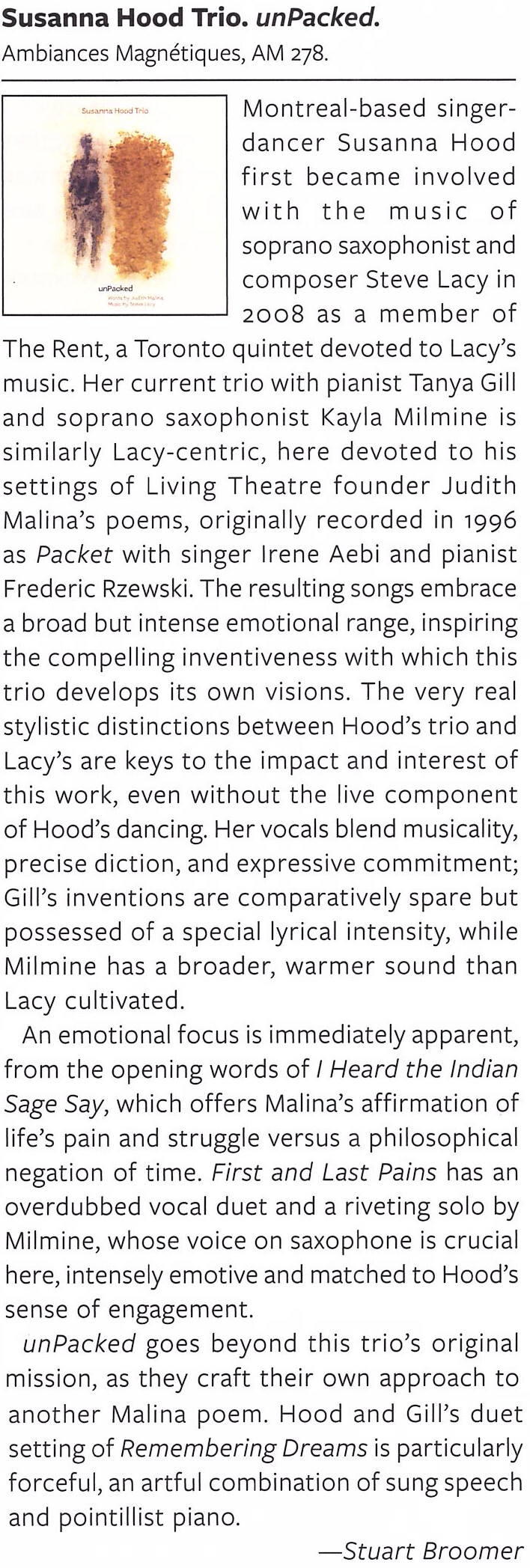
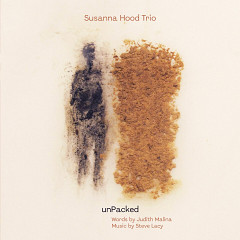
    The resulting songs embrace a broad but intense emotional range, inspiring the compelling inventiveness with which this trio develops its own visions.
  • 24
  • 25
  • 26
  • 27
  • 28
  • 29
  • 30
  • 31
  • 32