Sauter au contenu principal
actuellecd
  • This website is also available in English.

Blogue

3585 résultats
  • 101
  • 102
  • 103
  • 104
  • 105
  • 106
  • 107
  • 108
  • 109
  • Paso Doble dans Vital

    «Review», Dolf Mulder, Vital, no 1005, 3 novembre 2015
    mardi 3 novembre 2015 Presse

    A duo work of two improvisers. Eguiluz (voice) comes from originally from Mexico. Diamantakiou, playing upright bass, is originates from Marseille (France). They started their collaboration in 2012 in Montreal, where both have their base. Diamantakiou is also member of the ensemble Rubedo’ro, led by Eguiluz. As a duo they take themes from jazz standards as a starting point for their free improvised excursions. For their first release Paso Doble they made recordings in February-March 2014 in the studio, using themes from Mingus, Ellington and Bach. Their improvisations breathe a delicate and fragile atmosphere. They are full of subtle movements and gestures. Beautifully sung by Eguiluz who has a characteristic and recognizable voice. Also the playing by Diamantakiou is fine. A rich and solid work.

    A rich and solid work.

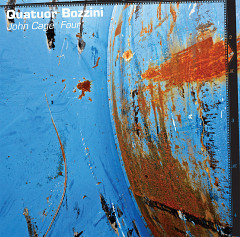
    John Cage: Four dans La Folia

    «Review», Grant Chu Covell, La Folia, 1 novembre 2015
    dimanche 1 novembre 2015 Presse

    As a collection, Cage’s string quartets permit an ensemble to explore different ways of collaborating. The String Quartet in Four Parts was written just before Cage’s plunge into chance. It’s traditionally notated and organized akin to the micro and macro structures Cage explored in his early percussion music. The Bozzini pivots expertly between delicate antique and dissonant chords. Thirty Pieces and Four are from the same decade, however are separated by a divide. Thirty Pieces consist of essentially 120 one-minute solos delivered four at a time. Each player prepares independently and in performance they coordinate as little as possible and spread themselves at far distances around the audience. It’s an accidental quartet; modern, aggressive, and lightly sprinkled with extended techniques and microtones. Four operates at a low threshold with neutral singularities. Chords and coincidences are expected but details are unpremeditated. Tones appear, unornamented, nearly expressionless and ugly. There’s a passage starting around 22:13 hinting at Mozart’s Dissonant. Here the Bozzinis demonstrate their impressive range, playing together, apart and indifferently.

    Here the Bozzinis demonstrate their impressive range, playing together, apart and indifferently.

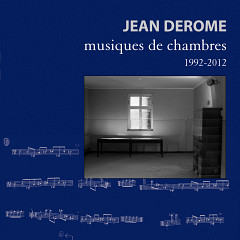
    Musiques de chambres dans The Squid’s Ear

    «Review», Massimo Ricci, The Squid’s Ear, 27 octobre 2015
    mardi 27 octobre 2015 Presse

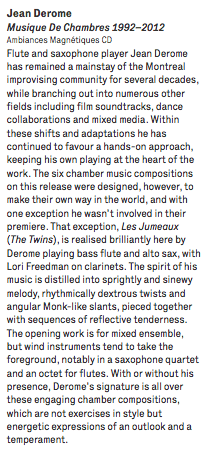
    Jean Derome — a veritable stalwart from the Quebecois scene since the early 70s — does not seem particularly interested in being hailed as the designer of epochal masterpieces, at least judging by the mathematical spirit-cum-playful twists conveyed by large chunks of Musiques de chambres 1992-2012. We often perceive the hand of a composer intent in establishing a somewhat stretchable relationship between instructions/scores and performers willing to extract essential juices from substances that do not appear exactly “juicy”. Indeed, most of this stuff exploits graspable rhythmical cells and superimposition of rather restricted melodic materials, the whole not infrequently comparable to out-and-out exercises with a few intriguing traps and unforeseen spurts. The latter characteristics differentiate it from the kind of poor man’s minimalism peddled by those who want to sanctify the name of lowercase at all costs.

    Derome plays in just two of the six cycles. Apart from Les jumeaux — a duo with clarinetist Lori Freedman — the record comprises series of mainly short-ish pieces, in any case lasting less than five minutes. All things considered, this fragmentariness is a plus. Ideas are expressed with conciseness and, in a way, detachment; the heart may not skip beats because of emotional turmoil, however the instruments resonate beautifully in (mostly) ample spaces. Never for a moment does inertia or boredom set in; as simple as a compositional choice might look, one follows plots and patterns with a degree of interest to see what the deal is. In general, nothing truly extraordinary happens; but we do get caught. Selected sketches possess a generous drive that lets forget about the lack of genuine harmonic complexity (Cinq études pour figures). Some of them show a propensity to contrapuntal spiciness (read: challenging use of close voicing inside discordant constitutions), the flute octet Les cheminées — featuring the Alizé Ensemble — representing perhaps the best example. A couple of snippets from the saxophone quartet Rouge — executed by Quasar — could hypothetically suggest an association with Gilbert Artman’s Quad Sax (the “distilled” version of Urban Sax: go get their lone release now if you missed it).

    Though my favorite Derome is still the fabulous reedist who swaps blows with René Lussier in Les granules, or enriches Lars Hollmer’s Looping Home Orchestra in Door, Floor, Something, Window, I am always glad to know what he is doing. You should be equally curious; intelligence is a rare thing in today’s music: either you like the results or not.

    I am always glad to know what he is doing. You should be equally curious; intelligence is a rare thing in today’s music: either you like the results or not.
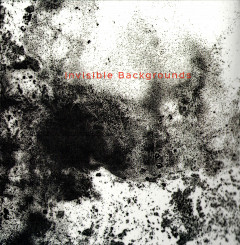
    Invisible Backgrounds dans Revue & Corrigée

    «Chronique», Cyrille Lanoë, Revue & Corrigée, 4 octobre 2015
    dimanche 4 octobre 2015 Presse

    Un disque atmosphérique, une trompette atmosphérique, des plages sonores forcément atmosphériques. De l’artiste on en connait peu. Sinon qu’il vient de Montréal et qu’il joue ou a joué dans des formations plutôt free rock qui se tiennent (dont La Part Maudite). Trompettiste maintenant vous vous en doutez. En solo il propose avec Invisible backgrounds plusieurs cordes de son arc en matière d’ambiances créées. Avec non pas autant, mais dix plages disons, variées. L’entame est jazzy, en volutes. Il y va même de l’utilisation (piochée à la BBC, quand je vous parle d’utilisation) du field recording sur luna negra. Montréal est entre autres connu pour ses groupes post-rock issus de la nébuleuse Constellation (Godspeed you! Black emperor, Silver Mt Zion…). Principalement développé sur time for new hands de belle manière, avec pour ma part des influences à aller cher chez Mogway ou les français de Madrid, en plus bien sûr des influences de chez Constellation citées plus haut. Un piano, une voix enregistrée, type pasteur, et cette trompette volante. Le titre qui a le plus retenu mon attention est celui qui suit, super 8. Des grosses sine wave en rotative, avec une fin abrupte appréciable. Tout est dans le titre: tout est mécanique. Court mais bon. Je me répète mais l’exercice du solo n’est pas aisé. Philippe Battikha, sans rien révolutionner, apporte de la fraicheur à des titres qui pourraient pourquoi pas s’échapper des morceaux les plus calmes de Hint, ou encore d’un autre duo, Spaceheads. En beaucoup plus feutré mais tout autant agréable. Avec une personnalité dans les manipulations de bandes, de pédales d’effets, dans les invitations comme cette belle contrebasse sur beyond you. J’avais été assez déçu en 2012 par un disque de Sontag Shogun qui s’essayait à de tels essais. Préférez donc celui-ce, de très loin.

    Un disque atmosphérique, une trompette atmosphérique, des plages sonores forcément atmosphériques.
  • 101
  • 102
  • 103
  • 104
  • 105
  • 106
  • 107
  • 108
  • 109