Sauter au contenu principal
actuellecd

Blogue

99 résultats
  • 3
  • 4
  • 5
  • 6
  • 7
  • 8
  • 9
  • 10
  • 11
  • Filature dans Vital

    «Review», Dolf Mulder, Vital, no 840, 16 juillet 2012
    lundi 16 juillet 2012 Presse

    Joane Hétu is one of veterans behind the Ambiances Magnétiques scene. She appears on many of the releases on this label as well with projects she carried out herself, of course with the help of others. Here with the newest example of it: Filature performed by Ensemble SuperMusique. It took Hétu five years to complete this work. It is an exponent of the Hétu’s projects in the field of music theatre, like Musique d’hiver and La Femme territoire. For this new release we miss the dance and video components. The cd documents only the music and the text. The music is in a serving role for the texts that are declamated and sung in French. The work deals with the experiences Hétu had in an earlier life as a weaver. But altogether it is difficult to make a picture of what this work is about. Only in pieces like Elle travaille, that offers a far echo of the RIO-rock Hétu produced as a member of Wondeur Brass and Justine, Filature becomes accessible for me.

    The work deals with the experiences Hétu had in an earlier life as a weaver.

    À chacun sa miniature, Martin Arnold: Aberrare dans Vital

    «Review», Dolf Mulder, Vital, no 840, 16 juillet 2012
    lundi 16 juillet 2012 Presse

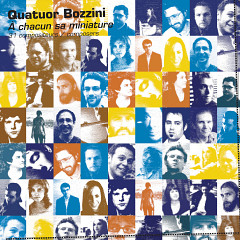
    Bozzini Quartet is a very special quartet. They have built up a varied and extensive repertoire. This time, with À chacun sa miniature the Bozzini Quartet makes a very generous gesture. On this double cd they present works from 31 young Canadian composers. Considering the amount of participating composers, almost a catalogue of what is going on in Canada. A bit too much also, because of the great number of new works. But a good opportunity to pick up what is going on in Canada. Their other new release Aberrare failed to fascinate me. This did not change after repeated listening, so this one was not meant for my ears. What kind of piece is it? Composer Martin Arnold is interested in continuation of music, but not along narrative lines. The music is not moving towards some goal, but it is more a process of unfolding, as the composer explains. In a way it is also dance music, what the composer concerns. But I felt it difficult to feel the same inspiration. Arnold is a Toronto-based composer and performer who had Frederic Rzewski, John Cage, Louis Andriessen, and others as his teachers.

    Bozzini Quartet is a very special quartet. They have built up a varied and extensive repertoire.

    Vivaces dans Le son du grisli

    «Critique», Luc Bouquet, Le son du grisli, 16 juillet 2012
    lundi 16 juillet 2012 Presse

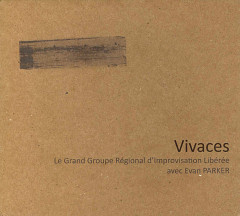
    Certains sont professionnels, d’autres sont amateurs: le GGRIL, basé à Rimouki, petite ville de l’est du Québec, dispose d’une dizaine de forces vives. Evan Parker, après Joëlle Léandre ou Jean Derome, est ce soir leur invité.

    Tout commence avec Semis, improvisation collective, courbaturant une masse épaisse, sobrement perforée par le soprano puis le ténor du britannique. Le concert se poursuit avec Bouturage, dirigé par Evan Parker. Débutant en douceur, la conduction de Parker posera quelques sûres balises (motif rythmique s’accélérant, modulations, surgissement d’une clarinette intrépide, accents répétitifs) avant d’encourager un intense duo d’accordéons. La dernière pièce, dirigée par le violoniste Raphaël Arsenault, laissera le saxophoniste — ici au ténor — évoluer en soliste au sein d’une improvisation anxiogène, ombrageuse, inquiétante. Oui, une belle soirée pour tout le monde.

    Oui, une belle soirée pour tout le monde.

    Sur un fil dans Le son du grisli

    «Critique», Guillaume Belhomme, Le son du grisli, 16 juillet 2012
    lundi 16 juillet 2012 Presse

    Sorti du GGRIL, Éric Normand emmène à la basse électrique un quintette dans lequel on trouve Jean Derome (saxophone alto, flûte), James Darling (violoncelle), Antoine Létourneau-Berger (vibraphone) et Michel F Côté (batterie, feedbacks).

    Sur un fil est cet enregistrement sur lequel Derome et Darling osent sur le morceau-titre des pas de danse oblique dont l’alto finira par bousculer les discrétions avant de devenir un disque que se disputent moments de réflexion et morceaux d’emportements. Lorsque les compositions ne sont pas de Normand, un air de John Tchicai donne à l’association prétexte à s’entendre autrement: basse (au son travaillé et même subtil) et flûte déboîtant sur une marche qu’enrayera une suite d’actes de forfanterie individuelle qui ne parviendront pas à mettre à mal sa cohérence — dont le tuteur est le motif de choix qui gonfle Fields, Cows and Flowers.

    Cinq musiciens Sur deux chaises enfin: jeux de micros, larsens et effets de manche, arrangent en torturés une pièce de chaos mémorable: l’alto en agitateur encore, qui saura cette fois découvrir dans la ligne claire un intérêt pour le changement changement. C’est en toute quiétude que se termine donc Sur un fil, vivifiant ouvrage électroacoustique.

    C’est en toute quiétude que se termine donc Sur un fil, vivifiant ouvrage électroacoustique.

    Pink Saliva, La Formule Xyz dans The Sound Projector

    «Water Dragons», Ed Pinsent, The Sound Projector, 5 juillet 2012
    jeudi 5 juillet 2012 Presse

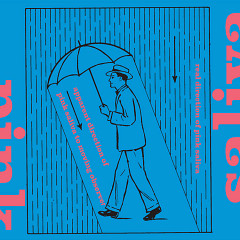
    We received a bundle of five items from the & Records label of Montréal which arrived here 20 January 2012. They all come in foldout silkscreen covers designed by Fabrizio Gilardino. Here are two of them.

    On Pink Saliva (&11), the trio of Pink Saliva perform 12 instrumentals live in the studio using a combination of trumpet, percussion, a bass guitar and a laptop, plus microphones for occasional wailing feedback effects and a lap-steel guitar. I was encouraged by the presence of Alexandre St-Onge on this one, as he made an intriguing “sleepytime” documentary record in 1999 called Une mâchoire et deux trous while wearing his “sound artist” beret. I enjoyed that one, but this record I find less compelling. The performances are mostly a vehicle for Ellwood Epps to play rather pointless raspberry-blowing effects through his trumpet, while the other two musicians provide listless backdrops of chuntery noise. I would welcome a bit more excitement or danger in the playing, but it feels very predictable — in spite of the obvious commitment to free-form playing. Things feel random, but not much fun; there is something self-important and solemn about the overall tone of these fellows which I mistrust.

    The record XYZ (&14) fares much better with me, with its stern no-nonsense discipline that at times feels as strong as iron. It was made by the trio of Martin Tétreault, Pierre-Yves Martel and Philippe Lauzier, all Montréal players to a man. I see they played before in 2008 on a CD called Disparition de l’usine éphémère, using not-dissimilar instrumentation but joined by the acoustic guitarist Kim Myhr. What we got here is the winning mixture of Lauzier’s woodwinds (bass clarinet and soprano sax) with live electronics — be it the feedback-static hum of Martel or the more complex set-up of Tétreault, which involves magnetic pickups, a mixing unit of some sort, and something called the Tétronic which is probably a device of his own making. Unlike the above record which hops about as though all the players have pants full of fleas, this disk just sits there and groans out monotonous and unnatural tones like a bad-tempered old turtle who missed his evening meal. No concessions made by the three brooding magicians here to variations in tempo, register, or pitch, and XYZ soon succeeds in wearing down your resistance. Even the very track titles refuse to acknowledge the listener’s humanity, alienating us with their alphabet soup of letters which resemble algebraic formulae. If these balmy summer days lead you to a hankering for some intensive Nakamura-styled feedback laser surgery but you’d also like to back it up a notch in the direction of Anthony Braxton or Jean-Luc Guionnet, then this is your next purchase. Succumb freely to these splendid close-knit wafers of electro-acoustic intensity, that’s my advice.

    Succumb freely to these splendid close-knit wafers of electro-acoustic intensity, that’s my advice.

    Filature dans The Squid’s Ear

    «Heard In», Kurt Gottschalk, The Squid’s Ear, 3 juillet 2012
    mardi 3 juillet 2012 Presse

    It’s a funny thing listening to songs sung in foreign tongues. Whether it’s the delicate miniatures of Erik Satie or Haino Keiji screaming against the void, there is something lost to be sure but perhaps something else — something not necessarily intended by the artist even — to be gained. Such is the case for the audio tourist listening to Joane Hétu, who has been developing a strong voice as a writer of narrative and a composer of song cycles over recent years.

    The simple yet strangely abstract songs that make up Filature were recorded in 2006 and the suite was presented at the 2007 edition of the Festival International de Musique Actuelle de Victoriaville, just a few hours north of Hétu’s Montréal home but it is only now seeing release. The three-part suite follows in the stead of the three discs of “winter songs” she’s released over the last decade. All of these sets of songs are wonderfully theatrical, in this instance meaning something very different than “cinematic.” Hétu’s song cycles aren’t of the sweepingly dramatic form of the big screen but rather exist on small stages in small rooms. She uses large ensembles sparingly and vocal melodies cautiously, evoking (even without benefit of the syntax) dramatic scenes.

    Filature is based on Hétu’s work as a weaver when she was young, and indeed was presented with video of looms at work when it was staged at Victoriaville. The metaphor in composition becomes a fairly literal weaving of disparate qualities: of silence and dark, woody tones; of slow instrumental phrases and soft nonmusical sounds; of singing and speaking and less easily classified mouth-made sounds. Saxophonist Jean Derome (like Hétu a fixture of the Ambiances Magnetiques musician collective) delivers much of the text in an unaffected singing voice, plain and almost conversational. In a very different way, Hétu blurs the two, easily sliding between talking and singing.

    Hétu benefits from having a group of musicians who know how to read the sentimentality, playfulness and starkness of her work. Along with Derome, the tentet assemblage of L’Ensemble Supermusique heard here includes cellist Mélanie Auclair, bassist Normand Guilbeault, electronicist Diane Labrosse, and percussionists Danielle Palardy Roger and Pierre Tanguay, a strong cross section of Montréal’s pool of improvisers. There is, at times, so little music happening (a bass drone, percussive scrapes and slow, dual voice and violin melodies, for example, or abstract syllabication with occasional horn section interjections) that it seems Hétu must function at least as much as director of actors as she does a conductor of musicians. Part of the success of the work is the company that delivers it.

    There is more that could have been done with this release. Bob Hébert’s evocative video work seen in Victoriaville could have been included in a DVD package, and certainly a translated lyric sheet wouldn’t have been unwelcome (the lyrics printed in French are included). But even as it is to an outsider looking in, Filature is a striking and satisfying piece of work.

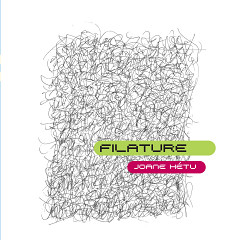
    … a striking and satisfying piece of work.
  • 3
  • 4
  • 5
  • 6
  • 7
  • 8
  • 9
  • 10
  • 11