Sauter au contenu principal
actuellecd

Blogue

99 résultats
  • 1
  • 2
  • 3
  • 4
  • 5
  • 6
  • 7
  • 8
  • 9
  • Hemlock dans Exclaim!

    «Reviews — Improv & Avant-Garde», David Dacks, Exclaim!, 9 octobre 2012
    mardi 9 octobre 2012 Presse

    If you make music in Montréal, there’s a good chance you know one of the 30-odd members of this behemoth, irregularly convened by Nicolas Caiola. Since 1997, he’s gradually figured out how to make the most of all the possible instrumental colours and playing styles of each member, and it’s never sounded better (on record) than on Hemlock. How lucky to have at one’s disposal an entire flock of flutes playing with a gaggle of strings and several bass-oriented saxophones, as on Yield. The ascending notes of Hemlock — part 1 gather another strange collection of instrumental colours into wild fanfare, which leads into the deep, dark groove of the song’s second part. Every track yields a sumptuous variety of music that continues to reference the warped big band charts and sounds of Sun Ra, as they always have, while at the same time realizing the potential of this large group of talented musicians. With Hemlock, Rachet Orchestra have finally found their sound, and it’s splendid. (9/10)

    With Hemlock, Rachet Orchestra have finally found their sound, and it’s splendid. (9/10)

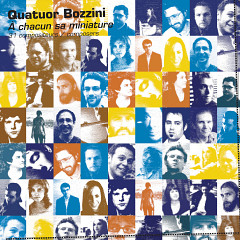
    À chacun sa miniature dans Circuit

    «Critique», Chantale Laplante, Circuit, 1 octobre 2012
    lundi 1 octobre 2012 Presse

    Depuis 2005, les membres du Quatuor Bozzini, entourés de compositeurs chevronnés agissant à titre de mentors, accueillent et accompagnent de jeunes compositrices et compositeurs dans un Composer’s Kitchen. Cinq ans plus tard, le Quatuor Bozzini a invité les trente et un compositeurs ayant participé à ces rencontres annuelles, à composer une courte pièce afin de célébrer l’expérience du Composer’s Kitchen, à la fois «atelier, laboratoire, salle de jeu et cours de maître», selon la définition donnée sur le site du quatuor.

    Le Quatuor Bozzini a atteint une renommée internationale bien méritée par son talent et sa persévérance dans la programmation d’un répertoire musical ancré dans la recherche et l’expérimentation. À cet égard, le Composer’s Kitchen semble témoigner tout autant de cette démarche tournée vers l’exploration musicale, que celle de son implication dans la communauté. En effet, chaque édition regroupe six compositeurs venus à Montréal des quatre coins du pays, pour approfondir de l’intérieur le genre quatuor à cordes dans une atmosphère intime caractéristique de la musique de chambre.

    Le disque À chacun sa miniature est en fait doublement ancré dans la communauté, le Quatuor Bozzini ayant pour ce projet lancé un appel au public afin de soutenir chacun des compositeurs et ainsi recueillir les commandites de cent membres de la communauté, mélomanes, compositeurs, professionnels de tous horizons. Le succès de cette campagne de financement a permis au quatuor de créer un fonds de dotation permanent dédié aux commandes d’œuvres et au soutien des activités du Composer’s Kitchen, afin d’assurer sa pérennité.

    L’aventure du Composer’s Kitchen aura fait mouche, car pour la 8e édition du mois d’avril 2012, il a été présenté dans un format élargi en collaboration avec le Huddersfield Contemporary Music Festival, accueillant un mentor et des compositeurs du Royaume-Uni. Dans un deuxième temps, les œuvres achevées des jeunes compositeurs seront présentées en novembre à Huddersfield, dans la cadre du festival. Une autre édition (Atelier niveau baccalauréat) a également lieu à Vancouver en août 2012.

    En attendant de pouvoir entendre les œuvres de ces nouvelles cuvées, nous avons accès à un enregistrement aux qualités acoustiques impeccables des trente et une miniatures de trente et un compositeurs qui témoignent, en écho à l’aspect mosaïqué de la pochette, d’une grande diversité de styles et, par ricochet, du dynamisme des jeunes forces à l’œuvre. Longue vie au Composer’s Kitchen pour sa complicité avec la communauté et les efforts investis pour que soient entendues et diffusées ces voix multiples.

    Le Quatuor Bozzini a atteint une renommée internationale bien méritée par son talent et sa persévérance dans la programmation d’un répertoire musical ancré dans la recherche et l’expérimentation.

    Solitary Pleasures dans Montreal Review of Books

    «Fortresses of Solitude», Abby Paige, Montreal Review of Books, no 39, 21 septembre 2012
    vendredi 21 septembre 2012 Presse

    […] While most of us are accustomed to reading short bits of text these days (140 characters, anyone?), many are nonetheless unaccustomed to the pace and attention required by the short bits of text that make up most poetry. Consequently, some poets are finding innovative methods to trip up the reader and demand a more considered interaction with the text. Fortner Anderson’s Solitary Pleasures is as much an art book as a poetry book, and haphazard typeface is the approach it uses to slow down the reader. Designer Fabrizio Gilardino has stamped each page by hand, letter by letter, using different font sizes and letter cases. He then altered the text digitally to create or preserve the appearance of errors and edits. The resulting text is impossible to scan like conventional printing. It must be studied and is, in fact, a bit hard on the eyes. Its unevenness mimics handwriting, making the words more like images, forcing us, almost like new readers, to proceed slowly and meticulously.

    The poems themselves, taken from Anderson’s 2004 daybook, chronicle the mundanity of daily life, punctuated by moments of clarity, awe, or lament. “I did seventy five crunche / nude / before breakfast,” begins the entry from July 19th. Later the same day, the speaker and a friend discuss how one can never know the mind “and must remain / content / with an evershifting vantage / as we look into from the shadows / which we longingly call / ourselves.” There is a certain voyeuristic pleasure in these poems; they fittingly feel like reading someone’s diary, and part of the drive to keep reading is the promise of discovery. That promise doesn’t always pay off, but here that unevenness feels immediate and true. […]

    There is a certain voyeuristic pleasure in these poems; they fittingly feel like reading someone’s diary, and part of the drive to keep reading is the promise of discovery.

    Vivaces dans Signal to Noise

    «Review», Jason Bivins, Signal to Noise, no 64, 15 septembre 2012
    samedi 15 septembre 2012 Presse
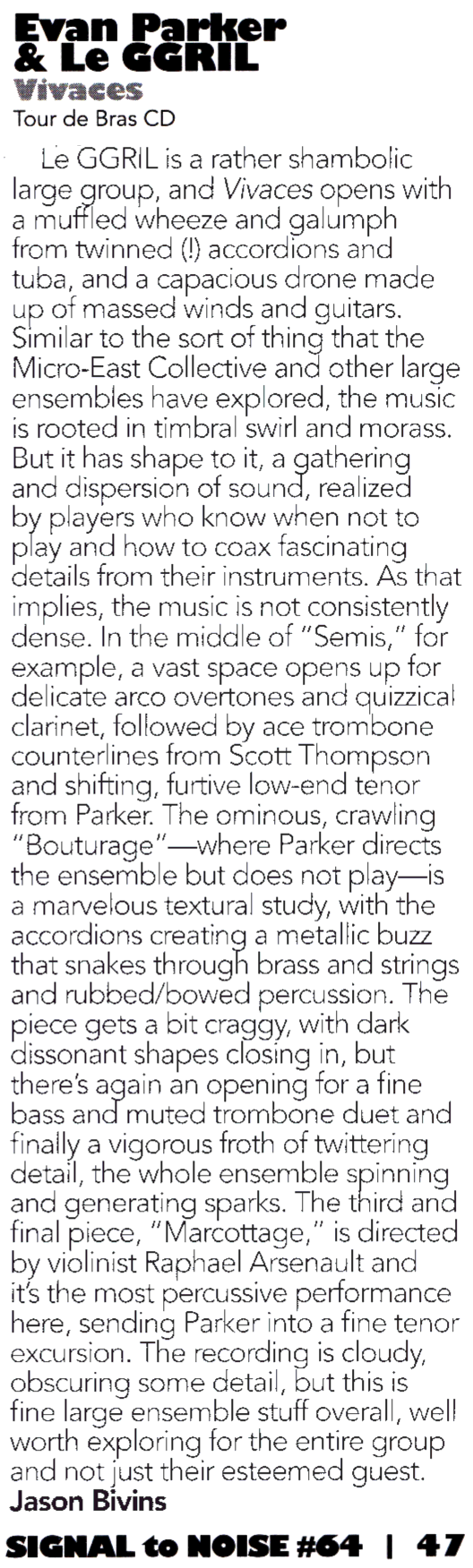
    The recording is cloudy, obscuring some detail, but this is fine large ensemble stuff overall

    Jane and The Magic Bananas dans The Squid’s Ear

    «Heard In», Massimo Ricci, The Squid’s Ear, 7 septembre 2012
    vendredi 7 septembre 2012 Presse

    Shalabi’s electric guitar, St-Onge’s bass with electronics and Côté’s amplified drums swear to us that the improvisational momentousness defining other brave and more renowned trios is not lost yet. In the 35 minutes of Jane and The Magic Bananas they don’t seem to care too much about aesthetical laws: the interplay is often caustically cluttered and essentially introverted, although not completely deprived of elements of direct communication with the audience. The dynamic pendulum oscillates between elementary patterns as the basis of magnetic mutability (Jogging Along The Path Of El ’Gabar) and moments of arrhythmic emancipation, frequently scented with harmolodic essences (Young Men Share Excitement In Far Deep Tchoukotka and, especially, Mesa Verde’s Alien Sunset). Do not think that there’s no room for calmer types of investigation: In Which Jack’s Cruise Is Ended walks slowly, gradually, until the mounting tension produces an untidy heap of jarring intervals corroborated by soul-plaguing threats in deceivingly clumsy mechanisms.

    It takes a while to realize that the initial perplexity elicited by the performers’ choices is in reality the reaction to a type of acoustic fractal geometry which needs to be taken as it is, in a warts-and-all kind of aural decontamination. No actual “beauty” to contemplate, no easy paths or tactful approaches. The instruments are played without surplus of fine-tuning — the quality of the respective timbres is, so to speak, brilliantly grubby — thus allowing the collective interaction to keep an uncomfortable edge perceptible throughout. This notwithstanding, the overall result is comparable to a short, solid fighter who — not endowed with huge technical and physical advantages — prefers a steady assault to the opponent’s body instead of an ineffective use of the jab. A distinct sense of compactness ultimately emerges from the energized discharges to warrant an affirmative verdict.

    A distinct sense of compactness ultimately emerges from the energized discharges to warrant an affirmative verdict.

  • 1
  • 2
  • 3
  • 4
  • 5
  • 6
  • 7
  • 8
  • 9