Sauter au contenu principal
actuellecd

Blogue

162 résultats
  • 13
  • 14
  • 15
  • 16
  • 17
  • 18
  • 19
  • 20
  • 21
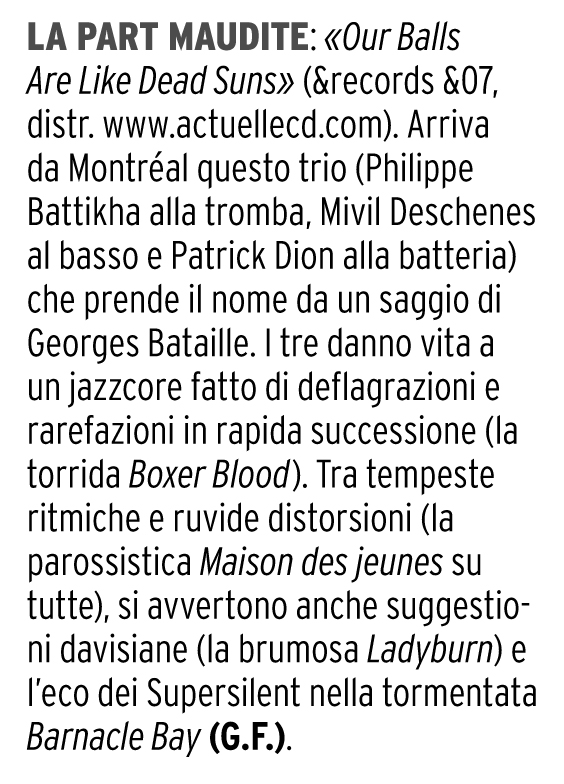
  • Récits de neige, Tryptique musique d’hiver dans Blow Up

    «Altrisuoni», Dionisio Capuano, Blow Up, no 155, 1 avril 2011
    vendredi 1 avril 2011 Presse
    Chiudendo una trilogia che si estende su un decennio (Musique d’hiver è del 2001 e Nouvelle musique d’hiver del 2007), la compositrice realizza la sua opera più densa, con riferimenti alla letteratura ed al contesto eco-sociale, ovviamente canadese. Non è inedita, fra gli artisti della foglia d’acero, la peculiare attenzione politica e sociologica. Si pensi a quel manifesto che è Le trésor de la langue di Lussier, o anche all’antologia “-40: Canadian Propaganda Films of the 1940’s Reworked” (co-prodotto dal National Film Board of Canada) che chiamava tipi dell’area elettro-digitale a sonorizzare video ‘di propaganda’ degli anni ’40. In Récits l’inverno è presentato come allegoria polireferenziale e la neve diviene il ‘precipitato’ di sostanza, le cui valenze chimico-fisiche, paesaggistiche e simboliche entrano nei suoni come fonte d’inspirazione e contribuiscono a plasmarne la morfologia. La struttura dell’opera è organizzata in quattro movimenti (La neige, Jamais froid, Rafales e Paysages), a loro volta suddivisi in tre — quattro sets. Si succedono così quindici quadri il cui spartito, tipicamente ‘contemporaneo’, ricompone un puzzle di post-impressionismo, jazz (c’è pure, unica composizione non originale, Flakes di Lacy), poesia sonora, bric-a-brac colto. Per goderne appieno più che il semplice ascolto, occorre una vera e propria esplorazione, la lettura dei testi, un approfondimento sui rimandi e su certe anfibologie terminologiche (il termine ‘bianco’ come ‘pagina bianca’, ‘notte bianca’, ‘arma bianca’). Ci si presenta quindi un disco, per quanto registrato live, che non possiede la forza trascinante di lavori egualmente stratitificati (ad esempio quello della Palardy Roger, in BU#154) e che necessita per l’assimilazione tempi dedicati. C’è, in Paysages, alla fine del percorso, il ricorrente motivo della ‘neve silenziosa’, dalla ‘voce dolce’, che ‘cancella tutte le forme ed i colori’. Tuttavia, per giungere a tale sintesi emozionale occorre dare diverso tempo a questa musica di depositarsi e sciogliersi; ma non è detto che ne abbia merito e diritto. Vi presentiamo così, per ellisse, un interrogativo — pure per noi la questione è aperta — sul suo ‘reale’ valore estetico. Indubitabilmente una miniera culturale e quasi un’enciclopedia emotiva. Ma la sua erudizione finisce per congelare (seppellire sotto la neve…) l’attimo d’illuminazione totalizzante che ogni volta si chiede all’arte.

    Si succedono così quindici quadri il cui spartito, tipicamente ‘contemporaneo’, ricompone un puzzle di post-impressionismo, jazz (c’è pure, unica composizione non originale, Flakes di Lacy), poesia sonora, bric-a-brac colto.

    Transition de phase dans Le son du grisli

    «Critique», Guillaume Belhomme, Le son du grisli, 1 avril 2011
    vendredi 1 avril 2011 Presse

    Trois phases (1 2 3) consignées en Transition de phase, disque que Jim Denley (alto préparé et flûte) et Kim Myhr (guitare, cithare et objets) — partenaires réguliers entendus récemment en Mural — ont improvisé en compagnie de Philippe Lauzier (soprano et clarinette basse), Pierre-Yves Martel (dessus de viole et életronique) et Éric Normand (basse électrique).

    Où tout commence par la juxtaposition patiente de longues notes volontairement peu assurées, de souffles découpant en conséquence et de cordes changées en suspensions de métal que le moindre mouvement fait chanter. L’idée naît ensuite dans le changement: les musiciens profitent de zones de perturbations sur lesquelles ils s’accordent, se soutiennent, s’expriment enfin. En intérieur de clarinette, Lauzier se plaît à buter et finit d’engager la rencontre à prendre la forme d’une cohérente conciliation d’expressions individuelles.

    Cithare vibrant contre machinerie crépitant, instruments à vent traçant d’autres lignes de fuite, les musiciens sont en phase toujours bien qu’en effet en perpétuelle transition. Les cordes pincées de cithare donnent une dernière couleur à l’improvisation, ressorts contre lesquels viendront se reposer les autres instruments. La dernière phase est la plus fragile, la déroute est encore autre et les propositions sont des trouvailles presque à chaque fois. Qu’on s’y perde est tout ce que l’on pouvait souhaiter avant que revienne l’humeur d’y retourner.

    Qu’on s’y perde est tout ce que l’on pouvait souhaiter avant que revienne l’humeur d’y retourner.

    Pink Saliva dans Hour

    «Spins», Mike Chamberlain, Hour, 31 mars 2011
    jeudi 31 mars 2011 Presse

    I’ve had this release by Pink Saliva sitting around since last fall. Every once in a while it rises to the top of the pile, where it inevitably stays for a few days, a most pleasing and ear-tickling set of pieces, electronically and acoustically mysterious and foreboding. With Michel F Côté’s skittering drums, bent and fractured long tones from the trumpet of Ellwood Epps, and trickster bassist Alexandre St-Onge cooking up something underneath on laptop, there’s depth here, darkness, delivered with a wink and a grin. 4/5

    … a most pleasing and ear-tickling set of pieces, electronically and acoustically mysterious and foreboding.

    24 Frames — Trance dans The Squid’s Ear

    «Heard In», Massimo Ricci, The Squid’s Ear, 25 mars 2011
    vendredi 25 mars 2011 Presse

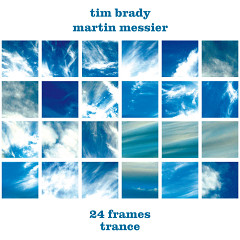
    In a recent Guitar Player feature, Tim Brady jokes about the fact that Brahms never wrote stuff for electric guitar, ironically justifying a relentless quest for the instrument’s potential residency in the empire of commonly accepted “serious” music. This double set — part of an ongoing series — is an intriguing proposition in that sense. On a compact disc lie six of the twenty-four Frames; on the DVD the same compositions (“for electric guitar, electronics, samples, multitrack technology and video”) are accompanied by Martin Messier’s experimental imagery, which comprise computerized abstraction and disfigurement of relatively normal films, such as a woman walking with difficulty in a snowy town.

    Brady recorded all the parts himself, a herculean task that — in his words — sometimes requires years just to find the right tone for a short cut. Unluckily, the artistic consequence of this sort of agony is only partially agreeable. Chilly linear materials and pitilessly pitch-transposed counterpoints summon up a combination of frozen heaven and dissonant hell, ultimately negating a definite position to the work. Think of a motorized King Crimson zombie to have an idea of the totally bloodless interlocking of different lines, sporadically escorted by peripheral undercurrents. Angular arpeggios, overdriven alien themes, plucked clusters and the obsessive repetitiveness generated by dozens of superimposed axes are perceived as rather conventional anomalies that don’t enlarge our database for this field, resulting interesting in spurts — and utterly unemotional.

    Where the Canadian really excels is in the creation of atmospheric sonorities and breathtaking milieus. Massive booming, enigmatic suspensions, evocative plateaus where the possibilities of a treated source are multiplied until the starting sound grows into a monster capable of killing, but also striking points of marvelous resonance, stunning us for a few seconds. Too bad that those dreams are often broken by the recurrence of a cerebral kind of assault that situates the record in the infinite archive of “over-average-yet-unmemorable” releases, in total disproportion to the incontestable compositional effort.
    Massive booming, enigmatic suspensions, evocative plateaus where the possibilities of a treated source are multiplied until the starting sound grows into a monster capable of killing, but also striking points of marvelous resonance, stunning us for a few seconds.
  • 13
  • 14
  • 15
  • 16
  • 17
  • 18
  • 19
  • 20
  • 21