Sauter au contenu principal
actuellecd

Blogue

188 résultats
  • 2
  • 3
  • 4
  • 5
  • 6
  • 7
  • 8
  • 9
  • 10
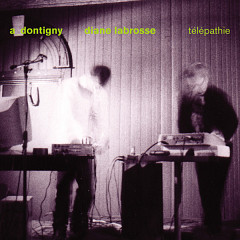
  • Télépathie dans Rif Raf

    «Kritiek», SVS, Rif Raf, 14 octobre 2003
    mardi 14 octobre 2003 Presse

    Vers vocht uit de druipende uiers van het Canadese No Type-label. Het duo Coin Gutter maakt niets ontziende, hard industriële en dan weer sacrale elektronische ambient en noise, vaak doorspekt met moderne compositie. Denk aan Yannis Kyriakides in een remix door Merzbow.

    Oeuf Korreckt is, ondanks zijn lullige groepsnaam, een bijzonder groovy elektronicacollectief dat met scherpe, licht industriële ritmes erg doeltreffend uit de hoek komt. Alleen jammer van die introverte, weinig verheffende productie.

    De sampling-artieste Diane Labrosse werkte de voorbije tien jaar met klinkende namen zoals Ikue Mori, Martin Tétreault en Zeena Parkins. Elektronicafreak A_Dontigny was dan weer lid van het beruchte collectief Napalm Jazz. Tesamen brengen Labrosse en Dontigny spannende, verrassende en verontrustende elektronica -en ambientpassages die je het best beluistert met de deur op slot en het huisalarm op extra sensitive.

    We Remain Faded van Headphone Science is de meest beklijvende release bij No Type. Met zijn mix van stuiterende hiphop en aan flarden gesneden raps leunt dit project van Dustin Craig nog het meest aan bij Prefuse 73. Maar de epische soundtrackmuziek die Craig in zijn composities verstopt, sleept deze plaat weg uit het avanthophoekje.

    Twee erg leuke 10inch-vinylletjes zijn die van de Zweedse Claudia Bonarelli en de Amerikaan Todd Brooks a.k.a. Books on Tape. Met respectievelijk wollige clickhouse en punky elektrobeats zetten zij de street credibility van No Type extra in de verf.

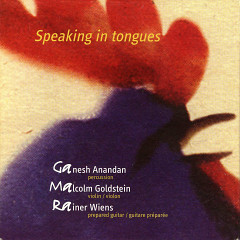
    Speaking in Tongues dans AllMusic

    «Review», François Couture, AllMusic, 7 octobre 2003
    mardi 7 octobre 2003 Presse

    Ganesh Anandan’s previous projects were mostly seated in the cross-cultural world music field. This album sees him pairing up with two of Montréal’s most textural free improvisers, violinist Malcolm Goldstein and guitarist Rainer Wiens. Both favor sound over note, delicate textures over melodic or harmonic development. It reflects on Anandan’s playing. He rubs and brushes more than he strikes, finding ways to become a third and equal voice instead of providing rhythmic accompaniment. This studio recording presents an open-minded trio eager to shatter preconceptions about how “world music” musicians can be integrated to free improv contexts. A percussionist with South Indian roots, Anandan approaches the genre in a more singular (i.e. non-idiomatic) way than Hamid Drake, who’s frame drum playing always evokes Northern Africa. Anandan also plays the frame drum, but he is more often heard on modified tambourines (they have all kinds of shakers and bells attached to them), metallophone, steel drum, or kalimba. Wiens’ prepared guitar can be seen as an extended kalimba of its own, chiming in unusual ways, but always quietly and serenely. Goldstein is also in a subdued mood, bowing his strings in fragile strokes, but he breaks into a tantrum in a couple of tunes, mostly notably in Fra Ma Ga Ra. Guest saxophonist Frank Lozano also appears in that piece. It brings an interesting change of pace and color, but the key tracks are found in Twenty Fingers, Voyage en train, and Foreign Tongues, where the trio’s identity and originality are most striking. Speaking in Tongues is not the kind of album that will hit you in the face. It requires a few attentive listens to draw you into its world, but the effort brings its reward.

    … an open-minded trio eager to shatter preconceptions about how “world music” musicians can be integrated to free improv contexts.

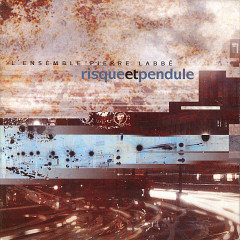
    Risque et pendule dans AllMusic

    «Review», François Couture, AllMusic, 7 octobre 2003
    mardi 7 octobre 2003 Presse

    Pierre Labbé’s first album as a leader draws on his past experiences and sends them down a new path. Those who know the saxophonist/flutist for his work in the group Papa Boa will find in Risque et pendule a similar complexity in the writing — and an alumni, guitarist Bernard Falaise. But beyond the avant-prog leanings of Papa Boa, the music also draws heavily on modern chamber music and free jazz, styles one finds in the background of some of the ensemble’s musicians. Labbé has not quite taken down the walls between those categories, but he has drilled gaping holes in them, enough to let influences run back and forth. The result is generally cerebral while presenting exciting moments and retains a filiation to the “musique actuelle” that once was Ambiances Magnétiques’ main cup of tea. Combats de Coqs and Bloops come close to Papa Boa, but even closer to the circus-like avant-prog of Miriodor (in which, incidentally, Falaise also plays). Other pieces like Outrages, Le Blanc des Yeux, and Contrepoint du vide feature motifs and arrangements more reminiscent of chamber music, from Bartok to early Art Zoyd. L’Empêcheur de tourner en rond (which loosely translates to “He Who Prevents Us from Running in Circles”) stands out, not because it is a better piece but because its main theme is lifted from Ornette Coleman’s Video Games. Overtly jazzy, it introduces a nice moment of wildness. Labbé is a discreet leader, more interested in letting his writing shine than showing off his chops. Only in Sur la corde raide does he holds on to the spotlight, first in a sweet-and-sour experimental solo backed by textural atonal strings (the ensemble includes a string trio: violinist Nathalie Bonin, cellist Julie Trudeau, and bassist Frédéric Alarie), then in the theme itself, deriving an unexpected Indian flavor. Labbé’s melodies may not be very endearing — it’s not stuff to fall in love to —, but on this first effort his writing has originality, grace and precision.

    The result is generally cerebral while presenting exciting moments…

    Luminance dans AllMusic

    «Review», François Couture, AllMusic, 7 octobre 2003
    mardi 7 octobre 2003 Presse

    This first solo outing for Queen Mab pianist Marilyn Lerner takes a somewhat different form, but you will have to be very attentive in order not to miss it. The improviser has worked with Avatar Studios’ resident sound engineer Steeve Lebrasseur to try to coax out of the old Grand some new sounds without resorting to preparations that involve extraneous objects. Lebrasseur, who had already worked his magic on guitarist René Lussier’s two late-’90s solo CDs (Solos de guitare électrique and Déboutonné), uses a number of different microphones — from hi-fi to very cheap — that he places in creative locations. In this particular case, some pieces have been recorded with two microphones put very close to the strings, or behind the performer, or in an adjacent room with a 4” loudspeaker relaying their capture under the piano for extra resonance. The most surprising piece in that regard is Codec Moment, where a cheap dictaphone microphone is placed across the room, providing a distorted image that interferes with the one captured by the two hi-fi mics placed inside the piano. And truth be told, it is also the only track where Lebrasseur’s touch is easily witnessed. Most of everything else will be lost on a regular living room stereo system. Luckily, Lerner’s music doesn’t require creative sound engineering to be engaging. Her background in jazz and Klezmer resurface at various points in the course of these short pieces, giving her more abstract improvisations and experimentations a human face. She performs La Boxe (“Boxing”) with her fingers knocking on the frame of the instrument while keeping the sustain pedal depressed. In Eerie she scratches the strings to produce long growls. But in the other pieces she plays the piano, letting her very personal language unfold, a language that recalls both Paul Bley and Irène Schweitzer.

    … her very personal language unfold…

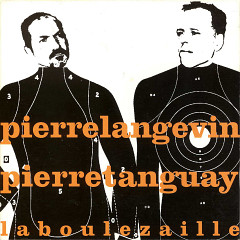
    La boulezaille dans Splendid E-Zine

    «Review», Ron Davies, Splendid E-Zine, 3 octobre 2003
    vendredi 3 octobre 2003 Presse

    Opening with a discordant flute, this disc initially leads the listener to expect the mind-bending found-sound experiments for which Ambiances Magnétiques are deservedly known. Instead, this pair of Pierres take listeners on a relatively grounded exploration of classical Indian music. The eight compositions abound with drones and delicately shaded textures, combining low-pitched wind drones with melodies just foreign enough to induce thought, but not confusion. I find it particularly pleasing that many of the disc’s soft sounds mimic those just outside my door. For example, the low pan flute notes that open Voila! are mirrored by the whistle of a train rolling through town. Elsewhere, a clank, a cough or an indefinable hum could easily be coming from my speakers or from the hallway. This type of sonic serendipity achieves a delicate balance between the inner and outer ear, mimicking the meditative balance between mind and body. This warrants the comparison to classical Indian music as much as the sound sources themselves do. More importantly, they demand repeated listens in order to fully explore the sounds on the record, as opposed to the sounds that exist in the environment or in my own head.

    This repetition serves to bring out the subtle textures of the recording itself. The slow, insinuating introduction of a tabla in Voila!, or the nearly subliminal kalimba counterpoint to the birdsongs in Le Grand Bonhomme de Chemin, initially go unnoticed. However, just as the trained mind notices subtle patterns after repeated examination, so do seeming minor variations in the music become large and meaningful with additional listens.

    Although the disc offers little of the frantic playing that tends to attract Western ears to Eastern music, there are nevertheless a number of wonderful, thoughtful moments to be experienced here. True, this music comes by way of two French Canadians, but the tradition and intent behind La Boulezaille are derived directly from India.

    … a number of wonderful, thoughtful moments to be experienced here.

    Studio — Analogique — Numérique dans Splendid E-Zine

    «Review», Ron Davies, Splendid E-Zine, 3 octobre 2003
    vendredi 3 octobre 2003 Presse

    Studio — Analogique — Numérique’s packaging alone screams “art”. It’s a trio of three-inch CDs, individually wrapped and presented in the sort of white box more typically used to deliver jewelry. The packaging creates a hell of an expectation for the contents. Depending on your level of tolerance for noise, Tétreault and Yoshihide live up to those expectations, for they have created an extremely thought-provoking collection of sounds.

    Disc one, Studio, pairs the two for a quartet of avant-garde compositions — the first of which, Duo 2, combines feedback and pink noise to create a hearing test from hell. This crashes into the silent brick wall of Duo 4, an almost entirely sound-free four minute interlude. Duo 6 returns with static snippets, slamming doors and unsettling hints of human voices that slowly fade into the abstract tones of Duo 8. While the material amounts to little more than noise (or, if you prefer, thoughtfully-assembled acousmatic compositions), it’s purposeful noise that, when combined with the duo’s extended bursts of silence, creates distinct images of isolation and ruin. Maybe it’s not fun, but it is effective.

    Disc two, Analogique, features Tétreault alone, exploring the ways in which he can use wind-sounds. This is no ambient recording, though; Tétreault begins with the gusting, otherworldly, analog howl from Duo 2 and puts it through its paces over five tracks (Analogique 5, 6, 4, 7, and 2, in that order). The key difference here is that he eliminates most of the surrounding sounds — no slamming doors or glitchy radios this time — stripping the piece of even distant connotations of humanity. Again, this may not be a lot of fun, but it’s an effective experiment, for, as the name implies, these manipulations are done in analog. To the non-techie, this means that all the changes in tone are achieved by hand, slowly twisting knobs and switching between reel-to-reel tape decks. Thus, through a thoroughly human process, Tétreault makes an alien statement.

    The final disc, Numérique, contains a single, twenty minute remix by Yoshihide. Again, the title informs the process, for in contrast to Analogique’s construction, this piece was created digitally. It also contrasts with Tétreault’s solo disc, in that it lacks the tones and concentrates on percussion — or more precisely, on ticking clocks, falling girders and the generic sound of one thing smashing into another. Although it carries the “remix” tag, this is more indicative of the piece’s focus on these more atonal sound sources than explorations of actual rhythms. It may not be fun, but… well, you get the idea.

    So if this trio of tiny CDs is not much fun, what’s the point? The pleasure here is an intellectual one, because the process of their creation reveals a lot about music. Analogique is all tone but lacks a human heartbeat. Numerique is all percussion but is devoid of emotional nuance. Analogique is created by grades — all instinct without precision. Numerique is the precise construction of quantified snippets with empty space in between. Only when these two sides come together for Studio do you get a sense of humanity, albeit a somewhat bleak one. We are tones set to rhythm, logic tempered by emotion. Music, as one of our most primal art forms, expresses these two sides of our souls as a seamless whole. By separating them, not only sonically but physically on two CDs, Tétreault and Yoshihide make a powerful statement that we work best when these aspects are combined. Thus, while Studio — Analogique — Numérique may not be something to throw in the stereo during your next party, it’s worth listening to when you have an hour (or several) to think.

    Tétreault and Yoshihide live up to those expectations, for they have created an extremely thought-provoking collection of sounds.
  • 2
  • 3
  • 4
  • 5
  • 6
  • 7
  • 8
  • 9
  • 10