Sauter au contenu principal
actuellecd

Blogue

188 résultats
  • 13
  • 14
  • 15
  • 16
  • 17
  • 18
  • 19
  • 20
  • 21
  • Montréal Free dans Signal to Noise

    «On the Record», Jay Collins, Signal to Noise, no 30, 1 juillet 2003
    mardi 1 juillet 2003 Presse

    Montréal Free is a four-disc box set spotlighting four separate groups that explore the realm of free improv. All are regularly featured performers at Montréal’s Casa del Popolo, a club founded in 2000 by Mauro Pezzente of Godspeed and his partner Kiva Stimac.

    The first group heard on this release features drummer John Heward, guitarist Sam Shalabi, bassist Alexandre St-Onge and the electric and prepared guitars of Rainer Wiens and is known as PO, an acronym for “provocative operations.” Collectively, they exploit textures with the emphasis being on coiling, twisting guitars, stirring arco bass reflections and vivacious drumplay. II for instance contains scratchy, abrasive guitar tones that eventually resolve into a mechanized industrialist motif. Distortion and guitar trickery have a role as well and eventually, Shalabi’s Arabic-tinged single note lines come to the fore. On the other hand, both IV and VI employ blustery and spirited bursts of energy, sometimes drawing upon repetitive patterns. While melodic content is distant and elusive, the explorative nature is intriguing.

    Disc two features the duo of ’Gypt Gore comprised of saxophonist Philémon and the ubiquitous guitarist Sam Shalabi both of whom appear later with Balai Mechanique. The duo invites two guests to expand their sound on four separate tracks, bassist Thierry Amar (of GY!BE and several other ensembles) on two and guitarist Andrew Dickson on two. As for duo pieces like Angular Momentum, And everything that looks like you, and Chair à canon, the duo follows one methodology, that of full-tilt, mercurial force without much of an intermission. Shalabi’s craggy, angular guitar lines continually joust with Philémon’s abrasive, impassioned alto sax in a percussive maelstrom that seldom subsides. While they avoid stepping on each other’s toes a sense of sameness does tend to set in as the torrential intensity doesn’t leave much breathing room for the listener. Shalabi demonstrates his diverse talents throughout, interestingly enough, even hinting at an almost jazzy sensibility on occasion. The guests have the effect of essentially reigning in the frenzy of the duo explorations, where more spacious, if even, ballad-like approaches are revealed. Navigation pacifique, an interaction with Dickson, is a strong point, suggesting a boat navigating through murky, unknown waters.

    The trio heard on disc three explores the art of using and filling space, rather than blowing the house down. Bassist Nicolas Caloia is perhaps the linchpin of this operation as he lightly coaxes the collective to follow new courses of action or drives the ensemble with his alternating rhythmic or broken tones. His arco work in particular, is striking, perhaps best evidenced in tandem with guitarist Chris Burns on presence #7. Drummer John Heward is supportive throughout, as he plinks, clinks and shuffles around his kit, carefully crafting his lines, like a painter choosing his colors and textures in a thoughtful manner (coincidentally, Heward is also known for his visual art). Burns demonstrates an impressive proclivity for interesting sounds and accents, particularly seen through his 12-string guitar work on presence #2 and presence #4. His lines evoke a slippery sensibility, like a slinky tumbling down the stairs. All in all this is a group focused on the depths of sound and intertwining lines that resuit from a combination of curious souls.

    The final chapter of this set comes from the “supergroup of the Montréal free improv scene” Balai Mécanique, a sextet consisting of saxophonist Philémon, trombonist Jacques Gravel, keyboardist Jesse Levine, guitarist Sam Shalabi, bassist Thierry Amar and drummer Will Glass. From the first notes, this is a balls to the wall affair that recalls the spirit of European free improv, and certainly, it is the fiercest of the groups heard on this set. The program itself contains seven tracks, four being lengthy explorations and three being brief interludes. The lengthy tracks encourage the interactions of each musician and contain a mix of waves of contrasting intensity and brief lulls before the impending tempest. Both Philémon and Shalabi follow similar paths that they explored on the ’Gypt Core sessions with extroverted, austere saxisms and the rumble tumble of jagged guitar lines. Of particular interest is Levine, who employs a host of sounds both on keyboard and piano. At times, he reminds one of enigmatic, spacey universes the other funky organ interludes (Cashel Boyle) and the next, flights of piano prowess. Most of the lengthier pieces swell and subside with brief breaks from the thunder only to eventually rise again in a final detonation of rugged, sinuous interplay. Ultimately, this is ambitious and demanding music that should put some hair on your chest.

    Taken as a whole then this four-disc set will prove a boon to fans of free improv and especially those curious about Montréal’s improvised music scene. While there may be some difficult moments the rewards can be significant.

    … this is ambitious and demanding music that should put some hair on your chest.

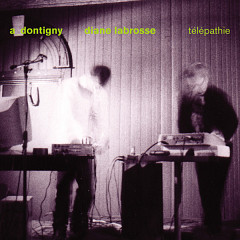
    Télépathie, A_dontigny, Diane Labrosse dans Real Tokyo

    «Review», Andreas Stuhlmann, Real Tokyo, 1 juillet 2003
    mardi 1 juillet 2003 Presse

    After months of silence, and just in time for their showcase at this year’s Mutek 03, Montréal-based label No Type has unveiled another bunch of fine releases. For one that represents the experimental electronic end of the label’s palette, A_dontigny (computer) and Diane Labrosse (sampler) have teamed up for a sonic dialogue in which telepathy might in fact have played a part. The four pieces on this album sound as spontaneous as they seem to be compositions that have been worked out over years. While A_dontigny usually creates walls of noise with his morceaux_de_machines project, Labrosse is known as a former member of art rock bands, and from collaborations with several Tzadik artists. Considering this, Télépathie sounds rather quiet, and with subtle rhythms and melodies mysteriously born out of the duo’s equipment, it’s an outstanding title in the label’s list of albums that convince with originality and high tension. (4.5/5)

    … subtle rhythms and melodies mysteriously born out of the duo’s equipment… an outstanding title…

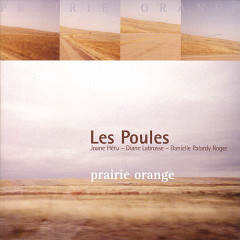
    Prairie orange dans Octopus

    «Critique», Steven Hearn, Octopus, 1 juillet 2003
    mardi 1 juillet 2003 Presse

    Les Poules, c’est Joane Hétu, Diane Labrosse et Danielle Palardy Roger. Les Poules jouent respectivement au saxophone alto, à l’échantillonneur et aux percussions. Les Poules viennent de Montréal. Les trois Poules ont de la voix, c’est sûr. Elles ont également de l’imagination! Ce disque d’atmosphère, méditatif et incisif, répond à de premiers méfaits, il y a quinze ans, dans Les Contes de l’amère loi. C’est de la musique improvisée, assurément. Ce qu’il y a en plus dans la basse-cour? Quinze ans de recherche, d’expérimentations, de tâtonnements éclairés, de dévouement sans faille à une musique exigeante et inventive. Quinze ans de collaboration avec des musiciens ou artistes qui ont considérablement enrichi leurs vocabulaires sonores, précisé leurs saveurs bruitistes, leurs manières de structurer un propos musical, de construire des pièces introspectives et souvent abstraites. Les voix ne disent plus de textes écrits mais sont devenues des instruments à part entière. L’attention, accrue, est portée sur les textures, la couleur, le potentiel musical du son… Nos trois Poules, qui ont désormais l’habitude de travailler sur des projets de danse, des pièces radiophoniques, des pièces de poésie, des films, ont gagné en épaisseur… Aussi, ce disque possède tour à tour des accents lyriques et incongrus, harmoniques et dissonants, structurés et anarchiques, doux et énervants.

    … dévouement sans faille à une musique exigeante et inventive.

    Nous perçons les oreilles dans Cadence

    «Review», Michael Rosenstein, Cadence, 1 juillet 2003
    mardi 1 juillet 2003 Presse

    Montréal stalwarts Joane Hétu (as, vcl) and Jean Derome (as, flt, perc, vcl) combined song forms, ragged improvisation, and playful theatrics for uneven results. Derome augmented his alto and flute with his usual bag of bells, birdcalls, toys, and even a megaphone for contrasting textures to Hétu’s unpolished alto and cracked, squeezed, and choked singing. There was always a sense of personal play to their set but, too often, it carne off as forced theatrics. The presentation of the Edmonton duo of Laura Kavanaugh (video, sampler, electronics) and lan Birse (electronics) was diametrically opposite to the raw theatricality of Derome and Hétu.

    Unstable Friends, Chants rupestres, L’âme de l’objet, Le barman a tort de sourire, Les Fleurs de Léo, Compil zouave, Duo déconstructiviste, Bavards, Grain, Muets, Bob, Bruire, Michel F Côté, Klaxon Gueule dans actuellecd.com

    «Michel F Côté», David Turgeon, actuellecd.com, 29 juin 2003
    dimanche 29 juin 2003 Presse

    Alors que nous entamons cette série d’articles sur divers thèmes en rapport avec la musique de notre catalogue, pourquoi ne pas commencer avec le plus difficile à cerner des artistes du collectif Ambiances Magnétiques, le prolifique et éclectique batteur Michel F Côté.

    Membre tardif d’Ambiances Magnétiques (il se joignit au groupe en 1988), Côté se plaça lui-même d’emblée en exergue, au sein de groupes à géométrie variable. On put l’entendre pour la première fois dans le premier album de Bruire, Le barman a tort de sourire, une boîte à surprise avec pas moins de 14 musiciens invités. Bruire est le très poétique groupe-projet de Côté, dans le cadre duquel il joue avec les codes de l’avant-garde, de la chanson et de la musique d’ambiance. Cet album inaugura d’ailleurs une trilogie qui se continua de manière toujours plus mature avec Les Fleurs de Léo, pour conclure avec l’inoubliable L’âme de l’objet. Ce voyage en trois étapes nous aura permis d’entendre des collaborateurs tels que Geneviève Letarte, Jerry Snell, René Lussier, Ikue Mori, Claude St-Jean et Jean Derome, tous contribuant à nourrir l’imagination fertile du batteur.

    Il fallut plus de six ans pour entendre un nouveau projet de Bruire, celui-là fort différent: Chants rupestres, quatuor d’improvisation avec Jean Derome, Normand Guilbeault et Martin Tétreault. C’est qu’entretemps, Côté s’est adonné à des activités passablement plus… déconstruites. On peut en voir les premières séquelles dans une collaboration avec Diane Labrosse, un CD quelque peu obscur, justement intitulé Duo déconstructiviste. Et si le premier disque (double) de son nouveau projet Klaxon Gueule, Bavards, garde une énergie «rock» très reconnaissable, c’est ce projet qui poussera Côté dans ses retranchements les plus abstraits.

    Car le moins que l’on puisse dire, c’est que la sortie de Muets, joli brûlot minimaliste complètement à l’opposé de Bavards, en surprit plus d’un. Il faut dire que ce disque, paru en 1999, était déjà plus en phase avec son époque que le Duo déconstructiviste qui était, en rétrospective, peut-être un peu trop en avance sur son temps. Mais ce changement était également dû à l’évolution esthétique du contrebassiste, Alexandre St-Onge, qui, d’un jeu relativement «classique», se tourna du jour au lendemain à une approche autrement plus conceptuelle de l’instrument. Côté et le guitariste Bernard Falaise le suivirent allègrement dans cette direction. Leur dernier disque en date, Grain (enregistré en compagnie de Sam Shalabi et Christof Migone), confirma cette tendance tout en la poussant plus loin encore dans la sophistication, faisant de cette œuvre l’une des plus abouties du corpus de Côté.

    Mais le batteur ne s’arrête pas là et retontit encore là où on ne l’attend pas. Ainsi, avec Éric Bernier et Guy Trifiro, il crée un nouveau groupe, Bob, dont le nouveau disque, Unstable Friends, vient tout juste de paraître. Sous une pochette plutôt déviante et très attrayante se profile une sorte de retour à la «pop» bizarre des débuts de Bruire! On connaît également l’existence, à travers les branches, d’un nouveau projet intitulé Mecca Fixes Clock (on y reconnait en tous cas les initiales du compositeur!) lorgnant davantage vers l’ambient orchestral. Côté reviendrait-il donc à ses premières amours?

    S’il est si ardu de dresser un portrait de Michel F Côté musicien, c’est peut-être aussi que son activité s’étend au-delà de la musique comme tel. En effet, il n’est pas rare d’entendre notre protagoniste au théâtre et à l’art performance, notamment en compagnie de Robert Lepage et de Catherine Tardif. Cette face de son travail trouve son écho sur Compil zouave, seul disque édité au nom du compositeur jusqu’à maintenant. Il faut mentionner également que Côté a débuté comme animateur de radio, entre autres à Radio-Canada, et qu’il a également écrit pour la revue Esse.

    On peut voir Michel F Côté comme une sorte de baromètre de l’activité du collectif Ambiances Magnétiques à travers les années: aux expérimentations avec la chanson des années 1980 succède l’impro-composition lyrique qui marqua le catalogue AM des années 1990, suivi elle par un type d’improvisation plus extrême, basée sur la présence physique de l’instrument.

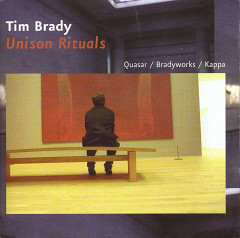
    Unison Rituals dans AllMusic

    «Review», François Couture, AllMusic, 19 juin 2003
    jeudi 19 juin 2003 Presse

    Released only a few months after Twenty Quarter Inch JacksTim Brady’s recording debut for Ambiances Magnétiques, Unison Rituals brings together five pieces for ensembles small and large. While the previous album focused on Brady’s work in the studio (with multitracking and electroacoustics), this one comes back to modern composition. Each piece features the note cycles and complex patterns of displaced accents that give his music such an immediately recognizable sound. Some find in these elements influences from Steve Reich and Philip Glass, which is undeniable, but Brady often steps out of this canvas. Escapement includes a soulful soprano sax solo during a surprisingly melodious bridge section. Two Chords Less Than a Blues moves back and forth between overlapping note cycles from the piano and tenor sax and trashy percussion breaks. But the highlight of the set is Double Helix, for piano, percussion, cello and saxophones. Beginning at dizzying speed, spinning its hermetic cycles like strands of DNA, the piece eventually cools down to leave room for some exquisite interplay between piano and cello and lead into the prettiest coda Brady has written yet. These three pieces are performed by his Bradyworks} ensemble. The album opens on the title sax quartet interpreted by Quasar. Its quirky interlocking lines and hiccuping accents are strongly reminiscent of Rova’s work — so is the quality of Quasar’s delivery. The last piece, Sound Off, was originally written as an outdoor piece for a mass band of 100 saxes, trumpets and trombones plus eight bass drums. This version, lasting only a quarter of the duration of the original, features 42 instruments (the big band Kappa). Brady explores stunning drone and dissonance effects that lead up to an unexpected major chord that is taken apart and sent back to the atonal magma. In short, Unison Rituals is Brady’s most impressive album since Revolutionary Songs in 1996.

    Brady’s most impressive album since 1996.
  • 13
  • 14
  • 15
  • 16
  • 17
  • 18
  • 19
  • 20
  • 21