Sauter au contenu principal
actuellecd

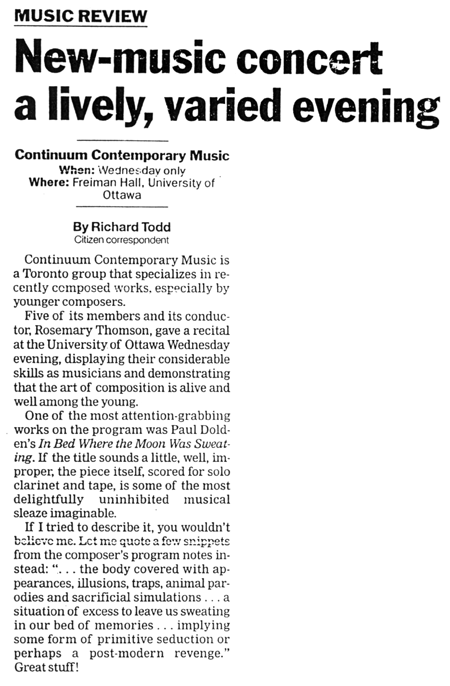
Paul Dolden

29 résultats
  • 1
  • 2
  • 3
  • 4
  • 5
  • D’autres critiques peuvent se trouver dans les pages des albums de cet artiste.

    Sonic Boom

    Robert Jordan, The Georgia Straight, 20 mars 1997

    […] Far more engaging was Paul Dolden’s The Gravity of Silence. Resonance #5, for flute and piccolo (both excellently played by Chenoa Anderson) accompanied by taped sounds. The Gravity of Silence. Resonance #5 turned out to be a volte-face for the typically irascible Dolden — it sounded as though he was having fun sending up classical showpiece clichés. This tonal and melodious music is a long way from the noisy, chaotic territory his music usually explores.

    Interview

    Thomas McLennan, Musicworks, no 64, 1 mars 1996

    Paul Dolden has been touted by many critics as one of the most original and innovative musical voices to take us into the next millenium: a fin de siècle artist. With his emphasis on a maximalist æsthetic, he walks a compositional tightrope by combining traditional western music practices with electroacoustic techniques, non-orchestral instruments, and the energy and drive of popular culture.

    Dolden has kept in sight the fact that one can be simultaneously entertained and challenged by the conceptualization of a reality never dreamt of before. One is seduced on many levels: by the virtuosic manipulation of musical language; the myriad gestures, colours, and contrasts; the speed; and the vigorous forcefulness of expression. One can be held in a state of rapture in the presence of music of such unreal beauty, but this sphere of existence continues long after the music stops. The voluptuous sound world of Paul Dolden always leaves one motivated to contemplate oneself and the world in novel and fantastical ways.

    Since 1981 Dolden has won eighteen national and international awards for composition. These include three first prizes and a Euphonies d’or at the Bourges International Electroacoustic Music Competition in France, and, most recently, Canada’s Jean A Chalmers Award for his composition L’ivresse de la vitesse. His works have appeared on numerous recordings includinq two solo CDs.


    Thomas McLennan: What in your mind creates a good performance of a piece for live instruments and tape?

    Paul Dolden: First, you must have a good sound system and everyone must know their musical parts extremely well. Beyond this, a richer musical experience happens when the performers know the tape part extremely well and therefore can play in a manner which seems as if they anticipate or lead the tape’s gestures, colours, rhythms, etc. If the live parts are played with this type of savvy, then the difference between the live part and tape seem to disappear and the two components seem to be working together on the same musical goal or idea. I should say that this illusion is possible only when the writing of the live and tape parts relate to each other timbrally, rhythmically, harmonically, and melodically. What is musically boring is if the performers sound like they are just following the tape, or are “slaved” to the tape.

    Could you comment on your reuse of materials in the current works of the Resonance cycle for live performer and tape.

    The mother piece for the Resonance cycle is the tape piece L’ivresse de la vitesse. All of the works for live instruments and tape in the Resonance cycle at particular moments allude to, or “resonate,” to the mother piece. This self-quotation is intentional and is an attempt to deal with the balancing of old and new information in the musical discourse. Moreover, it becomes a type of musical play or game of recognition, semi-recognition, and non-recognition. This game plays with musical memory which is the basis of musical structure. In the same way, the Walls cycle uses the Walls of Jericho tape pieces as a basis or “resonator” for the soloist and tape cycle entitled the Physics of Seduction. Invocation #3. Therefore, I am usinq the word “cycle” in its historical sense as each of the cycles could be played in their entirety and produce an evening-length work.

    Reflect on musical performance as you perceive its importance to musical language and composition.

    It is hard for me to imagine not having the experience of being a performer and trying to be a composer. Instrumental and vocal performance is the living history of musical thought and gesture, and to really understand instrumental writing a background in performance is necessary. Also, during a performance, whether it is for six friends in the front room or more than 800 at a professional concert, there is an excitement, an adrenalin rush, and a certain type of concentration that one can understand as a performer. To write utilizing that energy and style of thought will always lead to more interesting music.

    In the last two years, performance, for me, has taken two directions. I no longer play other people’s music. I have learned two of my own compositions, one for guitar and tape, and one for violin and tape. This process has informed me of what it’s like to play one of my scores, and what it’s like to be a soloist with a tape accompaniment. The other type of performance I am doing is free improvising on guitar, violin, and cello. For me this is primarily an exploration of sound and gesture that I keep more private because I do not find it musically profound. It is a process to go through in which i enjoy the discovery of combining notes, sounds, and colours wliich sometimes feeds back into my compositional practice.

    How do you retain a balance between the individual character of instruments and orchestration with so many tracks? (For example your work with 400 tracks or musical parts occurring simultaneously.)

    First of all understanding orchestration, and secondly, engineering. In terms of orchestration, it is important to understand how each instrument sounds in each register, and what happens when different instruments are combined. This goes beyond a textbook knowledge and requires a good aural memory because there are endless permutations. Important aspects of this are knowing which instruments mask which sounds, and which ones fuse with others at particular dynamics and/or ranges.

    After one has created a score of notation, this must be translated to a recorded signal which is well produced. For my music, the most important aspects of engineering are: microphone placement during the recording of instruments; submixing (because I do not have a 400 track board to control levels between different members of the orchestra); and panning and equalization. Panning is not used much because each track is a beautifui stereo image using a particular technique of stereo microphone imaging. What is more important is which instrument receives what type of EQ curve to achieve a particular musical sound.

    As far as maintaining the individuality of instruments, my work in the ‘80s was primarily concerned with the concept of the fused sound, therefore there was a decreased emphasis on being able to hear a particular line or instrumental colour. Over the last few years I have become more interested in hearing individual lines or groups of lines in the multiplicity of 400 parts.

    Could you comment on your present exploration of twelve-tone equal temperament? And, do you see this continuing?

    Tuning has been very important in my work. In the ‘80s I was only writing in microtonal systems, many of which I designed myself. I used just intonation and particular microtonal systems which often meant there would be anywhere from thirty to sixty notes per octave, which led to the fused sound of those works. I do find a certain clarity in twelve-tone equal temperament, and in some ways it almost seems sparse after ten years of microtonal work.

    The main reason for the return to equal temperament is that all microtonal systems, I discovered, led to a certain type of stasis. It seems that I have, at this level, reinvented the wheel, because equal temperament was designed to facilitate faster moving harmonic rhythm. My music has gradually become more concerned with harmonic rhythm, so that moving to equal temperament has been quite a natural progression.

    I find the return to equal temperament makes writing much easier because everything is instantly transposable and invertible. The problem with many microtonal systems is that when a harmony is inverted or transposed many notes have to be slightly adjusted. So I am able to write much faster now. One of the reasons I left twelve-tone equal temperament originally is because all of the intervals are mistuned except the octave, and you hear this particularly with the more consonant intervals.

    However, I am primarily writing fast music these years, so you do not really hear the mistunings, because at higher speeds the ear does not have enough time to register this aspect of equal temperament. I am slowly starting to think about how to integrate my current writing with all of the experience I gained in microtonal music. I am trying to envision a type of music that has a very fast moving harmonic rhythm, but also moves through different types of microtonal ideas, and comes back to equal temperament and keeps moving to avoid that whole static aspect of microtonal systems.

    You have stated a belief in the revolutionary potential of music lyinq in the transcendental aesthetic experience or moment. Can this moment live on in the listener/society and develop into something beyond itself?I believe that one of the important aspects of successful aesthetic perception is the search for the ecstatic moment: that moment of the loss of self which we also experience during extended drug usage and during sex. In these moments there is a loss of memory of who you are, what you stand for, what/where you are, etc. What is fascinating about these moments is that they allow for new ideas, visions, feelings, and thoughts to emerge. Now, the aesthetic/artistic experience is unique among these three experiences in that it is a completely safe environment, you can never physically harm yourself.

    I would like to think this ecstatic aesthetic experience is always goinq on in every culture. Certainly in western culture/society it has a different emphasis in different art forms, and areas of human endeavour, at different times. At present we definitely live in a film culture as people say to me they go to the film to “lose themselves.” For art music right now, most people do not search out these moments. In fact, the most common response we receive is that we tend to confuse people rather than allow for transcendental ecstatic experiences. But this is a larger social problem because the musical languages we are using are currently unrepresented in the media, which is where most people find out about works of music.

    Which composers are your major influences now?

    Composers who always inspire me, and will probably always inspire me to write, are Bach, Beethoven, Chopin, Debussy, Mahler, Stravinsky, Bartok, Ligeti, and Berio; and Lutoslawski and Xenakis to some extent. After this I have musical flings with different composers at different times that last anywhere from a few months to a few years. Right now I am very fascinated with Brahms, and with contemporary composers Magnus Lindberg, Robert Saxton, and Alfred Schnittke.

    How often do you visit historical structures in your music? What are the forms you create yourself?

    When you listen/write/perform music all of the time, inevitably you absorb without thinking the historical structures. For instance, we all speak in sentences and paragraphs, which immediately creates a structure in our verbal discourses. Obviously not all structures are equally fascinating or equally great. I think most historical musical structures operate implicitly in my music and I may not even be aware of them. I am, like most composers, more aware of structures that I think are more original, or at least those I had to spend a certain amount of time consciously thinking about.

    Recently, I started writing pieces not knowing ahead of time where I am going, whereas before I would compose the structure first. Currently, I consider how much new information do I keep introducing, and how much information previously in the piece will be repeated or reiterated with variations. It is that tension between old and new material, and working it out, that becomes the structural tension I am conscious of when writing. For the listeners, structure is somethinq to hang their hats on, so I am always aware of the tension between when they are beinq completely confused and when they are kept at the edge of their seats in anticipation.

    Explain the extensive relationships that exist in your cornpositional language between melody and harmony, and notes and timbre. Also, how do you accomplish syntax in the field of electroacoustics, where the focus traditionally has been on sound collections?

    Good music is always about numerous things — notes, counterpoint, melody, harmony, colour, and structure. Electroacoustic theory over the last few years has created a paradigm for discussing music in which syntax, or the language of music, is contrasted with morphology, which is the actual sound type, including anything from the sound of footsteps, to oboes, to the final textural quality of the sound. Traditional electroacoustic theorists have argued that what makes electroacoustic music special is its focus on morphology, while instrumental music is mainly concerned with syntax. I do not find this distinction new or revealing. I am convinced that good composers throughout history have always been aware of the colouristic possibilities of music making, but perhaps did not have all of the terminology for it that is currently at our disposal. I would suggest that we could select very syntactically based composers such as JS Bach and Brian Ferneyhough, and one could listen (as I often do) to these composers morphologically. That is, listen to their music in terms of changing orchestration, colours, and density. Likewise, one can listen to what is considered morphologically based music — for instance, Francis Dhomont or Edgar Varèse — in terms of note movement and organization.

    To place myself on this continuum: I have always been interested in a maximalist aesthetic, in creating music that somehow combines everything. In some ways I am always conscious of both syntax and morphology when composing. For me, a fundamental link between syntax and morphology is harmony. If one listens to a great piece of music in a musical way, then one listens both syntactically and morphologically as the two work together; in other words, one listens harmonically. Let me expand. The question asks about the relationship between the melody and harmony. I have always loved harmony, and often when composing I define the harmony and then create the lines for each instrument from that. You do not need a PhD in contemporary music theory to know that harmonies and chords lead to a morphological way of listening. Specifically, chords lead to fused chords, which lead to fused timbres or fused textures. By working with notes and building harmonies of thirty to fifty note chords with their horizontal/melodic implications, I am in fact defining the morphology. In short, the 400 tracks have a predefined morphological sound, which is the sound of the harmony being articulated by all the lines. Seventy to eighty percent of my 400 tracks in any given piece are traditional western orchestral instruments, the remainder being gamelan, hand percussion, drum kits, electric guitar, and voice (but we are used to choral and orchestral mixtures). So I would say that at one level, morphologically speaking, there is nothing new about my music, it is just extended orchestration. In other words, morphological transformations are a minor compositional strategy in my music. Ultimately the perceived motion is created through syntax: large scale variety, contrast, harmonic direction, different types of counterpoint, and instrumental gestures and articulations.

    With his emphasis on a maximalist æsthetic, he walks a compositional tightrope…

    L’art de la transformation

    Daniel Feist, SOCAN — Paroles & Musique, no 2:7, 1 juillet 1995

    Le Canada est célèbre pour son hockey, ses Rocheuses et son saumon rouge, ses recherches en médecine et ses films d’animation, et même pour sa technologie de l’ère de l’espace. De quoi étre fier!

    Mais qui aurait pu croire qu’il est aussi chef de file en musique électroacoustique? La plupart des Canadiens, selon toute vraisemblance, ne connaissent même pas ce style de musique.

    Cela n’empêche pas Francis Dhomont, Robert Normandeau et Gilles Gobeil, du Québec, Barry Truax et Paul Dolden, de Vancouver, et Bruno Degazio, de Toronto, de faire partie d’un groupe grandissant de compositeurs de musique électroacoustique canadiens acclamés partout dans le monde.

    «Le Canada joue un rôle unique dans le domaine de l’électroacoustique, affirme le compositeur torontois Al Mattes. Il suffit de consulter la liste des lauréats des principaux prix qui sont remis tous les ans à Bourges, en France.»

    Cofondateur il y a deux décennies de l’avant-gardiste Music Gallery de Toronto, Mattes est actuellement président de la Communauté électroacoustique canadienne (CÉC), le seul groupe de soutien pancanadien pour les obsédés sonores. Fait révélateur, l’adhésion à la CÉC a presque doublé depuis deux ans.

    «Je crois qu’il serait légitime d’affirmer que la musique électroacoustique a été inventée au Canada, dit Mattes. Il existe plusieurs souches différentes, naturellement, mais l’idée du contrôle du voltage est véritablement issue de l’œuvre de Hugh Le Caine.»

    Le Caine (1914-1977) était une personne extraordinaire et il n’est donc guère surprenant que le prix de la composition de musique électroacoustique de la SOCAN, remis annuellement, porte son nom. En tant que directeur du Laboratoire de musique électronique du Conseil national de recherches à Ottawa au début des années 40, Le Caine était habité par la motivation de créer des instruments et des sons nouveaux. Certaines de ses plus remarquables inventions, tels la saqueboute et le générateur de structures sonores sérielles, furent des précurseurs des synthétiseurs d’aujourd’hui.

    On doit aussi à Le Caine d’avoir jeté les fondations des premiers studios électroacoustiques d’importance au Canada, d’abord à l’Université de Toronto et ensuite à l’Université McGill de Montréal. Les départements de musique des universités de toutes les régions du Canada constituent depuis un environnement fertile pour l’univers effervescent de l’électroacoustique. Maintenant à la retraite, des pionniers comme Istvan Anhalt (Université Queen’s) et Otto Joachim (qui a son propre studio depuis le milieu des années 50), ont été suivis par des compositeurs tels Gustav Ciamaga (Université de Toronto), alcides lanza (McGill) et Jean Piché (Université de Montréal).

    La CÉC compte environ 250 membres dans ses rangs, mais selon l’administrateur Ian Chuprun, «le nombre d’électroacousticiens qui ne sont pas membres est beaucoup plus élevé. La culture pop a commencé à faire davantage appel aux techniques électroacoustiques dans tous les secteurs — à la télévision, au cinéma, dans la publicité — et l’ensemble de ce domaine est du même coup devenu plus accessible.»

    Kevin Austin, de l’Université Concordia à Montréal, abonde dans le même sens: «Nous ne parlons pas de musique au sens traditionnel. Dans une large mesure, il s’agit d’une exploitation du son sans l’intervention directe des notions de hauteur et de rythme telles que nous les comprenons. Mais il est beaucoup plus facile d’apprécier la musique électroacoustique maintenant qu’à l’époque où elle faisait ses premiers pas, étant donné que plusieurs des sons utilisés ne sont plus perçus comme étant très inhabituels.»

    Très actif dans les milieux de la musique électroacoustique depuis plus de 25 ans, Austin a mis sur pied l’ensemble MetaMusic en 1972, ainsi que le Groupe électroacoustique de Concordia en 1982. Il a aussi joué un rôle déterminant dans la création de la CÉC en 1986.

    «Dans les années 50, la transformation d’un son pouvait prendre des semaines, déclare Austin. De nos jours, il suffit d’utiliser un générateur et de raccorder une résonance vocale à l’attaque d’une guitare, et bingo! vous venez de créer un nouveau son.»

    L’un des compositeurs de musique électroacoustique les plus en vue du Canada, Paul Dolden, ne partage pas cette vision des choses: «Je n’aime pas du tout le mot électroacoustique. Je préférerais dire que je suis un compositeur faisant appel à la technologie. Ce que je fais, c’est de la musique orchestrale embellie. J’aime les notes, cela est indéniable. Je suis peu intéressé aux soi-disant ‘objets sonores’ et je déteste les sons synthétisés. Mais comme je travaille sur bande et qu’aucune de mes œuvres ne peut être exécutée en direct, je suppose qu’on peut classer le tout dans la catégorie ‘musique électroacoustique’. Mais je crois sincèrement que nous n’avons pas besoin de ce terme.»

    Ces jours-ci, Dolden s’est enrichi de 10 000$ en remportant l’un des deux Prix de composition musicale Jean A. Chalmers, l’autre étant allé à Jean-François Denis. Ce dernier enseigne [de 1985 à 1989] les rudiments de la musique électroacoustique à l’Université Concordia, et son prix lui a été remis afin de souligner sa contribution à titre de présentateur de concerts, d’éditeur et de fondateur d’empreintes DIGITALes, une étiquette de disques accumulant les succès. Quant à Dolden, c’est sa composition L’ivresse de la vitesse qui a retenu l’attention du jury.

    «Cela consiste en 400 pistes d’instruments acoustiques, explique Dolden. Vous devriez voir la partition. Elle contient des millions de notes! Ce que j’ai fait, essentiellement, c’est réduire cinq symphonies à une durée de 15 minutes. Le but visé était d’accélérer la musique au point d’en arriver à un état d’ivresse.»

    Le mois dernier, Dolden a présenté sa récente œuvre en première dans le cadre d’un concert de la Société de musique contemporaine du Québec (SMCQ) à Montréal. «Je l’ai appelée The Heart Tears itself Apart with the Power of its own Muscle. Resonance #3, précise-t-il. «La portion sur bande fait appel à une grande quantité d’artefacts de la culture pop. C’est du rock pour intellectuels.»

    À l’autre antipode de l’univers électroacoustique se trouve Barry Truax, de l’Université Simon Fraser. Compositeur et académicien influent depuis le début des années 70, il a reçu, grâce à sa pièce Riverrun, ie très convoité Prix Magisterium à Bourges, où se tient le plus prestigieux concours de musique électroacoustique au monde.

    «Jadis il y avait la musique sur bande, la musique électronique et la musique informatique, se souvient Truax. Il y avait des regroupements distincts qui mettaient l’accent sur les technologies. Les trois factions entretenaient peu de rapports. Mais les barrières se sont mises à tomber, notamment en raison de la différence entre l’analogique et le numérique.»

    Truax doit sa réputation à son travail dans le domaine de la musique assistée par ordinateur, et il fut l’un des premiers à programmer ses propres logiciels. «Cela était nécessaire dans les années 70, dit-il. De nos jours, c’est devenu un inconvénient.»

    Le compositeur de la côte ouest travaille actuellement à exécuter une importante commande pour le compte de la International Computer Music Conference, qui aura lieu au début de septembre. Cet événement annuel marquant s’est tenu à Copenhague l’année dernière et à Tokyo en 1993. Cette année, c’est Banff, Alberta, qui en sera l’hôte.

    Les expérimentations acoustiques de la compositrice vancouveroise Hildegard Westerkamp, une associée de longue date de Truax, ont toujours porté sur les sons environnementaux. «Il m’arrive souvent de concilier l’écologie et la composition sonore, explique-t-elle. J’espère donner la première d’une nouvelle pièce à l’ISEA95 Montréal (Symposium international des arts électroniques) en septembre à Montréal.»

    Récemment revenue d’un symposium de deux semaines sur les sons, organisé par l’Akademie der Kunste à Berlin, Westerkamp est l’éditrice du Soundscape Newsletter, l’organe officiel du World Forum for Acoustic Ecology. «Le médium électroacoustique est tellement fascinant. Je trouve dommage qu’il y ait si peu de femmes qui s’y intéressent. Je crois que la technologie représente l’obstacle majeur. Méme si cela ne décourage pas tout le monde, il y a aussi le contexte plutôt difficile lié au domaine qui peut parfois aussi rebuter certaines personnes.»

    Le cas de Bruno Degazio, un compositeur et concepteur de sons chevronné de Toronto, illustre bien ce point de vue: «Actuellement je travaille à l’aide d’un contrôleur d’instruments à vent WX7 et d’un VL1 de Yamaha. Le VL1 est un synthétiseur de modélisation physique qui réagit comme un instrument de musique lorsqu’on en joue. C’est la voie de l’avenir.»

    Cette année, Degazio est engagé à plein temps dans des projets de films IMAX. Parmi ses récentes œuvres, on retrouve d’impressionnantes trames sonores dont celles de Titanica, The Last Buffalo et The Fires of Kuwait, un documentaire mis en nomination aux Oscars.

    Comme cela se produit dans nombre d’autres domaines, l’électroacoustique se conçoit différemment au Québec. Beaucoup de compositeurs québécois ont été profondément influencés par l’école de la musique concrète en France, qui s’attarde surtout à étudier la manipulation électronique d’«objets sonores» plutôt que les sons crcés électroniquement. Par conséquent, leur approche créative tend à être différente.

    L’Association pour la création et la recherche électroacoustiques du Québec (ACREQ), mise sur pied par Yves Daoust et Marcelle Deschênes en 1978, est l’un des regroupements importants de la province. Bon nombre de compositeurs remarquables lui sont affiliés, dont Alain Thibault, Robert Normandeau et Gilles Gobeil, qui ont tous remporté plusieurs prix internationaux. Gobeil a pour sa part décroché le deuxième prix au Ars Electronica, un festival présenté en Autriche.

    «Le milieu est en pleine effervescence à l’heure actuelle, dit Gobeil. Plusieurs changements sont survenus et je suis particulièrement heureux de voir que nous commençons à communiquer davantage et à écouter les œuvres de nos collègues.»

    L’étiquette empreintes DIGITALes de Jean-François Denis permet de mesurer l’ampleur de ces déblocages. «Notre catalogue contient maintenant 24 compacts et, oui, il y a un marché pour eux! Je ne me contente pas de fabriquer ces disques. je les vends aussi!» insiste Denis. Je ne suis pas surpris non plus par le potentiel de la musique électroacoustique, étant donné qu’il y a beaucoup d’artistes sensibles qui ont opté pour ce genre.

    Pour obtenir un aperçu du talent de ces musiciens, on peut écouter DISContact! II, une compilation récente de 51 œuvres de membres de la CÉC. Bien qu’aucune des pièces ne dure plus de trois minutes, plusieurs d’entre elles témoignent d’un développement d’idées acoustiques sortant de l’ordinaire.

    … qui aurait pu croire qu’il est aussi chef de file en musique électroacoustique?

    Canada’s Electroacoustic Success Story

    Daniel Feist, SOCAN — Words and Music, no 2:7, 1 juillet 1995

    Canada is famous for hockey, the Rockies and sockeye salmon, medical research and film animation, even space age technology. There is reason to be proud.

    But could you have guessed we lead the way in electroacoustic music? Odds are, most Canadians don’t even know what it is.

    Yet Francis Dhomont, Robert Normandeau and Gilles Gobeil from Quebec, Barry Truax and Paul Dolden from Vancouver, and Toronto’s Bruno Degazio are counted among a growing number of internationally acclaimed Canadian electroacoustic composers.

    “Canada occupies a unique place in the area of electroacoustics,” says Toronto composer Al Mattes. “You just have to see who wins the major prizes each year at Bourges in France and other important events. Canadians are always up there near the top.”

    Mattes, who co-founded Toronto’s avant-garde Music Gallery two decades ago, is current president of the Canadian Electroacoustic Community (CEC), the country’s only coast-to-coast support group for the sonically obsessed. Significantly, membership in the CEC has almost doubled in the last two years.

    “I think you could make a legitimate claim that electroaccustic music was invented in Canada,” says Mattes. “There are a number of different roots of course, but the idea of voltage control really comes from Hugh Le Caine’s work.” Le Caine (1914-1977) was an extraordinary figure and it’s no wonder SOCAN Foundation’s annual electroacoustic composition award, one of five categories in the society’s Awards for Young Composers, bears his name. As director of the Electronic Music Laboratory at the National Research Council in Ottawa dating back to the 1940s, Le Caine was driven by an urge to create new instruments and sounds. A number of the inventor/composer’s remarkable instruments, such as the Sackbut and the Serial Sound Structure Generator, were precursors of today’s synthesizers. Le Caine also laid the foundations for Canada’s earliest important electroacoustic studios, first at the University of Toronto and later at Montréal’s McGill University. Ever since, music departments in universities across the country have been a fertile environment for the burgeoning electroacoustic scene. Now-retired pioneers like Istvan Anhalt (Queen’s University) and Otto Joachim (who has had his own private studio since the mid-1950s) have been followed by the likes of Gustav Ciamaga (University of Toronto), alcides lanza (McGill), and Jean Piché (Université de Montréal).

    The CEC has about 250 members but, according to administrator Ian Chuprun, “there’s a much larger number of electroacoustic composers who aren’t members yet. Pop culture has started to use more electroacoustic techniques all over the place — in television, in film, in commercials — and that has made the whole field more accessible.”

    Kevin Austin of Concordia University in Montréal agrees: “This is not music in the traditional sense. A large part of it is the use of sound without direct reference to pitch and rhythm as we’ve come to understand it. But electroacoustic music is much easier to appreciate now than when it was first developing, because many of the sounds are no longer perceived as being so different. We’ve grown accustomed to sounds being ‘morphed’.”

    Austin, actively involved in the electroacoustic scene for more than 25 years, founded the MetaMusic ensemble in 1972 and the Concordia Electroacoustic Composers’ Group in 1982. He was the driving force behind the creation of the CEC in 1986.

    While the media have made electroacoustic ideas more accessible from an audience point of view, technology has made the process more approachable from a composer’s perspective.

    “To ‘morph’ a sound in the ’50s might have taken weeks of computer time,” Austin says. “Today, you can sit down with a sampler, attach a vocal resonance to the attack of a guitar, and presto, you have a new sound.”

    One of Canada’s top electroacoustic composers, Paul Dolden has a different point of view: “I just don’t like the word ‘electroacoustics.’ I would prefer to say I’m a composer who uses technology. My work is basically glorified orchestral music. The fact is, I like notes. I’m not much interested in so-called ‘sound objects’ and I hate synthesized sounds. However, since I do work on tape and none of my pieces can be performed live, I suppose it can all be classified as electroacoustic. But I just don’t think we need the term.”

    Today Dolden is $10,000 richer, having just won one of two Jean A. Chalmers Musical Composition Awards, along with Montréal’s Jean-François Denis. Denis, who taught electroacoustic music at Concordia University [in 1985-89], captured his $10,000 award for his valuable work as a concert presenter and editor, and for launching the successful record label empreintes DIGITALes. Dolden was recognized for his composition L’ivresse de la vitesse (“Intoxication by Speed”).

    “It’s 400 tracks of all acoustic instruments,” Dolden explains. “You should see the score. There are millions of notes! Basically what I’ve done is reduce five symphonies down to 15 minutes. The idea was to speed up music to the point of intoxication.”

    Last month, Dolden premiered his latest work at a concert presented by the Société de musique contemporaine du Québec (SMCQ) in Montréal. “I called it The Heart Tears itself Apart with the Power of its own Muscle. Resonance #3. It’s a piece for string orchestra and tape. The tape part uses a lot of pop culture artifacts. It’s a rocker for intellectuals.”

    At the other end of the electroacoustic scene, in Vancouver, is Barry Truax of Simon Fraser University. He has been an influential electroacoustic academic and composer since the early ’70s. Two years ago, on the strength of his piece Riverrun, Truax was awarded the coveted Magisterium Prize at Bourges, the most prestigious electroacoustic festival competition in the world.

    “In the old days, there was tape music, electronic music and computer music,” Truax recalls. “They were separate communities with an emphasis on the technologies. The three groups didn’t really interact a lot. Eventually, the barriers started coming down and you can certainly point to a breakdown in the difference between analogue and digital as a factor.”

    Truax is acclaimed for his work in the area of computer-assisted music, and was among the first to program his own software. “That was a necessity in the ’70s,” he says. “Today it’s just an inconvenience.”

    The composer is currently at work on a major commission for the annual International Computer Music Conference in early September. The event was staged in Copenhagen last year and in Tokyo in 1993; this year it will be held in Banff, Alta.

    A long time Truax associate is Vancouver composer Hildegard Westerkamp, whose acoustic explorations have always focused on environmental sounds. “A lot of the time I am walking the edge between sound ecology and sound composition,” she says. “I’m hoping to premiere a new piece at ISEA (the International Symposium for Electronic Arts) in Montréal in September.”

    Westerkamp, who recently returned from a two-week sound symposium organized by the Akademie der Kunste in Berlin, is editor of The Soundscape Newsletter, official voice of the World Forum for Acoustic Ecology. “The electroacoustic medium is so fascinating,” she says. “I find it unfortunate that so few women are in the field. I think the big stumbling block is the technology. It doesn’t discourage everyone, but the circumstances can be quite difficult.”

    Just ask Bruno Degazio. “Right now I’m working with a WX7 wind controller and a Yamaha VL1,” says the accomplished sound designer and composer from Toronto. “The VL1 is a physical modeling synthesizer that plays and feels like a musical instrument. It’s the way of the future.”

    This year, Degazio is booked solid on IMAX film projects. His recent work includes impressive soundtracks to Titanica, The Last Buffalo and the Oscar-nominated documentary The Fires of Kuwait.

    As it is in many other areas, the electroacoustic scene in Quebec is distinct. Many Québécois composers have been profoundly influenced by the school of “musique concrète” in France, which focussed on the electronic manipulation of “sound objects” rather than on electronically created sounds. As a result, their entire creative approach tends to be different.

    A key organization in Quebec is the Association pour la création et la recherche électroacoustiques du Québec (ACREQ), established by Yves Daoust and Marcelle Deschênes in 1978. A string of outstanding composers have been affiliated with ACREQ. Among them are Alain Thibault, Robert Normandeau and Gilles Gobeil, all of whom have won numerous international awards. Gobeil recently captured second prize at Ars Electronica, a festival in Austria.

    “The scene is very stimulating right now,” Gobeil reports. “There have been a lot of changes and what I especially like is that we’re starting to communicate more and listen to each other’s work.”

    One proof of that is Jean-François Denis’s label empreintes DIGITALes. “Right now we have 24 CDs on our label and yes, there’s an audience for it! I don’t just make these CDs, I sell them too,” Denis insists. “I’m not surprised by the potential of electroacoustic music either, because there are many sensitive artists working within the field.”

    To get a measure of the electroaoustic talent that is out there, curious ears can explore DISContact! II, a recent compilation of 51 works on two CDs by members of the CEC. Though each piece lasts just three minutes or less, the development of acoustic ideas is often extraordinary.

    … could you have guessed we lead the way in electroacoustic music?

    Chalmers Award Recipients

    Robert Crew, The Toronto Star, 16 mai 1995

    Paul Dolden, winner of the composers’ award for L’ivresse de la vitesse, his 15-minute piece for [recorded] orchestra, Eastern instruments, choir and found sound objects, was praised by the jury for producing “an image of music for the next millennium.” A leading figure in Canada’s electroacoustic community, Dolden has had the same piece praised in London and Prague, where it won first prize in the Musica Nova ’94 International Competition.

    Jean-François Denis, winner of the presenters’ award, “is central to the growth and success of electroacoustic music in Canada.” He programmed an annual concert series featuring original works and Canadian premieres as a professor of electroacoustic music at Concordia University in Montréal from 1985 to 1989 and is one of the founders of the organization Canadian Electroacoustic Community. Denis’ magazines Contact! and Flash! and recording activities have had a widespread influence.

    A leading figure in Canada’s electroacoustic community… is central to the growth and success of electroacoustic music in Canada.
  • 1
  • 2
  • 3
  • 4
  • 5