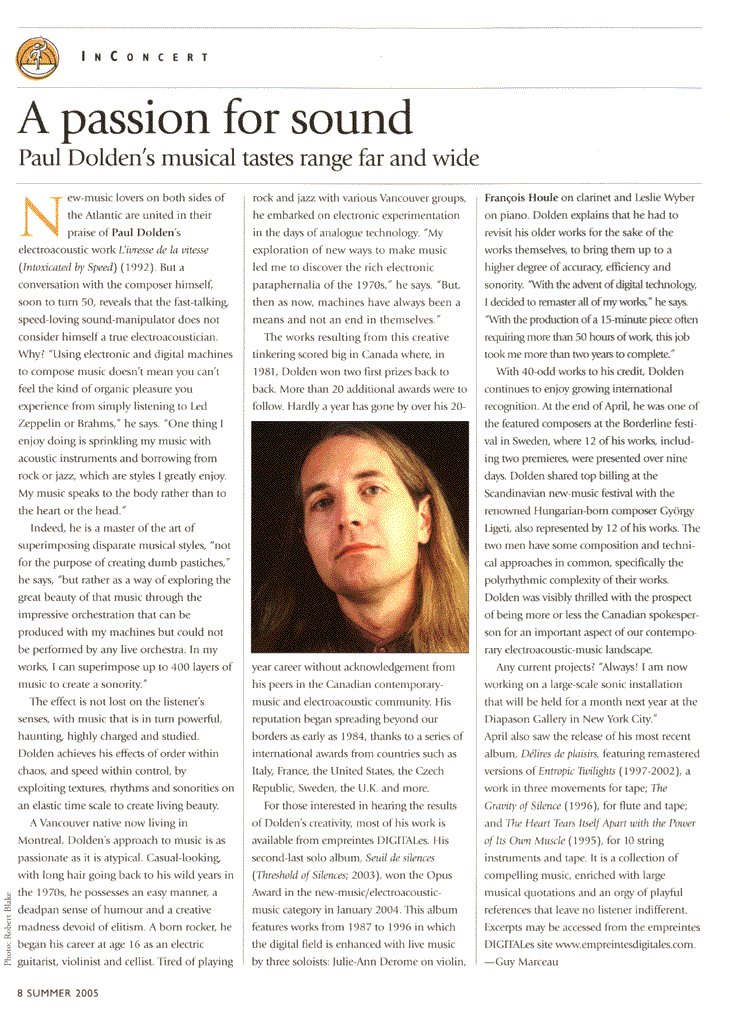
“Electricity has changed everything about music,” declares Canadian electroacoustic composer Paul Dolden, “instrument design, presentation, circulation, etcetera. Even simple amplification completely changes the sound of the music and the way we experience it.” Dolden’s immersion in the electronic age has paid off aesthetically — the freshness of his palette makes listeners reappraise the possibilities of strings and winds. Every timbre he touches seems re-energised.
Dolden once studied in Vancouver, and it was there, at the Arts Club Lounge, that I met him to discuss his extraordinary music, some of which was highlighted in The Wire’s “100 Records That Should Have Set The World On Fire” (issue 175). The disc in question, L’ivresse de la vitesse, was released four years earlier in 1994 on empreintes DIGITALes, and it has just been remastered with the newest and cleanest sounding audio technology. In fact, between 2000-2002, Dolden reformatted his entire catalogue from analogue tape to digital for same label’s 2003 reissue programme. Meanwhile, a disc of all new Dolden material is due out later this year. Evidently his music blooms in the digital age — it certainly flourishes in the clarity of computerised precision. For his part, Dolden refers to his output as ‘recordings’, not ‘works’ or ‘pieces’, as his compositional methods can only be realised in the studio.
Though Dolden is now based in Montréal, he still looks West Coast. Tall and lanky, he wears his hair long and his jeans cut-off short with sandals on his feet, looking more like an environmentalist on call than a maximalist, postmodern electroacoustic composer. Our animated conversation swerves between delineating his artistic influences, musical economy and any number of other topics flying by too fast to accurately record. But it’s a friendly affair, basking in perfect weather and lubricated by microbrewery beer.
L’ivresse de la vitesse (Intoxicated by Speed) is typical of Dolden’s compositional method. It is built up from hundreds of tracks of acoustic instruments that have been extended, reduced and layered. All the parts were originally written out, with click tracks prepared for the performers to work from. By way of treatments, Dolden usually accelerates the musical line to hyperkinetic speeds, pushing them out to non-idiomatic extremes, well beyond human performers’ capabilities. With so many tracks, many subject to compression, reverb and more even as they’re brought into perfect rhythmic alignment, Dolden’s composing style is nothing if not excessively labour-intensive. It takes him at least a month, working about 50 hours per week, to get down just one minute of recorded music. But the pay-off is a lush, bizarre assemblage of tone colours often dovetailing into one another through slippery crescendos and diminuendos at mind-boggling speeds.
Equally unique is Dolden’s handling of stark contrasts between blocks of sound that first infect and then subsume each other in the blink of an eye. An unknowable conquest in sound appears complete, only for the music to wink at you and carry on. The dramatic impact of these chilling events would make Edgar Varèse proud. But Dolden himself might add that his own originality is magnified somewhat by most other contemporary composers’ unwillingness to embrace today’s technology. “I am just a contemporary guy who is using everyday tools to make his music,” he insists. “These tools are part of being a contemporary professional musician everywhere except in the classical music tradition. I cannot remember the last concert I paid admission to where the live musicians were not amplified. Only orchestras and chamber musicians refuse to feel the flow of electricity under their skin.”
Dolden’s handling of mixed chorus is especially effective. His treatments make them sing faster and with greater angularity than is humanly possible; his percussion sections, meanwhile, gleefully transcend the mind’s ability to follow a rhythm, as they’re transformed into a sparkly aural wash. Dolden’s selection of colours is never static. He combines saucepans with brass, didgeridoos with electric guitars and gamelan orchestra, his constantly changing palette scintillating and seemingly limitless. His music is saturated with rhythmic motifs unifying disparate genres and blocks of colour. The completed original piece itself tends to become the springboard for a further series derived from the basic score, invariably accompanied by a soloist. For instance, L’ivresse de la vitesse is the flagship of the Resonance series, the first of which, In a Bed Where the Moon Was Sweating. Resonance #1, features a virtuoso clarinet part floated over ferocious oceans of computer bent percussion. Seconds later, the soloist’s sanguine evocations are back with the patter of an apparently amphetamined-up orchestra, pitched somewhere between the electronic soundworld of Harry Partch’s microtonal Yankee Doodle Fantasy and The Residents’ better recordings, with tiny, understated moments of Maurice Ravel’s orchestral skeins, all flowing effortlessly together.
Though Dolden is open to a multitude of musical forms, he actively dislikes the more academic aspects of electroacoustics, an attitude he shares with a fellow Canadian, the late concert pianist Glenn Gould, who quit the concert stage in 1964 to devote himself exclusively to recording. As early as 1965, Gould began splicing together his own alternative renditions of various classical pieces to achieve his ideal interpretation. For example, he patched two separate takes of the A minor fugue from Bach’s Well Tempered Clavier to produce a sound that switches gear from a solemn and legato opening to a skittish and staccato middle section in a way even a player with unsurpassable technique such as Gould wouldn’t have been able to repeat live. Dolden’s music expresses a comparable dissatisfaction with human limitations. “Think of me as a latterday Glenn Gould,” he encourages. “Gould saw the possibilities of the recording studio for achieving his own musical ends, as have I. He gave up live performances in the mid-1960s for recordings only. The same is more or less true of The Beatles, who mostly quit live shows around the same time and instead concentrated on a new kind of recording — the concept album. They, Gould and myself are all taking the live experience further. Whether you are listening to myself, or Gould late in his career, or Sgt Pepper’s Lonely Hearts Club Band, or a Massive Attack CD, the thing they have in common is that you are listening to people perform on musical instruments, enhanced by the engineer.”
With his studio-centric methods of composition, problems of speed, dexterity and idiom do not get in his way. But while Gould was a radical conservative, invigorating established music through technological means, Dolden’s recordings are practically unclassifiable. Most ‘maximalism’ rarely, if ever approaches the rigour necessary to encapsulate his music. He is, in essence, a composer for the postmodern age. The eclectic nature of Dolden’s statement summarises his outlook: everything is up for grabs. Preexisting sounds and styles are natural resources for his industry and, being Canadian, he has basically no experience of resources running low.
‘Postmodern’ is promiscuously applied to lots of different music, often as not neither ennobling or illuminating its subject in any meaningful way. Dolden’s music, however, makes clear how postmodern theory can be applied to music. In his recordings, a thrash Metal surge contains as much density and complexity as would a Baroque concerto movement, a World beat jam or a modernist 12-tone episode. His musical postmodernism signifies, in Francis Fukuyama’s widely discredited phrase, the ‘End of History’, wherein all kinds of music are held to be of equal value.
But his soundscapes are first and foremost visceral, where the whooshy click ’n’ cut ambience of so much current electronic music makes more cerebral demands, even as the engineering is often surprisingly shoddy, technically speaking. Dolden’s work, by contrast, is immaculately produced. It’s also brutal like a Mike Tyson uppercut and chic like Andy Warhol’s Studio 54, with just a whiff of sensual corruption. “In the end,” he says, “my music has more to do with rock and jazz and Ligeti or Xenakis than it has to do with what is commonly referred to as ‘electroacoustic music,’ which could be defined as a period of music produced by technology that flourished in France in the 1960s and 1970s and is currently imitated by primarily university teachers throughout the world.” His estimation of popular electronica is comparatively generous. “There’s not much actual music in a track by, say, Autechre, but their production is marvellous.”
Dolden’s music might be comparatively urbane, but it is also restless, hovering defiantly among the categories that threaten to absorb and ossify his creative spirit. This restlessness is inherent in the man himself. He complains constantly about most of the music that fuels his own creative energy. In separate interviews he has asserted that contemporary composition is a dead tradition, and so too are jazz and improvisation. He has nothing good to say about electroacoustic music, and he has referred to rock and dance music as “stupid”. But in essence his battle is with the limitations of categorisation. Categories make him bristle, inducing hyperbolic, even irrational outbursts. Indeed, he sometimes won’t even admit to being a classical composer at all, as that label flies in the face of his postmodern call for ongoing stylistic blurring and fluid aesthetic identity.
Dolden is nonetheless a kind of classical composer, albeit a singular one. His money comes from the usual conservatory sources — from compositional prizes and government funding. Further, his music begins with a written score, and musicians who identify themselves as classical players usually record it. It’s also easy to discuss his recordings with that telltale, classically oriented, benevolent fussiness. “I bitch about a lot of people’s music,” he says. “But I will listen to music for hours on end, every day. I have a huge record collection. It encompasses every imaginable form of music from every part of the world. On the average day I’ll toss on Mahler, Led Zeppelin, jazz and Techno, for instance, and love it all.
“The problem is that I hear the lack of spontaneity in classicai composition, the lack of improvisation in other forms of written music. I wonder why these musical traditions can’t learn from each other? You won’t see the classical crowd at a jazz concert and vice versa, and rock is disdained by all who consider themselves musical artists. I love the strengths in every type of music, such as the power of rock, the unfolding complexity of new or old classical music, the wild spontaneous personal aspect of improvisation, the hypnotic trance aspect of contemporary dance music and many forms of World Music. But then I wonder: why can’t I hear a music that appeals to all these ways of listening and feeling?”
But reconciling the attractive elements of different kinds of music is not the process by which Dolden expends his energy. Rather he recasts various musical styles into spiky relationships that generate a new kind of tension. Observing the broad strokes of his recent output, L’ivresse de la vitesse and the Resonance cycle — each piece featuring one of his colossal tape soundscapes and an accompanying soloist — the emphasis is on a massive textural effect. Tetrachords and simuitaneous tonal centres galvanise the music’s resolve with shifting, glacial harmonic energy, except when the music, molten lava-like, pours through his transpositions and sequences. Other times, these same techniques sound courtly, even gallant in character. It’s all quite a kick in the pants to hear such methods, many of them hundreds of years old, sounding either tempestuous or genteel, within swathes of extreme density and colour. And Dolden never repeats the same musical argument, for he’s no forager through the terminal zones of his own ideas.
After L’ivresse de la vitesse, the next big project was Entropic Twilights and the tangential, self-plundering Twilight series of 1997-2000. Their sound departs from his earlier material in the way individual lines and melodies are emphasised; harmonies take more of a back seat, reduced from 40-plus parts to merely four, giving them more directional power but less density; the canvas is smaller. It’s also sweeter stuff, gentler, shrugging off some of the more forcefully dissonant, maximalistic predilections of his youth. It’s stirring to hear this side of a composer, whose music was once synonymous with overwhelming volume and speed. “The main point is that I am writing pop music-like melodies with contemporary counterpoint and wired harmonies and scales,” he asserts, adding, with a shade of irony, “and most important is that everyone can sing along and tap their feet.”
The melodies are also often funny, with an optimistic or sometimes comically sinister lilt. “I cannot believe that concert audiences never laugh at the obviously ridiculous music moments I set up,” he despairs, “while Joe [Average] hears the humour and gets it immediately! In the Baroque period it was considered impolite for a composer to be ‘serious’ in his or her message. Music of the Romantic period changed that. Contemporary music needs to reacquaint itself with a sense of lightness.” Entropic Twilights has a deceptively simple sound. The second movement, for example, begins with an edgy, portentous pop ambience that resembles the ingredients of a dance track’s pre-beat introduction. But instead of coagulating into funk or an explosion of breakbeats, the opening notes left hanging in the air begin to unfold like a Baroque movement. A regular rhythmic beat starts up below, but it in no way resembles the timbres or patterns of a conventional drum kit. And yet, as the listener reappraises the situation, the displacement of these elements rapidly begins to make sense. Disco melodies, African power drumming and Palestrina-like polyphony come into play, not in a battle for domination but to coincide concurrently.
The new material on the Entropic Twilights disc upholds his reputation of unpredictability and innovation. Purists may bicker, but until they come up with something as flashily insighfful as combining sounds suggestive of both Rachmaninov and The Ramones, Dolden will remain the go-to composer of the 21st century. “I always felt like a kid in the candy store of all the music of the world,” he concludes. Paul Dolden’s CDs are released on empreintes DIGITALes.