Sauter au contenu principal
actuellecd

Aussi dans le blogue

9 résultats
  • 1
  • 2
  • Jürg Frey: String Quartets dans Эксперимент

    «Review», Эксперимент, 7 février 2026
    lundi 23 février 2026 Presse

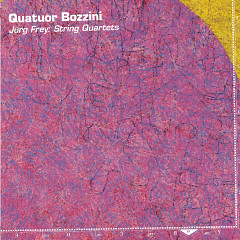
    From Collection QB, Quatuor Bozzini’s imprint, comes a legendary recording originally produced by Editions Wandelweiser in 2006. This reissue commemorates the quartet’s 25th anniversary, and brings back an essential piece of their eclectic discography back into circulation. Swiss composer Jürg Frey: String Quartets disc was met with enthusiasm upon its release and has since been name-checked by Björk (in her interview with the Creative Independent), praised by beloved critic Alex Ross, and cited as inspiration for many others, and justifably so. Its initial run is now out-of-print.

    This disc’s centrepiece is the ethereal 29-minute Streichquartett 2, which achieves its beautifully faint gauzy surface by subjecting a long string of slow chords to a fingering technique known as half-tone harmonics which blurs both the pitch and colour of each sonority. The work foats on the very brink of audibility for its entire duration, and audiences feel the precarious weightlessness intrinsic to its execution, even on recording. Many regard the piece as nothing short of a landmark in the string quartet tradition, fragile and majestic in equal measure. Grant Chu Covell remarked in La Folia that it “will take your breath away, notwithstanding a resemblance to one’s final earthly moments.”

    In the original liner notes the composer cites Agnes Martin’s art as an infuence on his approach — ”There was a kind of visibility to her art, which I felt corresponded to the audibility in my music. Audibility: the moment when sound waves move in space and the air touches the body. The eardrum is the sensory connection between the outside and the inside world: we hear the sound and the composition.” Indeed, Streichquartett 2 ’s hushed smears of sound almost appear to be more about pure sensation than they are about any of the standard musical parameters.

    The second quartet is preceded by several other shorter works. His first quartet, from 1988, offers a personal and more restrained vision of the soft, insistent chromaticism innovated by Morton Feldman in his latter years. (Unbetitelt) VI probes subtle variations of colour, its stately, mostly monophonic unfolding evoking plainchant. Frey distributes a scale-driven melodic figure between the various instruments, only sparingly introducing harmony. As with the composer’s other works, its ostensible simplicity gently pulls the ear into the very core of the sounds, and the quartet’s characteristically immaculate performance only serves to amplify this mesmeric magic. The diptych Zwei allerletze Sächelchen (Two very last things) is striking in its delicate brevity. Each of its two movements are under a minute — just enough time to trace a feeting contour in sound.

    Quatuor Bozzini has gone on to record all of Jürg Frey’s subsequent quartets, each of which has commanded similar critical acclaim. Last year’s recording of String Quartet No. 4 was listed among Alex Ross’ 15 Notable Recording of 2024 in the New Yorker, and is a finalist for the Conseil québécois de la musique prix Opus. Naturally, the quartet brings the meticulous patience that’s become their signature as an ensemble to all of these recordings. Since their inception, the Bozzinis have worked closely with some of the most important minds in contemporary music from Cassandra Miller to Christian Wolff, and Éliane Radigue to Yannis Kyriakides. Their eagerness to explore is matched by a rigorous ear for quality and this combination has made them one of the most important chamber ensembles today, giving rise to a long string of commissioned works and some 500 premieres spanning myriad compositional approaches.

    Le disque […] a été acclamé dès sa sortie et a depuis été cité par Björk […], loué par le critique Alex Ross et cité comme source d’inspiration par de nombreux autres, à juste titre.

    Jürg Frey: String Quartets dans Take Effect

    «Review», Tom Haugen, Take Effect, 20 décembre 2025
    mercredi 7 janvier 2026 Presse

    Originally released in 2006, this reissue assembles the Swiss composer’s first two quartets and other works, where Quatuor Bozzini’s inimitable strings illuminate the timeless vision.

    Streichquartett leads with Nadia Francavilla’s and Clemens Markel’s violin’s radiating mystery and hypnotic ideas across the cinematic and occasionally plucked 11 minutes, and (Unbetitelt) VI follows with the rich bowing of the violins alongside Isabelle Bozzini’s well timed cello bouts.

    The back half belongs to the 2 segments of Zwei allerletze Sachelchen, where atmospheric is key and dreaminess enters in ways that are cryptic and short lived, while Streichquartett exits with nearly 30 minutes of gentle waves of ambience that make great use of Stephanie Bozzini’s viola.

    An often slow moving body of work, the Montréal quartet again impress us with their detail, as seemingly simple moments unfold with beauty, wonder and emotion that truly does justice to Frey’s work.

    … le quatuor montréalais nous impressionne une fois de plus par son souci du détail, alors que des moments en apparence simples se dévoilent avec une beauté, une merveille et une émotion qui rendent véritablement justice à l’œuvre de Frey.
    9/10

    Jürg Frey: String Quartets dans Trybuna Muzyki Spontanicznej

    «Recenzje», Trybuna Muzyki Spontanicznej, 9 mai 2025
    mardi 13 mai 2025 Presse

    Un compositeur notable de musique contemporaine, un quatuor classique canadien tout aussi notable et cinq compositions datant du siècle dernier, interprétées au début du suivant et aujourd’hui rééditées. Les deux premières durent une douzaine de minutes chacune, les deux suivantes sont des miniatures de quelques dizaines de secondes, tandis que la dernière dure près d’une demi-heure, une épopée de sons qui s’estompent d’une beauté unique.

    La première histoire est une sorte de trépidation douloureuse, une berceuse déchirante et sans joie, sous la forme d’une répétition constante construite par des oppositions, tant sur le plan sonore que dramatique. Le récit ondule, adhérant avec détermination à l’idée de minimalisme et parfois de réductionnisme constitutif. Le silence joue ici un rôle important, qui, de temps à autre, fait entrer clandestinement des bribes de mélodies qui s’estompent. La deuxième piste semble s’inspirer de l’esthétique de la musique ancienne, est plus sombre et est certainement la plus classique de l’ensemble de l’album. La narration apparemment simple subit ici une rupture systématique, mais elle ne perd pas la marque d’une exposition moelleuse. Il fait souvent un pas en avant, puis deux en arrière. Il avale de petites portions de mélodie, les mâche et les remet en place. La fin même semble porter une note d’optimisme mystérieux. Parmi les miniatures annotées, la première cherche un fond, la seconde brille d’un post-baroque strident. Le cinquième morceau occupe la moitié de l’album et en constitue définitivement la qualité. Elle coule du fond de la crypte obscure, s’étirant entre les dents serrées, évoquant une procession des morts. C’est d’une beauté indicible, bien que construit avec des méthodes extrêmement réductrices. Une grande omission qui déplace des montagnes. Une vie qui porte depuis longtemps la marque d’une mort irrémédiable. Elle sent la musique ancienne, la bande-son parfaite d’une mort exceptionnellement lente.

    … d’une beauté indicible…

    Jürg Frey: String Quartets dans nitestylez.de

    «Review», Baze Djunkiii, nitestylez.de, 26 avril 2025
    mardi 29 avril 2025 Presse

    Released via the Quatuor Bozzini run and headed Collection QB label on March 7th, 2k25 is String Quartets, a collaborational release which sees the ensemble take on pieces by Swiss composer Jürg Frey. Originally put out on the circuit via Edition Wandelweiser in 2006 the recent re-issue was driven by the ensembles 25th anniversary the hour long album features a total of four compositions written in the period from 1988 to the year 2000, opening with Streichquartett — an eleven minutes spanning exploration of repetitive yet ever so slightly shifting Minimal Music with all four instruments playing in perfect unison whilst continuously meandering around a seemingly set set of parameters when it comes to pitch and sustain. With (Unbetitelt) VI we’re taken into a stripped down, yet emotionally touching world of Contemporary Classical composition whereas the two micro-pieces in Zwei allerletzte SächelchenMailied and Vorbei weigh in a brief excursion into unscathed rural beauty before the albums main piece Streichquartett 2 rounds things off in a surprisingly Dark Ambient-leaning manner, serving stripped down, yet highly fascinating, hypnotic and time-dissolving micro-movements at the very brink of the audible spectrum which therefore turn out to be quite an essential piece of contemporary Deep Listening Music for all genre aficionados. Go check!

    … an essential piece of contemporary Deep Listening Music for all genre aficionados.

    Jürg Frey: String Quartets dans the tonearm

    «Needle Drops», Lawrence Peryer, the tonearm, 14 mars 2025
    lundi 14 avril 2025 Presse

    Quatuor Bozzini’s reissue of Jürg Frey: String Quartets commemorates the quartet’s 25th anniversary and features five works documenting Frey’s compositional development from 1988 to 2000. The album’s centerpiece, the 29-minute Streichquartett 2, uses a fingering technique called half-tone harmonics that blurs pitch and timbre, creating an ethereal sound that hovers at the threshold of audibility. The hypnotic nature of this music has stopped me in my tracks, pulling me in closer with each listen.

    Swiss composer Frey’s approach draws from visual artist Agnes Martin, whose work Frey encountered while composing his first quartet in 1988. As he explains in the liner notes, “There was a kind of visibility to her art, which I felt corresponded to the audibility in my music.” This connection between sensory experience and minimal expression runs throughout the album, from the restrained chromaticism of Streichquartett to the almost monophonic unfolding of (Unbetitelt) VI and the brief, delicate sketches of Zwei allerletzte Sächelchen (which should not be listened to while operating heavy equipment).

    The Bozzini’s precise execution amplifies the music’s mesmerizing qualities, highlighting why they’ve become one of contemporary music’s most significant ensembles, having premiered approximately 500 works across diverse compositional approaches.

    The Bozzini’s precise execution amplifies the music’s mesmerizing qualities, highlighting why they’ve become one of contemporary music’s most significant ensembles…
  • 1
  • 2