
Who’s Playing
Lee Pui Ming
… a veritable showcase of
Lee ’s artistic versatility and ingenuity… — Musicworks, Canada
Rarement, en effet, un enregistrement a su rendre aussi présent dans nos salons d’écoute un mouvement, des gestes, des pas, des pratiques musicales. — Revue & Corrigée, France
Musique improvisée combinant piano, objets, saxophone alto, voix et corps. Une musique curieuse, enveloppante et insaisissable.
- Compositeur·trice(s): Lee Pui Ming, Joane Hétu
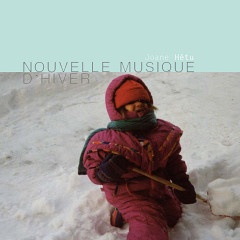
- Image de couverture: Jean-François Denis, Chris Sankey
- Graphisme: Jean-François Denis
CD (AM 098, 2002)
- 1Greetings (2001), 0:32
- 2Steps (2001), 7:26
- 3Silica (2001), 6:31
- 4Bones (2001), 4:54
- 5Sinews (2001), 5:14
- 6Torso (2001), 6:54
- 7Belly of the Beast (2001), 10:49
- 8Uvula (2001), 5:43
- 9On Your Feet (2001), 15:17
- 10Juices (2001), 0:21
- Étiquette: Ambiances Magnétiques
- AM 098
- 2002
- UCC 771028109821
- Durée totale: 63:44
- Boîtier Jewel
- 125 mm × 142 mm × 10 mm
- 95 g
Sur le web
Quelques articles recommandés
-
-
-
-
-

-
-
-
-
 Artistes divers
 -
-
-
La presse en parle
A showcase of pianistic versatility
One of the more compelling aspects of postmodernism is found in the hybridization of style, media, and the cross-pollination of disparate cultures. In particular, the fusion of the oriental and THE occidental in tandem with the dialectical tension between formal composition and improvisation has proven to be a fertile breeding ground for those venturesome artists aspiring to make it new.
As a classically trained pianist in the Western tradition, who integrates jazz, Chinese music, and free improvisation in her protean performances,
The human body and its various motor functions constitutes the conceptual conceit inspiring and informing
The physical and material presence of the piano is a pervasive theme in
Belly of The Beast shifts the emphasis from the artist’s feet to the foot pedals of her piano. In this composition the full reverberation of a depressed sostenuto pedal disguises the tonic note as a rumbling drone that anchors a flurry of dense chord clusters. Delicate subtleties of
For the final cuts of this CD,
While Who’s Playing is a veritable showcase of
Critique
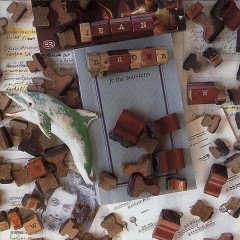
Est-ce l’illustration de la pochette
… autour des 10 ans du distributeur québécois DAME…
Taylor d’un côté, Cage de l’autre et le cœur au milieu, telle pourrait être la devise de Lee Pui Ming. De Cecil Taylor, la pianiste a retenu la force tellurique, l’assise charnelle, la respiration corporelle. Dans Steps, des blocs émergent, se soudent, se séparent, se retrouvent, livrés au hasard de l’instant. De John Cage, Lee Pui Ming a gardé la fluidité, les silences constructeurs, les glissandos et structures mouvantes. Silica évoque une ruche bourdonnante
Review
Listening to this record of free improvisational piano is a little like watching a group of bored children on a swing set. They’ll spend a few minutes actually swinging, then the ringleader ventures to hang by his knees from the top. A few minutes later, they’re walking a hazardous tightrope across the top of the swing set, then building a fort underneath. If you leave them alone for the time it takes to drink a single cup of coffee, you will return to find them gathering firewood in preparation for burning the whole thing down.
Like these kids,
Who’s Playing starts with Greetings, a half-minute interlude of slaps and moans and sing-song spoken word. Then we move to the demented, freeze-frame cakewalk of Steps, a prickly jazz improvisation that sounds more like music you’ve heard before than anything else on the album. Silica, the third track, finds us opening up the piano cover and discovering a slithery, metallic menu of sounds inside. Bones returns to the piano as it’s usually played, with a tentatively played conversation between high notes and low, but then
The title of Who’s Playing comes from a short, unattributed poem in the liner notes, which asks “When one is completely present in the moment — / Playing, or listening / — Who, then, / in that moment, / is playing / and who / is listening
Disques
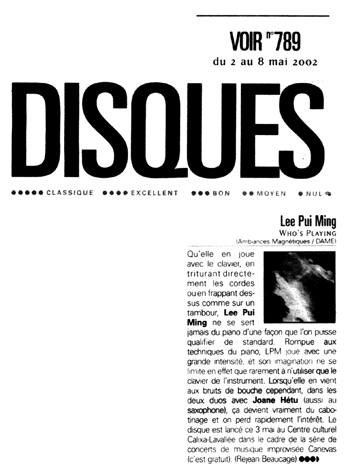
Qu’elle en joue avec le clavier, en triturant directement les cordes ou en frappant dessus comme sur un tambour, Lee Pui Ming ne se sert jamais du piano d’une façon que l’on puisse qualifier de standard. Rompue aux techniques du piano, LPM joue avec une grande intensité, et son imagination ne se limite en effet que rarement à n’utiliser que le clavier de l’instrument. Le disque est lancé ce 3 mai au Centre culturel Calixa-Lavallée dans le cadre de la série de concerts de musique improvisée Canevas (c’est gratuit).
Review
In the sparse text adorning the inside cover of her new CD,
Interestingly, the success of the improvisations documented on this recording directly corresponds with
Music
Lee Pui Ming moulds piano and vocal into a gleeful avant-garde concoction that is all her own. She playfully dances upon her keys, strings, framework and octaves with the bombastic grace of a slam-dancer in a rodeo. Sometimes perplexing and always intriguing, her style exudes an exhilarated and innocent freedom that makes it unique, an elegant simplicity hidden within complex expressive release that isn’t oblivious but natural. Ming’s energetic spontaneity (surely a sight when she’s performing live) is Who’s Playing
Critique
L’improvisateur se doit de se le demander
Blogue
-
dimanche 1 juin 2003 / Presse
… a veritable showcase of
Lee ’s artistic versatility and ingenuity… Suite -
dimanche 1 septembre 2002 / Presse
Rarement, en effet, un enregistrement a su rendre aussi présent dans nos salons d’écoute un mouvement, des gestes, des pas, des pratiques musicales. Suite
-
jeudi 1 août 2002 / Presse