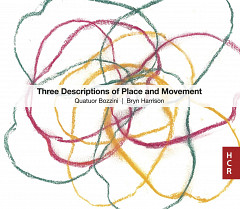
Three Descriptions of Place and Movement is Harrison’s first string quartet, but even this seemingly facile descriptor loses all stability when the third movement emerges, essentially a triple quartet with the astonishingly gifted Quatuor Bozzini overdubbing all parts. They’re no strangers to Harrison’s work, having performed his epic piano quintet with Mark Knoop several years ago, and Three Descriptions is equally ambitious, lasting an hour. Its form involves something approaching a radical take on theme and variation in that a brief opening movement, containing much of the work’s material in embryonic form, is followed by two extended explorative deconstructions and re-assimilations. While the album should be heard in order, the easiest point of entry is the middle movement, with the motives paired off and the texture relatively sparse, all in a hushed dynamic. Like Jason’s section of Faulkner’s The Sound and the Fury, relative syntactic simplicity means that the musical argument can be deduced, affording easier access to the rest. Notions of tonality, modality and even of center blur but never completely disappear, as with the boldly etched fifths, fourths, and thirds beginning at 14:43 of the second movement. Just as quickly though, these are subsumed only to return, altered, at 20:59.
Harrison’s take on repetition is more than complex, and violinist Sarah Saviet executes each twist and turn with stunning clarity and invention. Listen, just to cite one example, to her constantly morphing dyad repeated from 19:50 to 20:35 of the 50-minute solo violin piece A Coiled Form. I’m reminded of those early 1990s glitch albums on which broken CD players blur form and structure via similarly fractured repetitions. In an interview on Another Timbre’s site, Harrison speaks of these repetitions as multifaceted, implying a collaborative composer/performer relationship in developing them and expanding the work from an initial five minutes to its present length. Again, as in the string quartet, thematic material exits only to return but in a fashion unpredictable on first listening. Are those arpeggiations at 36:00 related to the minuscule glitchy arc at 20:35? Are the succeeding major-sounding sonorities merely rhythmically similar extensions, and is the glassy timbre really the music’s unifying factor?
In the end, as might be expected with such large forms, familiarity is only achieved through these skewed repetitions. Harrison’s is a music of recurrence in its subtlest manifestation, a kind of static reappraisal of idea and context that nevertheless function in stark tandem. All matters of tonal procedure and whatever its opposite might be become subservient to the seamless blending of form and structure. Beyond even this duality resides a soundworld of staggering beauty, one inhabited completely by Saviet and by Quatuor Bozzini. They traverse each gesture with such obvious commitment that it becomes a portal of discovery, a door opening onto music of seemingly infinite significance and incalculable reward.