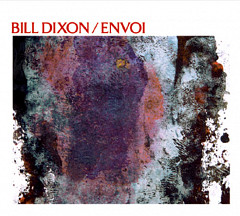
“You’re sitting in a cab, maybe going over a contract, discussing mundane matters; you open the door, step out, and you’re confronted by the universe.” I can still hear Bill Dixon’s voice coming down the phone. It was a pivotal moment, because it was one of the few times he spoke of the emotive qualities underlying his music. It wasn’t that he was unwilling to discuss his work, far from it! He would fill extraordinary hours with the technical underpinnings of his unique compositional approach, but seemed unwilling to address directly the characteristics of his work that evoked matters of the spirit, those aspects of his vision that verbiage would not contain. And yet such concerns pervade every note he played and composed. Envoi is, in one way, just another Dixon composition, but the fact that it is his last performance lays on the work the burden of summation. Recorded at the Victoriaville Festival in 2010 and using the same forces as on 2008’s Tapestries, it does indeed look back while maintaining the autonomy expected from every Dixon performance.
As is often the case, Dixon’s universe is a slowly expanding one. There are moments of white heat, such as the big bang and percussive roar that opens the piece, and in the final minutes, a monumental crescendo brings the whole work into sharp focus, as was the case with Seventeen Musicians in Search of a Sound: Darfur. Despite these bursts of catalytic energy, much of Envoi exudes calm and reflection that I can only attribute to age and experience. Nowhere have Dixon’s characteristic intertwining melodies been so beautifully realized as they are here by trumpeters Stephen Haynes, Graham Haynes, Taylor Ho Bynum and Rob Mazurek. Clarinetist Michel Côté adds to the sense of uhr-drone that has been so integral to Dixon’s music at least as far back as “A Quiet Feeling”, and Warren Smith’s tympani almost sound like another string instrument at times. Most surprising, though, are the pointillisms that keep the music moving, the sudden ring of a single pitch on vibraphone, or a strategically bowed attack from Glynis Lomon’s cello or Ken Filiano’s bass. Dixon was too ill to play on the performance, but I was not prepared for how perfect “Shrike” would be as an insert. A brief solo trumpet recording from the Odyssey box set, it combines long tones with dots of sound, recreating Envoi’s aesthetic in microcosm. It is the perfect point of transition, bringing Dixon’s past into a vibrant present. The recording is excellent, the playing superb all round, and the result is a fitting testament to the musical universe he created.