“My music is not so much polyrhythmic as polygravitational,“ says Canadian composer Maxime Rioux, aka Maxime De La Rochefoucauld, of his mechanical orchestra of self-built ‘automates,’ whose interlocking actions accumulate into ritualistic, trancelike rhythms described by their creator as “creating chaos with an order.” When I reach Rioux’s apartment for our interview, he tells me he only woke up five minutes earlier, but already his attention is transfixed by the tiny gadget he’s fiddling with. It turns out that it’s a component scavenged from the inside of an of fice thermostat — a Honeywell thermostat, to be exact. “A friend just gave this to me; they’re very hard to find,” he enthuses, like someone who’s just stumbled onto a Shakespeare Folio. To the uninitiated it looks just like a thin spring with a mercury-filled glass bubble attached to one end. After ten minutes of explanation, during which Rioux repeatedly rocks the mercury back and forth inside the bubble to demonstrate something or other, I’m no closer to understanding exactly how this device will bring a technological quantum leap in his music. But given the importance of such electronic minutiae to his work, I’m prepared to believe him.
New Yorkers got a rare firsthand glimpse at the fruits of Rioux’s obsession during the Montréal based composer’s recent residency there, when he put on a series of performances of his ongoing project, Automates Ki, at various venues in the city. The ‘Automates’ (French for automatons) are an army of tiny robot-instruments rigged up in an impossibly complex tangle of wires, stands, beaters and primitive mechanical arms. Going out as Maxime De La Rochefoucauld, Rioux drives this array of soundmakers using simple, ultra low frequency (that is to say, inaudible) waves generated by an analogue synthesizer. Numbering about 40 for a full performance, the automatons consist mostly of drums, cymbals, and shakers of various sizes, as well as several toy mandolins and banjos. Excluding the occasional store-bought instruments, they’re constructed from the booty of one hundred yard sales: an assortment of bottles, thread spools, corks and bits of metal. Triggering them is a maze of weights, spindles, vibrating speakercones, makeshift driveshafts, and even used computer disks. Where the mercury-filled bubble will eventually fit in is impossible to say.
Yet it’s all beautiful to behold, and clearly there’s a degree of theatre involved in generating what he calls “an illusion of rhythm.” Not surprising, as Rioux’s background is in visual art (he has a degree in sculpture.) At iive performances, audience members crane their necks feverishly, trying to trace sounds to their sources and figure out what makes each automaton tick before it stops, another one somewhere else picks up the beat, and necks crane in a different direction. The modularity and mutability of his set-up — which is put together by hand for each gig, a process that can take more than a day — allows him to place the automatons in a nearly infinite variety of arrangements. For example, during his New York residency, there was a traditional audience/stage setup at the jazz loft Roulette, while at the sound art gallery Diapason the automatons were scattered in an almost random pattern around the exhibition space, in front of and behind audience members and even, in a bit of extra credit mischievousness, above door frames.
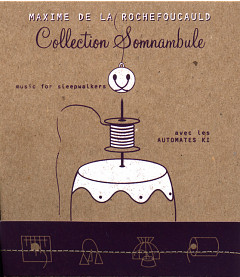
Unlike much process-oriented music, the Automates actually work well on record (and Rioux even provides photographs of some automatons as a helpful visual aid). The debut CD, Automates Ki(Plastique, 1997), has somewhat recklessly been compared to electric Miles Davis; other reference points include Pierre Bastien, the French composer and builder of similarly bizarre hybrid instruments; and radical dub: think early African Head Charge. In spite of the tremendous sonic range of the automatons, the beats seem perpetually rootless, as if some important foundation instrument has been cut out of the mix, which of course isn’t the case at all. Rioux/Rochefoucauld’s first release also included live playing on heavily reverberated trumpets and keyboards, lending the tunes a nomadic, Middle Eastern quality. In contrast, the recently released Collection Somnambule (Music For Insomniacs) has a more grounded feel, with less flighty human accompaniment and reverb, and more of a focus on the crashing, cascading polyrhythms of Automates percussion. ‘Other-worldliness’ is a common description of Automates music. In fact, according to Rioux, — people all over the world describe it as “foreign” or “alien” — from anywhere but “here.” “When I performed coricerts in Senegal,” he says, “I brought only my mechanisms along, and hooked them up to native Senegalese instruments. And you know what? The locals said, ‘It sounds like something from Sierra Leone’!”
Rioux is, of course, working within a long tradition of automaton music (player-pianos and music boxes, for example, as well as the more advanced mechanisms of Maurice Martenot, father of the ondes martenot, and Alvin Lucier). But unlike much of the music composed for automatons — where machines simply carry out the precise wishes of their composermasters — Rioux’s has a very high randomness quotient. He doesn’t like the idea of keeping his automatons on a short leash and has no interest in “composing melodies.” He recently bought a record of composed music for automaton violin and hates it. “No soul” is his only comment. The importance of ‘soul’ to Rioux is perhaps revealed by the name of his project: ‘Ki’ is a reference to Chinese chi or Japanese ki — the vital but invisible energy all around us. The sounds of his automatons are physical representations of unseen waves or energy. He certainly plays this up in concert, deep in thought as he routes mysterious, unheard sounds this way and that from his mixing console. But his mystical side is always tempered by a certain science fair geekishness. A couple of minutes declaiming about the balance between chaos and order in the sonic manifestations of his waves, and he’s inevitably back to talking like an engineer. “Now, if you look at this on an oscilloscope…” he begins. At which point he loses me again.