actuellecd
  • This website is also available in English.

Blog

3585 results
  • 485
  • 486
  • 487
  • 488
  • 489
  • 490
  • 491
  • 492
  • 493
  • Ensemble SuperMusique (ESM) in Ici Montréal

    “La vie, c’est du sport!”, Catherine Perrey, Ici Montréal, March 7, 2002
    Thursday, March 7, 2002 Press

    Jean Derome nous entraine dans son sillage, entre canot-camping et portages. Il ne nous laissera pas deriver.

    Jean Derome a recu le Prix Opus, Rayonnement à l’étranger, édition 2001. Comme quoi, il faut du temps pour se faire entendre! Plus souvent en concert de l’autre côté de l’Atlantique qu’ici même, Derome serait-il enfin reconnu chez lui? On ne s’attardera pos trop sur la question…

    On parlera plutôt d’expédiffon aquatique. Canot camping, c’est le résultat d’un travail réalisé avec 11 improvisateurs, de vrais boyscouts de l’improvisaffon. D’ailleurs, l’album Canot camping: expédition 4 a été composé pour «11 personnes et non pour 11 instruments.» Onze personnes vivantes. C’est-à-dire capables de répondre du tac au tac aux stimulations auditives. Sans frontière entre l’interpréte et la personne à la direction musicale. Ce qui est typique de la démarche de Jean Derome: «L’interpréte est trés important, et justement, comme un prisme, il capte la lumière. Dès les premières notes de Canot-camping, ce qui fait la force de cet ensemble, c’est justement le poids de la métaphore. Métaphore pour pluie, vent, courants. Métaphore pour nuit, étoiles, tente.

    Une dynamite intérieure

    «J’essaye de les pousser exactement dans la chose où ils sont bons, et d’autres fois de les mettre exactement dans des situations où ils vont être déséqulilbrés», poursuit Jean Derome, avec un petit sourire narquois. Et c’est ça qu’une connaissance, disons Intime, des interprètes permet.

    Dans une relation classique direction musicale-interprètes, cela risque de chambouler radicalement la concepffon de la pièce. Ici, tout est fonction de la relation «climatique. (s’il pleut ou s’il vente) entre Jean Derome et ses interprètes. On part d’un point A, mais c’est pour arriver au point Z, et les dérives sont donc trés controlées. Et surtout, ça laisse une trés grande responsabilité à chacun des musiciens. «En improvisation, c’est à chacun d’être conscient de l’ensemble, il y a des décislans trés, trés rapides qui doivent se prendre.» Avant de couler à pic avec les musiciens!

    Voici comment 20 années de pratique de canot-camping ont irrigué la pensée de Jean Derome: «Dans le canot-camping, ce que j’aime comme thémathique, c’est l’aspect anecdotique. Ça rejoint les gens sur une base trés simple: le courrant, les champs, les changements de climat, les possibilités. Les possibilités de façonner, par des signes, avec les musiciens, puis de passer trés rapidement d’une chose à l’autre. La pièce est une mosaïque de petits mouvements. Mais l’ordre n’est pas nécessairement prédéterminé, on peut complétement changer le cours de l’expédition.» Tout est dit.

    -28+Alieni, 21 situations in Espace sculpture

    “Artist’s Recordings: New Sound Spaces”, André-Louis Paré, Espace sculpture, no. 59, March 1, 2002
    Friday, March 1, 2002 Press

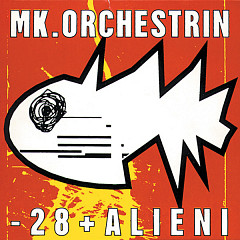
    In the tradition of soundeffect music, here are some recordings by artists who use sound as material to be sculpted. In Jean-Pierre Gauthier’s recording, Machines consentantes and Hachures (1999/2000), we hear the sound of mech” anized drums, automated flutes and decoys, vibrating garage sheet metal and quite audible radio interference. This sculptor of homemade instruments occasionally works in tandem with Mirko Sabatini. The Italian drummer plays solo on his CD titled MK. Orchestrin, the fruit of Sabatini’s lengthy research on sound and the workings of his instrument. Michel Tétreault is another sound artist often present in the visual art milieu. One of his many recordings was produced with Japanese artist Yoshihide Otomo. In 21 situations (AM 069), they manipulated turnta” bles in a different way than DJs, creating unusual sounds. Lastly, Jocelyn Robert gives us a genuine sound performance with his recording 20 moments blancs lents created for the twentieth anniversary of Chambre blanche in Quebec City. Here the artist attempts to translate the gallery’s time into sound.

    Tango in Revue & Corrigée

    “Critique”, Pierre Durr, Revue & Corrigée, no. 51, March 1, 2002
    Friday, March 1, 2002 Press

    L’auditeur éventuel ne s’attend bien sûr pas à une compilation des meilleurs tangos. Peut-être et plus sûrement pense-t-il à un détournement de cette musique? Ou alors à une vision sonore de la déconfiture argentine, un peu premonitoire, certes?

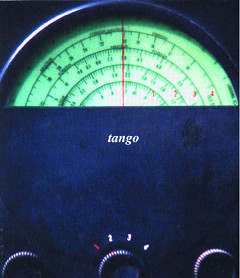
    En fait, il n’y a pas réellement de rapport avec le tango. Ou alors de manière très fortuite, si le récepteur de radio accroche dans sa recherche un émetteur branché sur ce langage musical.

    Le Tango de Martin Meilleur est en effet un montage sonore réalisé à partir de sons bruts captés sur les fréquences en ondes courtes, au moyen de divers récepteurs. Ces captations ne sont pas retraitées — le lecteur se rappelle peut-être Devil’s music de Nicolas Collins retraitant, lui, la matière sonore captée — mais collées, juxtaposées, quelquefois amplifiées. Le résultat en est un enorme patchwork radiophonique mondial: l’auditeur passe d’une émission culinaire ou d’un bout de musique à une radiodiffusion d’un spectacle ou à une retransmission d’informations diverses, intégrant tous les sons parasites, naturels (genre perturbation météorologique) ou inherents à la qualité du récepteur. La mondialisation à domicile, en somme.

    … un enorme patchwork radiophonique mondial…

    Zucchini in Revue & Corrigée

    “Critique”, Pierre Durr, Revue & Corrigée, no. 51, March 1, 2002
    Friday, March 1, 2002 Press

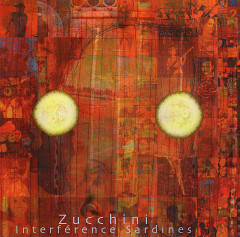
    C’est un enregistrement déroutant auquel nous convie cette formation de Québec (comme son nom ne l’indique pas) dont les notes de presse nous précisent qu’il s’agit de leur second opus.

    Déroutant, non parce que la musique en est inattendue. Au contraire, elle est parfaitement identifiable. Le paradoxe réside dans le fait qu’il s’agirait de plusieurs musiques identifiables. Un côté musique de chambre (deux pianos, deux violons ou altos en fournissent les éléments principaux), mâtinée de passages proches du cabaret (la voix de Andrée Bilodeau), d’accents plus jazz lors de fugitifs instants (avec en particulier les interventions des saxophones des invités Jocelyn Guillemet et Lyne Goulet), le tout rythmé par la basse, la guitare, et bien sûr les percussions, elles-mêmes parfois décalées et agrémentées d’instruments incompris manipulés par un invité (leur seul musicien dont le nom nous est familier), Pierre Tanguay. Et cela sans nuire à la fluidité de l’ensemble et à la cohérence du projet. Les titres eux-mêmes participent de cet esprit où l’absurde s’insinue presque logiquement dans une trame néo-dada: luthier sportif, un nescalier, un autre poisson dans l’mur…

    “L’interférence sardines” ne révolutionnera certes pas la musique actuelle — ce n’est pas son propos — mais contribuera sûrement à introduire un instant de poésie et d’humour dans un(des) genre(s) musical(aux) trop souvent figé(s).

    … un instant de poésie et d’humour…

    Les 4 ronds sont allumés in Splendid E-Zine

    “Review”, Luke Martin, Splendid E-Zine, March 1, 2002
    Friday, March 1, 2002 Press

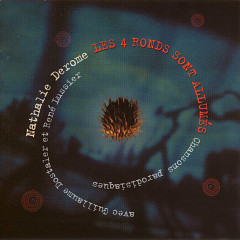
    If you’ve ever wondered what would happen to musical films if you were able to get into the projectionist’s booth and play around with the pacing and speed of the reel, then this is the CD for you. Recorded as part of a 1999 festival, the album features Derome’s bizarre songs, accompanied by Guillame Dostaler and René Lussier — two musos who sound like they’ve escaped from the Tom Waits Camp For Musical Strangeness and gone on the lam to Canada. It’s strangely compelling; there’s fantastic guitar work that brings Marc Ribot’s multi-faceted approach to mind, while carnival synth and a generally fractured approach to backing a singer flesh out the songs. Certainly, Derome’s voice, as powerfully evocative as it is, would be nowhere near as successful without the freakish-sounding tunes it rides. If PJ Harvey went to the circus, she couldn’t get this level of strangeness out. Vocally, recitative is pretty much the way the show goes here. Ah Non! Anna features an intruding robotic voice, while elsewhere, Derome’s voice runs the gamut from teasing to the terrified, while familiar tunes float by in the background — I swear that Ton Grand Nez borrows from The Doors’ Love Her Madly. And somehow, amid the confusion, it works. You don’t need to speak French to enjoy this album; the pacing and the feel of the tunes is such that they’re enjoyable for reasons other than those of lyricism; however, I suspect that you need a better handle on the language than my schoolboy-level to get the full effect of such a nuanced performance. I may be missing the subtleties, but even for a relatively ignorant listener, Les quatre ronds sont allumés has a carny-backed appeal that’s hard to resist.

    … a carny-backed appeal that’s hard to resist.

    Plinc! Plonc! in Cadence

    “Review”, Michael Rosenstein, Cadence, no. 28:3, March 1, 2002
    Friday, March 1, 2002 Press

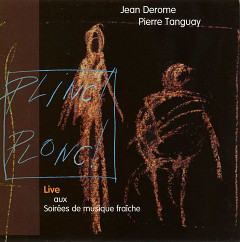
    Montréal-based reed player Jean Derome and drummer Pierre Tanguay have their fingers in so many projects it is hard to keep track ot them all. They jump from film scores to music for dance programs; from theatrical game pieces to politicized compositions; from Monk tributes to rock-tinged throw-downs. Rather than seeming disjointed or fractured, in their musical world all of these elements jostle up against each other with abandon. This live duet concert captures the two in a set that flows from free Jazz to skewed folk and hits all points in between. Though the playing can be fierce and frenzied, a sense of playful hijinks is never too far away. The title tune alone unfolds with the variety of many whole CDs. Things start out with a torrid burst of tenor flurries over churning drums steeped in the free Jazz tradition, morphs into a skewed duet of birdcalls and hand percussion, slides into a funky, honking R&B vamp and ends up with Derome’s fife dancing a twittering jig over Tanguay’s pattering percussion. In many of Derome’s larger, more tightly composed projects, it is easy to lose track of what a strong reed player he is, but here, his playing is laid bare. He assuredly moves from muscular free blowing to melodic sections full of lilting beauty to antic cavorting with a fluid sense of structural flow. Tanguay is the perfect sparring partner matching Derome’s energy and wit with split-second timing and response. The two can flip free skronk scat duets where their off-the-wall vocals trade percussive riffs like drunken tabla players and then jump to a skewed reading of Monk’s Ba-Lue Bolivar Ba-Lues-Are that staggers and struts with a joyful energy. Though it seems like things can fall apart into manic mayhem at any moment, the two always maintain a dramatic animation that propels the improvisations along right up until their final duet on Jew’s Harps. There is no doubt that being at this concert would have been a night of captivating entertainment but the release does a noble job of capturing the proceedings for those of us who couldn’t make it.

    … captivating entertainment…
  • 485
  • 486
  • 487
  • 488
  • 489
  • 490
  • 491
  • 492
  • 493